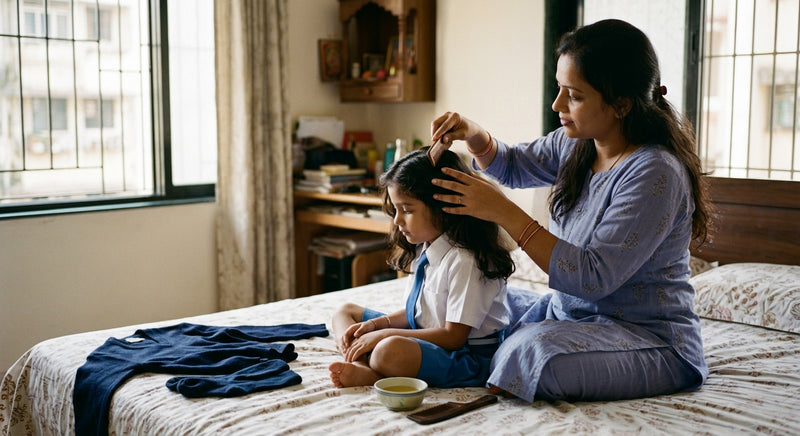
It's 8:45 on a June night. The cooler is rattling, your two-year-old has one sock on, and the toothbrush is somewhere under the sofa. You've been "brushing her teeth" for eleven minutes and maybe forty seconds of that landed on an actual tooth.
So here's the short answer, from someone who does this forty times a week: stop trying to make a toddler sit. Lay them down. Head in your lap, body between your knees, and you brush from above, looking straight down into the mouth. A fast, complete brush reaches every surface. A long, negotiated one tends to find the same four front teeth over and over. Twice a day, and the bedtime one is not optional. Don't wait for cooperation, either. Cooperation turns up somewhere around three or four. The teeth need cleaning now.
At a glance
- Most toddlers resist brushing because of position, not taste or temperament — standing at a basin, they can't see your hand coming.
- The lap position (child lying down, head on your thighs) gives you light, sightlines and both hands. It's what we use in the clinic.
- Brush the high-risk spots first: the gumline of the upper front teeth and the chewing surfaces of the back molars. If the window closes early, at least those are done.
- Night brushing matters more than morning brushing. Saliva — the mouth's own rinse — drops while your child sleeps.
- Indian seasons quietly change things: late summer bedtimes, monsoon snacking, cold winter tap water and sticky til-gud in January all need small adjustments.
Why won't my toddler sit still for brushing?
Parents almost always blame the toothpaste, or the child's temper. In most of the mouths I see, it's neither.
Look at the setup for a second. A toddler standing at the washbasin has their back to you. They can't see the brush arriving. Something firm and unfamiliar enters their mouth from behind, and their head is free to move in every direction, so it does. You're bent double, one hand steadying a wobbly child, the other trying to angle a brush by feel. Neither of you can see anything.
Then there's the room itself. Cold tiles, a wet floor, an echo, a bare bulb overhead. And the hour: the toothbrush usually appears at exactly the point in the evening when a two-year-old has nothing left in the tank. Neither do you.
The last piece is developmental, and it isn't a problem to be solved. At two, a child's main job is to discover that they can refuse. Brushing happens to be a place where refusal is loud and gets an enormous reaction. Give it a smaller reaction and a good deal of the fight goes out of it.
The lap position: how to actually do it
Move out of the bathroom. Sit on your bed or on a mat on the floor, back against the wall, legs straight out. Fan on, if it's that kind of night.
- Have your child lie down on their back with their head resting on your thighs, feet pointing away from you. Their face is now upside-down under yours.
- Bring their arms gently down beside their body. If they flail, tuck their upper arms lightly under your knees or forearms. Contained, not pinned.
- Look straight down into the mouth. You have light, both hands free, and a stable head. That's most of the job solved before you've touched a tooth.
- Use your non-brushing hand to lift the upper lip with one finger. Of everything here, this is the movement that matters most. The gumline of the upper front teeth is where early decay begins in toddlers, and it's the one place you never see when they're standing.
- Angle the bristles at about 45 degrees where tooth meets gum. Small, gentle circles. Then sweep the chewing surfaces of the back teeth back and forth.
- Work in four quadrants, roughly 30 seconds each — upper right, upper left, lower left, lower right. Say each one out loud. Toddlers cope far better with a route they can predict.
If there are two adults at home, use the knee-to-knee position. Sit facing the other adult, knees touching, your laps forming a flat table. The child sits facing the first adult, then lies backwards so their head lands in the second adult's lap. One person holds hands and talks; the other brushes. It takes ninety seconds. It is exactly what we do at the child's first dental visit.
What to do tonight
- Brush right after dinner, while there's still some patience in the room, rather than at 9:30 pm when everyone is finished. And yes, that means nothing but water afterwards.
- Take the routine out of the bathroom. Bed, mat, or your lap on the sofa.
- Squeeze the paste on before you sit down — a smear the size of a grain of rice under age three, a pea from three to six.
- Start at the upper front gumline with the lip lifted. Do the hardest bit while you still have their goodwill.
- Let them hold their own brush in one hand while you use yours. It ends more fights than any app I've seen a parent download.
- Spit, don't rinse. Rinsing with a cup of water washes away the fluoride you just placed on the tooth.
- End on your terms. Even if it's short, finish the quadrant you're in, say "done", and let go. Never let a struggle end with you surrendering mid-mouth.
Does the Indian weather really change how I brush?
The technique stays the same. What the seasons change are the conditions around it, and conditions are what break a routine.
| Season | What actually changes | What to do |
|---|---|---|
| Summer (Mar–Jun) | Bedtimes drift later. Mango, chikoo, cold drinks, ice cream, aam panna — sticky and sugary, often eaten right through the evening. | Fix the brushing time to dinner rather than bedtime. Give sweets with a meal instead of as a standalone snack; the mouth recovers better. A glass of plain water after mango pulp is a genuinely useful habit. |
| Monsoon (Jul–Sep) | Kids are indoors and grazing all day. A wet toothbrush left head-down in a closed cup stays damp and starts to smell. Power cuts turn a lit bathroom into a scary one. | Set snack windows instead of open grazing. Store brushes upright, uncovered, bristles up, somewhere airy. Keep a torch by the bed; the lap position works fine in dim light because you're up close. |
| Winter (Nov–Feb) | Cold tap water makes children clamp their mouths shut and sensitive teeth flinch. Chapped lips make lifting the upper lip genuinely painful. Then comes til-gud, gajak, revdi — sticky and clinging to molar grooves. | Use lukewarm water, and warm the brush head under it for a few seconds first. Dab a little balm or ghee on cracked lips before you start. Brush after sticky sweets, and keep those sweets to a once-a-day event rather than an open tin on the table all afternoon. |
| Hard-water homes | Scale builds on bristles, the water tastes chalky, and children reject the rinse. Hard water itself doesn't damage teeth. | Change the brush every three months, or sooner if the bristles splay. If your child hates the taste, use filtered water for that one glass. That's the whole fix. |
Which tricks actually work?
The ones that survive contact with a real toddler are boring ones. Same place, same order, same song, every single night. Novelty wears off by Thursday; a route they can recite doesn't.
Brushing a doll's or a bear's teeth first buys you about thirty seconds of goodwill. Use it, don't stretch it. "You brush first, then it's Amma's turn to finish" works well from about two and a half. A mirror and a torch turn the mouth into something to look at rather than something being invaded.
Now the honest bit. Sticker charts don't work at eighteen months; they work from about three. Electric brushes split children down the middle. Some love the buzz, some are frightened by it, and you cannot predict which until you've bought one. Strongly flavoured "fun" pastes make some kids treat toothpaste as food. And screens? They work, because the mouth follows the eyes. I would rather a two-minute video and a clean mouth than a clean living room and unbrushed molars. Keep it for the bad nights, though. Use it every night and the routine becomes the screen.
One thing I'd ask you to stop doing: brushing as a threat, or as punishment for having eaten a sweet. You'll win tonight. The next four years get harder.
And if your toddler still takes a bottle of milk to bed, no brushing technique in the world will keep ahead of it — the pattern of decay that follows has its own name, its own look, and a clear way to prevent it. That's the change to make first.
When to see a dentist
A few other things are worth an appointment. If your child refuses to chew on one side. If the brushing fight has been total and unchanging for several weeks, because an ulcer, a tongue-tie, an erupting molar or a sensory difficulty can all hide behind "he just hates it". Or if they've simply never seen a dentist. The first visit should happen by the first birthday, or within six months of the first tooth appearing, whichever comes first. It takes ten minutes, we do it in the lap position, and it is mostly a conversation with you.
A paediatric dentist won't diagnose anything from a photograph or a description, and neither should you. What we can do is show you, in your child's own mouth, exactly where you're missing.
The thing worth remembering
The child who fights you at two will not be fighting you at five. That's how development goes; you don't have to earn it. What you're doing now isn't winning an argument. You're keeping twenty small teeth clean through a phase that lasts about eighteen months.
So make the brush faster rather than longer. Get their head into your lap. Lift that upper lip, do the front gumline before anything else, and stop at two minutes even if it wasn't perfect. Good enough, twice a day, all year, is what actually keeps the teeth.
In summary
- Lay your toddler across your lap instead of standing them at a basin — position, not persuasion, is what makes brushing work.
- Lift the upper lip and brush the gumline of the front teeth first; that's where toddler decay starts and where a standing brush never reaches.
- Use a rice-grain smear of toothpaste under three, a pea from three to six, and teach your child to spit rather than rinse.
- Shift brushing to just after dinner in summer, warm the water in winter, and brush after sticky til-gud or chikki rather than before.
- Book a dental visit by the first birthday, and sooner if you see chalky white lines, a dark spot, or your child waking at night in pain.
Frequently asked questions
How do I brush my toddler's teeth if they clamp their mouth shut?
Lay them in your lap and use a finger to gently lift the upper lip — this usually opens the mouth on its own. If they still clamp, slide the brush behind the back gum pad on one side; there's a natural gap there. Brush what you can reach, calmly, then swap sides. Never pry with force. Warm water in winter helps a great deal too.
Is it okay to hold my toddler down to brush their teeth?
Gentle containment is different from force. Lying them across your lap with their arms tucked lightly under your knees is a stable, safe position we use in the clinic every day. It should be quick, calm and predictable. What isn't okay is pinning an angry, screaming child while you scrub for five minutes. Keep it under two minutes and end on your terms, not theirs.
How much toothpaste should a toddler use?
Under three years, a smear about the size of a grain of rice. From three to six, a pea-sized amount. Toddlers swallow toothpaste, so the quantity matters far more than the flavour. After brushing, encourage them to spit but not rinse with water — rinsing washes away the fluoride before it can do its job on the tooth surface.
Does brushing at night really matter more than in the morning?
Yes. Saliva naturally washes and buffers the mouth all day, and its flow drops sharply during sleep. Anything left on the teeth at bedtime sits there for eight or nine hours with no rinse. If you only manage one properly brushed session in a chaotic day, make it the last thing before bed — after the final feed, not before it.
Do sticky winter sweets like til-gud and chikki cause more cavities?
They cling to the grooves of the back molars far longer than a chocolate does, so the teeth spend more time exposed to sugar. The fix isn't banning them. Give them once a day, ideally alongside a meal rather than as a standalone snack, follow with a glass of water, and make sure the night brush that day is a thorough one.
When should my child's first dental visit be?
By the first birthday, or within six months of the first tooth appearing — whichever comes first. It is short, gentle and done in the lap position with you holding your child. Most of it is a conversation about brushing, feeding and habits. Coming early means the first visit is a pleasant one, not an emergency about a painful tooth.