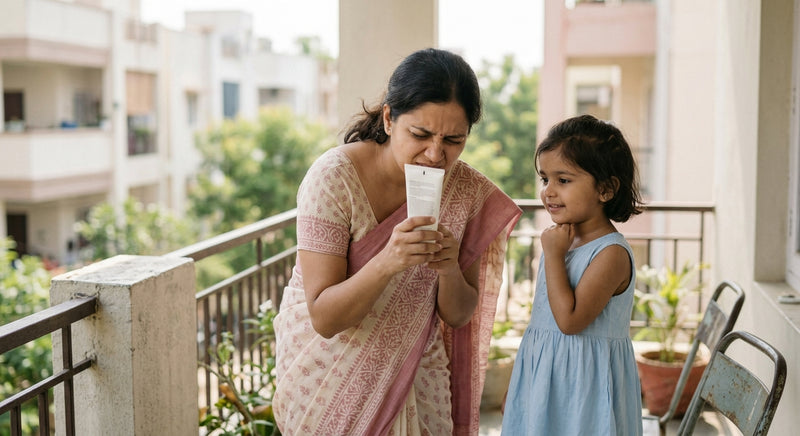
Forty jars. All of them “gentle,” “natural,” “dermatologically tested.” And there you are at 11pm, scrolling with one thumb because the other arm is busy, trying to work out which one is actually any good. I've been on both sides of that aisle.
So let me save you the spiral. A good baby moisturizer has a short ingredient list you can mostly read, a base that both pulls water in and locks it in, no added fragrance or colour, and a form that suits your baby and your city's weather. The rest is the front of the jar talking. Here's the checklist I actually run — about a minute a product, any brand, any shop.
At a glance
- Pick for the base formula first — a humectant (draws water in) plus an occlusive (locks it in).
- Shorter ingredient list = fewer things to react to. You should recognise most of it.
- Skip added fragrance, colour and "essential-oil" blends for under-ones.
- Match the form to the weather: balm/cream for dry winters, lighter lotion for humid months.
- "Natural" and "organic" are nice-to-haves, not the test. The label ingredients are the test.
Why baby skin needs a different bar than yours
This isn't precious marketing talk. Baby skin is built differently. It's 20–30% thinner than an adult's — so it loses water faster and lets irritants in more easily. The barrier, that brick-and-mortar top layer that holds moisture in and keeps trouble out, is still finishing its job through the first year or two.
Which is exactly why you ended up reading this. Up to roughly 48.6% of babies run into atopic-type skin trouble — dryness, rough patches, the odd flare on the cheeks. A moisturizer's real job was never to smell lovely. It's to quietly back up that half-built barrier, morning and night.
The 5-point checklist (works on any label)
Turn the jar over. The front is the brand; the back is the product. Read the back. This is what I check, roughly in this order.
1. The base should do two jobs, not one
A cream that only “adds moisture” but never seals it leaves skin tight again within the hour. You want both halves working together:
- A humectant that pulls water into the skin — glycerin is the workhorse, cheap and gentle. Aloe and certain sugars do this too.
- An occlusive/emollient that seals it in and smooths the surface — shea butter, ceramides, squalane, mild plant oils, dimethicone.
Glycerin near the top, a real butter or oil somewhere in the mix — that's a formula built on solid ground. That pairing is the whole point of a moisturizer.
2. Short list, words you recognise
Honestly, this one test alone clears out most of the noise. Eight to fifteen recognisable ingredients usually means someone thought about the formula. Thirty-five, with a paragraph of unpronounceable extras, usually means they didn't. Fewer ingredients, fewer triggers for touchy skin. You don't need a chemistry degree — you need to recognise most of what's in there.
3. Watch for fragrance, colour and “natural” oils
Under one, I'd skip all three. Added fragrance — it'll say “parfum” or “fragrance” — is one of the more common causes of contact reactions on sensitive skin, and your baby can't tell you it stings. Artificial colour does nothing for your baby; it's there for you. And don't be lulled by “all-natural essential oil” blends — undiluted lavender or tea-tree can irritate thin baby skin just fine. Unscented, or very lightly and deliberately scented, is the safer bet.
4. Someone real should stand behind it
Look for “dermatologically tested” and a named manufacturer on the pack. In India, BIS compliance and a proper cosmetic manufacturing licence are the floor, not a flex — they just mean it's made to standard. Better still if the brand makes its own formulations instead of sticking a label on a generic batch; that usually means a real person is accountable for what's inside. (For the record: at Janma we make ours in our own GMP-certified facility in Nagpur, and our formulas are clinically and in-vivo tested. That's the bar I'd want any brand to clear, not just ours.)
5. The form has to suit your baby and your weather
Most parents skip this, and it's why the “perfect” cream your cousin in Pune swears by feels like a greasy film on your baby in Chennai. A thick balm that's heaven in a dry Delhi December turns heavy and sticky in coastal humidity. Texture follows season and skin — more on that just below.
Balm vs cream vs lotion vs oil — which form, when?
They are not interchangeable. The short version:
| Form | Best for | Watch-out |
|---|---|---|
| Balm / butter cream | Very dry, flaky, eczema-prone skin; dry winters; protecting the diaper area | Can feel heavy in peak humidity |
| Lotion | Everyday all-over moisturizing; humid months; quick post-bath use | Lighter, so very dry skin may need a richer option |
| Cream | The middle ground — daily use, most skin types | Quality varies hugely; read the base |
| Plain oil (malish) | Lovely for massage and bonding | Oil alone doesn't hold water in skin the way a humectant-based cream does — pair it, don't rely on it |
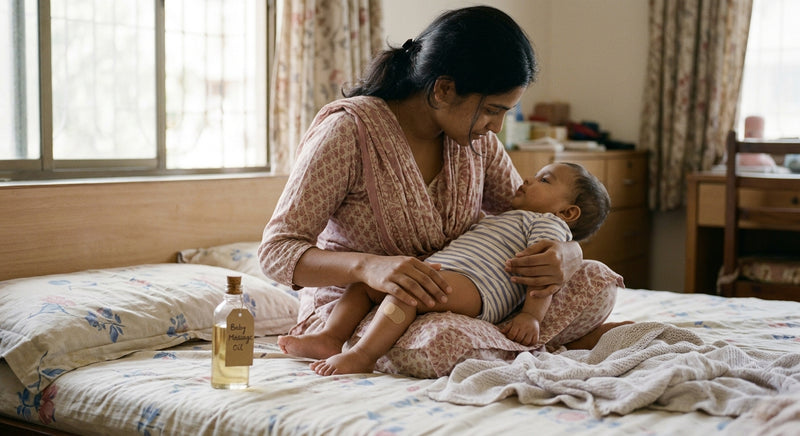
A word on malish, because it comes up in nearly every Indian home, mine included. Oil massage is genuinely lovely — for circulation, for sleep, for that quiet ten minutes of connection. I'd never tell you to stop. But an oil-only routine isn't moisturizing. Oil seals the surface; it doesn't draw water in. The gentlest order is a warm oil massage, then the bath, then a humectant-based moisturizer on damp skin. Do it in that sequence and you get the most out of each step.
What to actually do tonight
Don't overhaul anything. Try this with the jar you already own, and upgrade only when it runs out.
- Turn your current jar around and run the 5-point checklist. Passes? You're done. Stop shopping.
- After tonight's bath, pat — don't rub — your baby almost dry, leaving the skin a little damp.
- Within about three minutes, smooth on a thin, even layer while the skin still holds that bath-water.
- Hit the dry spots twice — cheeks, shins, the backs of the hands — once more before bed.
- Choose the form by tonight's weather: richer when it's dry and cold, lighter in humid heat.
What you can safely ignore
A few words sound load-bearing but shouldn't decide anything. “Hypoallergenic” is a hopeful word, not a tested, regulated guarantee. “Chemical-free” is impossible — water is a chemical. That long list of botanical extracts looks impressive, but each one is usually present in a sliver, more for the label than for your baby's cheeks. And a bigger price tag tells you very little about whether the barrier formula is any good. Read the base, read the list. Every time.
When to see a doctor
A moisturizer is for ordinary dryness and upkeep — not for treating a skin condition. Please see your paediatrician if your baby has skin that's cracked, oozing, or bleeding; redness that spreads, feels warm, or comes with fever; dryness or itching that doesn't settle within a week or two of gentle care; or any rash that clearly distresses your baby. A doctor can tell eczema apart from an infection or an allergy, and point you to the right treatment — which is sometimes more than a cream.
Once you've found one that ticks the five boxes and genuinely suits your baby, the kindest thing you can do is keep it boring — same cream, same routine, twice a day. If you'd rather not juggle three jars, our Hydra Healing Moisturizing Balm was built to exactly this checklist, for dry, sensitive and barrier-stressed skin across ages. It's the one I'd hand a new parent who just wants to stop guessing.
In summary
- Choose a baby moisturizer on its base formula first — a humectant like glycerin plus an occlusive such as shea butter or ceramides.
- Favour a short, readable ingredient list and skip added fragrance, colour and undiluted essential oils for under-ones.
- Match the form to the weather: richer balm for dry, cold months, lighter lotion for humid heat.
- Moisturize twice a day, and apply within about three minutes of the bath while skin is still damp to lock water in.
- Ignore vague claims like 'hypoallergenic' or 'chemical-free' and see a paediatrician for cracked, weeping or spreading skin.
Frequently asked questions
What ingredients should a baby moisturizer have?
Look for a humectant that pulls water into the skin — glycerin is the gentle workhorse — paired with an occlusive or emollient that locks it in, like shea butter, ceramides, squalane or a mild plant oil. Together they hydrate and seal. Keep the overall list short and readable, and skip added fragrance and artificial colour, which are common irritants for sensitive baby skin.
Is balm or lotion better for a baby?
It depends on the skin and the season. A balm or butter cream is richer and better for very dry, flaky or eczema-prone skin and for dry winters. A lotion is lighter and easier to spread for everyday use and humid months. Many parents keep both: balm for dry patches and cold weather, lotion for all-over daily moisturizing when it's hot and humid.
How often should I moisturize my baby?
Twice a day works for most babies — once right after the bath while skin is still slightly damp, and again before bed. Very dry or eczema-prone skin may need an extra application on problem spots like cheeks and shins. The most useful habit is moisturizing within about three minutes of the bath, while the skin still holds water, so the cream seals it in rather than letting it evaporate.
Are fragrance-free baby products really better?
For babies under one, yes, fragrance-free is the safer default. Added fragrance is one of the more common triggers for contact reactions on thin, sensitive skin, and a baby can't tell you it stings. Note that "unscented" sometimes means a masking fragrance was added to hide a smell, while "fragrance-free" means none was added — so fragrance-free is the cleaner label to look for.
Is oil massage enough, or does my baby still need a moisturizer?
Massage with oil is wonderful for circulation, sleep and bonding, and you don't need to stop. But oil alone seals the skin surface without drawing water in, so it isn't the same as moisturizing. The gentlest routine is a warm oil massage, then a bath, then a humectant-based moisturizer on damp skin. That order lets you keep the malish tradition while still properly hydrating the skin.
Does "hypoallergenic" mean a baby moisturizer is safe?
Not reliably. "Hypoallergenic" isn't a strictly regulated, tested guarantee — it's a marketing word suggesting lower allergy risk. The same goes for "chemical-free," which is impossible since water is a chemical. Judge a product by its actual ingredient list and base formula instead: short, readable, humectant plus occlusive, no added fragrance or colour, and made by a manufacturer that tests and stands behind it.