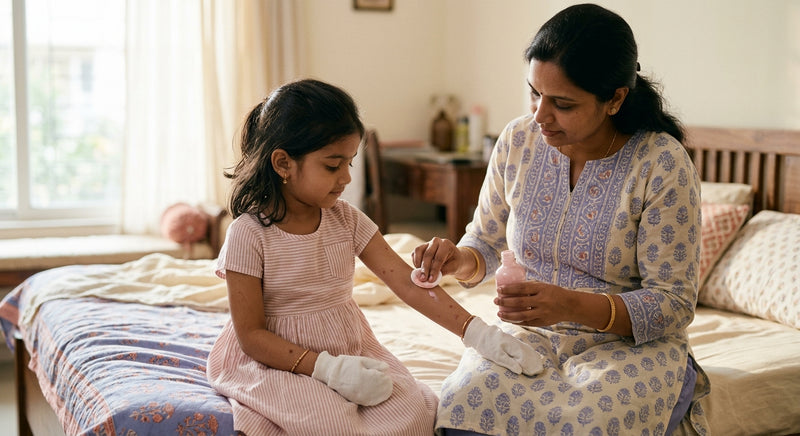
The question I get most often on a shop floor in Nagpur, phone in hand, three tabs open: "which of these baby washes is best?" Almost always the parent is comparing brands. That's the wrong axis. Under the labels there are really only four formulation formats on the Indian shelf, and once you know which format you're holding, the decision takes about ninety seconds.
Short answer: for most Indian babies, a mild syndet (synthetic detergent) cleanser at skin pH is the safest default year-round. A lipid-rich / cleansing-lotion format suits dry winters and eczema-prone skin. Oat-based formats help itchy, reactive skin. And a syndet built on Ayurvedic botanicals gives you the pH science plus the oils a lot of Indian families want. Season and water hardness decide between them more than any brand name does.
At a glance
- Compare formats, not brands — the surfactant system is what touches your baby's skin.
- Soap sits around pH 9–10. Baby skin sits around pH 5.5. That gap is the single biggest variable in the whole comparison.
- Hard water (most of North and Central India) turns real soap into a gritty scum on skin — syndets don't do this.
- Summer = more frequent, lighter cleansing. Winter = less cleanser, more moisturiser. Monsoon = dry the folds, not just the skin.
- A baby's skin is 20–30% thinner than an adult's, so a harsh wash shows up faster on them than on you.
What actually differs between baby cleansers?
Four things, in order of how much they matter:
1. The surfactant system. This is the cleansing engine. Traditional soap is made by saponifying fats — it cleans beautifully and is alkaline by chemistry, not by choice. Syndets use milder synthetic surfactants (you'll see names like sodium cocoyl isethionate, decyl glucoside, coco-glucoside, sodium lauroyl sarcosinate) that can be built at pH 5.5. Same job, gentler on the acid mantle.
2. The pH. A newborn's skin surface is still acidifying in the first weeks. That acid mantle keeps the barrier enzymes working and unfriendly bacteria unhappy. Wash it with something at pH 9 daily and you're repeatedly knocking it back.
3. The lipid load. How much oil, butter or emollient rides along with the surfactant. High lipid = less stripping, more residue-feel. Low lipid = fresher finish, needs a moisturiser after.
4. Everything else — fragrance, preservative, essential oils, colour. Important for reactive skin, but genuinely secondary to the three above.
The four formats, compared for Indian conditions
| Format | How it cleans | Best Indian fit | Watch-out |
|---|---|---|---|
| Mild syndet wash / foam | Gentle synthetic surfactants, built at skin pH, light lipid load | Year-round default; excellent in hard water; summer sweat | Needs a moisturiser after in winter |
| Lipid-rich cleansing lotion | Low-foam, emollient-heavy; cleans by dissolving rather than lathering | Dry Delhi/Punjab winters, eczema-prone skin, newborn sponge baths | Can feel filmy in humid monsoon; may not shift oil-massage residue |
| Oat-based (colloidal oatmeal) wash | Mild surfactant plus oat as a soothing, film-forming buffer | Itchy, reactive, post-flare skin | Not a treatment; still check the pH on the label |
| Ayurvedic-botanical syndet | Skin-pH surfactants carrying oils/extracts like ghee, almond, oats, herbs | Families who want malish-and-bath tradition with modern formulation | Quality varies hugely — look for GMP manufacture and testing, not just a herb list |
| True soap / besan-style bar | Saponified fats, pH ~9–10 | Honestly, no strong case for infant skin | Alkaline; forms scum in hard water |
Does hard water change which cleanser you should buy?
More than most parents expect, and this is where imported formulation advice falls down. Large parts of India — Rajasthan, Gujarat, Haryana, Delhi, much of Maharashtra, Telangana — run hard borewell or municipal water loaded with calcium and magnesium.
Here's the chemistry: those metal ions react with the fatty acid salts in true soap and precipitate as insoluble scum. That's the squeaky, slightly powdery feel after a bucket bath. It clings to skin, sits in the folds, and mildly irritates an already-thin barrier. Syndet surfactants are much less prone to this — they don't form the same insoluble salts, so they rinse clean even at high hardness.
So: if your bath water leaves white marks on the steel tumbler or the tap, choose a syndet format. That single observation is more useful than any brand comparison chart.
Which cleanser for which Indian season?
Summer (Mar–Jun)
Sweat, prickly heat, dust. Babies genuinely get dirtier. A light syndet foam once daily, plus a plain water rinse in the evening if it's been a 42°C day. Don't add a second full wash — water alone clears sweat salt fine. Keep neck folds, thigh creases and behind the ears properly dried; that's where ghamori starts.
Monsoon (Jun–Sep)
Humidity is high, so skin isn't dry — but folds stay damp, and damp folds are where fungal trouble begins. Cleanser choice matters less here than drying technique. Avoid heavy lipid-rich lotions that leave an occlusive film in the creases. A rinse-clean syndet wash is the better monsoon pick.
Winter (Nov–Feb)
The opposite problem. In Delhi, Lucknow or Nagpur in January, indoor air is dry and bath water runs hot. Cut cleanser use to alternate days on the body (face, neck, hands, nappy area daily is fine), use a lipid-rich format or add a rich moisturiser within three minutes of the towel, and drop the water temperature to lukewarm — around 37–38°C, wrist-test warm, not steaming.
Post-monsoon / transition weeks
These are the sneaky flare weeks. Humidity drops fast, skin hasn't adjusted. Hold your cleanser steady and increase moisturiser instead of changing everything at once.
How to read the label and decide in 90 seconds
- Look for a stated pH near 5.5, or the words "soap-free" / "syndet".
- Scan the first five ingredients — that's where the surfactant system lives.
- Check for a sulfate-free or mild-surfactant system if your baby has reactive skin.
- Decide on fragrance deliberately: fragrance-free is the safer default under one year and for eczema-prone skin.
- Look for who made it — own GMP facility, dermatologically tested, in-vivo tested — rather than a long botanical list on the front.
- Patch test any new wash on the inner forearm for 24 hours before a full bath.
Where Janma sits in this comparison
I'll be direct, because you asked for a comparison and you deserve a straight answer about our own product. Our Head to Toe Baby Foam Wash is an Ayurvedic-botanical syndet: skin-pH, tear-free, soap-free surfactants carrying the oils Indian families already trust from malish. We make it in our own BioCert Organic, FDA-licensed, GMP-certified facility in Nagpur — we own the formulation rather than buying it white-labelled, which is why I can tell you what's in it and why.
That format is a strong year-round choice for hard water and Indian summers. In a dry January, on very dry or eczema-prone skin, I'd still tell you the wash matters less than what you apply after — and a barrier-supporting balm does more work than any cleanser can. Our in-vivo studies showed visibly calmer skin in as little as one day in 24- and 36-month subjects, and lab work showed increased Keratin-10 and Filaggrin expression, which is the barrier-support side of the story.
When to see a doctor
Comparing cleansers is really comparing surfactant systems, pH and lipid load against your city's water and this month's weather. Get those three right and the label on the front matters far less than you think.
If you want a soap-free, skin-pH wash that behaves well in hard Indian water, our Head to Toe Baby Foam Wash is where I'd start.
In summary
- Compare cleanser formats — syndet, lipid-rich, oat-based, Ayurvedic-syndet — rather than brand names on the front label.
- Choose a soap-free, skin-pH wash if your tap water is hard, since true soap leaves scum on skin and in folds.
- Wash lightly and daily in summer, keep folds dry through the monsoon, and cut full-body cleanser to alternate days in dry winter.
- Read the first five ingredients for the surfactant system, and go fragrance-free under one year or on reactive skin.
- See a paediatrician for weeping, crusting, fever-linked or fast-spreading rashes, and for any new widespread rash under three months.
Frequently asked questions
Is soap or a syndet wash better for an Indian baby?
A syndet wash, in almost every Indian situation. True soap is alkaline by chemistry — around pH 9 to 10 — while baby skin sits near 5.5, and repeatedly shifting that pH works against the barrier. Soap also reacts with the calcium and magnesium in hard water to leave a fine scum on skin and in the folds. Syndet washes rinse clean and can be built at skin pH.
Does my baby need a different cleanser in winter and summer?
Often the same cleanser used differently, rather than two products. In summer, wash once daily and rinse with plain water after a sweaty day. In winter, cut full-body cleanser to alternate days, keep the water lukewarm, and moisturise within three minutes of towelling. If skin is very dry in January, a lipid-rich cleansing lotion format helps, but the moisturiser does more work than the wash.
How do I know if my bath water is hard?
Lather a little wash in a mug of tap water. If the foam collapses quickly and leaves a cloudy film on the mug, or your taps and steel utensils show white deposits, your water is hard. Hard water suits soap-free syndet formats far better than true soap. Rinsing the last mug with filtered or boiled-and-cooled water also reduces residue on skin.
Are oat-based baby washes better for eczema-prone skin?
Colloidal oatmeal is genuinely soothing and film-forming, and an oat-based wash can feel calmer on itchy, reactive skin. But a wash sits on skin for under a minute before rinsing, so it can't do much treating. Check that the oat wash is also soap-free and at skin pH, and put your effort into a barrier-supporting moisturiser afterwards. Eczema flares need a paediatrician's input.
Should I choose a fragrance-free baby cleanser?
Under one year, and for any baby with reactive or eczema-prone skin, fragrance-free is the safer default. Fragrance is a common contact-allergen category, and a baby's skin is 20 to 30 percent thinner than an adult's, so reactions can show up faster. For older children with settled, tolerant skin, a light fragrance is usually fine. Patch test any new product on the inner forearm for 24 hours.
How often should I bathe my baby in Indian weather?
Once daily is fine through summer and monsoon, and most babies do well on alternate-day full washes in dry winter months. Keep baths to around five minutes with lukewarm water, roughly 37 to 38 degrees Celsius. In humid weather, drying the neck, thigh and elbow folds properly matters more than how often you use cleanser — damp folds are where rashes usually begin.