It is 7pm. Your mother-in-law is at the bedroom door with a katori of warm oil and a very specific opinion about your baby's ears. You love her. You also read something on a WhatsApp group at 2am that has been sitting in your chest all day. So who wins?
We have sat with Indian families through this exact standoff for years, and here is where we land. Most of what dadi says is right. A few practices need one small change. Three should stop today. Of the ten below, we'd keep three as they are, adapt four, and stop three. Very little on this list is silly. Practices that lasted generations usually lasted for a reason. The exceptions are the ones that reach a baby's eyes, airway or gut, and those need a firm no.
At a glance
- Malish, the lap bath and mundan stay. They are safe, and the touch itself does real good.
- Ubtan, ghee, dhoop and swaddling are all fine with one change each: less friction, less quantity, less sun, looser hips.
- Kajal in the eyes, oil in the nose or ears, ghutti before six months. These three stop, and no adaptation makes them safe.
- A baby's skin is 20-30% thinner than an adult's, so anything that would mildly scrub your face is too much for theirs.
- Say "we're keeping most of what you did". It is true, and it is the sentence that ends the argument.
How we sorted them
Three questions, and the order matters. First, can it reach the eye, the airway or the bloodstream? Second, does it rub, heat or block skin that is still learning how to be skin? Third, is the promise behind it actually true, even where the practice itself does no harm? Anything that fails the first question goes straight into "stop". Fail only the second or the third and it usually just needs one adjustment. The longer reasoning behind each sits in our complete guide to traditional Indian baby-care practices and safety.
The 10 traditions, sorted
| Tradition | What dadi says | Verdict | What we'd actually do |
|---|---|---|---|
| Daily malish before the bath | Makes baby strong and helps sleep | Keep | 10-15 min, plain edible-grade oil, warm room, before the bath |
| The lap bath (baby on your outstretched legs) | Safest way to hold a newborn | Keep | Keep it — best head control you'll get. Sit on a low stool, not the wet floor |
| Mundan | Shaved hair grows back thicker | Keep (ritual, not the promise) | Do it for the family, not the hair. Fresh blade, clean scalp, moisturise after |
| Ubtan (besan, haldi, malai) | Cleans, brightens, removes body hair | Adapt | Smooth on, never scrub. Skip the face. Twice a week, not daily |
| Ghee on dry patches and lips | Nothing moisturises better | Adapt | Fine in a pea-sized dab on lips/cheeks. Not for widespread dryness or hot months |
| Dhoop — morning sun on the baby | Vitamin D, and it "clears" jaundice | Adapt | Brief, before 9am, in shade or filtered light. Never as a jaundice treatment |
| Tight swaddling / straightening the legs | Legs grow straight, baby feels secure | Adapt | Snug arms, loose hips — legs must bend and open freely. Light cotton only |
| Kajal in the eyes | Big eyes, protection from nazar | Stop | Nothing goes in a baby's eye. Move the teeka behind the ear or onto clothing |
| Oil drops in the nose or ears | Clears the passages, prevents cold | Stop | Saline drops if a paediatrician advises. Oil outside the ear only, never inside |
| Janam ghutti / gripe water / honey | Settles gas and colic | Stop before 6 months | Burp, bicycle the legs, tummy massage. Nothing by mouth but milk |
The three we'd keep, unchanged
Malish. This is the one dadi is most right about. Warm oil, an unhurried ten minutes, and no fan blowing straight onto the baby. Most babies settle with it before a feed. It also hands you the best look at your baby's skin you will get all day, so you catch a new dry patch or a warm fold long before it turns into a rash. Sesame in winter, coconut in a Nagpur summer. Cold-pressed and edible-grade either way.
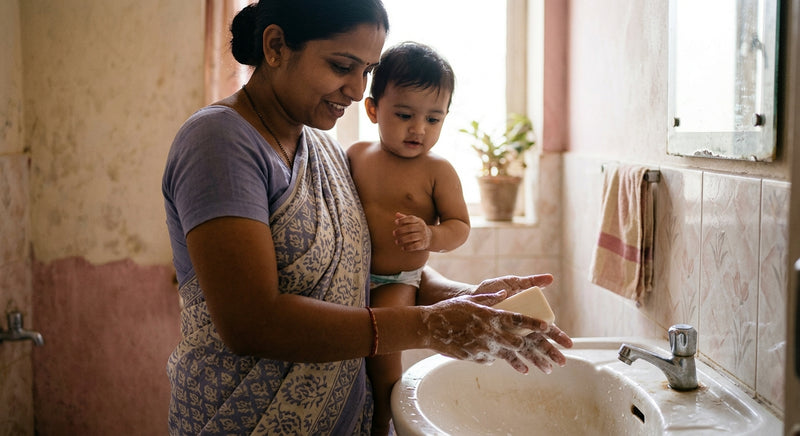
The lap bath. Legs stretched out, baby lying along your shins: for the first few months this is better technique than a plastic tub, and it is not nostalgia to say so. Your knee takes the neck, both your hands stay free, and there is nowhere for a soapy baby to slide.
Mundan. Do the ritual. Ignore the promise. Shaving does not change the follicle, so the hair comes back at whatever thickness it was always going to be. What actually needs planning is the week afterwards, when the scalp is bare, sun-exposed and often nicked. We wrote a full guide to caring for a baby's scalp in the first week after mundan because parents write to us about it at day three, when the flaking starts.
The four we'd adapt
Ubtan. Nothing wrong with the recipe. The pressure is the problem. A baby's skin is 20-30% thinner than an adult's, so what your hands read as gentle lands as friction on them. Mix it looser than dadi does. Smooth it on in one direction, leave it 2-3 minutes, rinse. No rolling it off in little balls, and nothing near the eyes. Follow with a plain, tear-free wash; our Head to Toe Baby Foam Wash was formulated to rinse residue off without stripping, which is exactly the job here.
Ghee. Lovely on a chapped lip or one dry cheek. Less lovely as an all-over body cream in a humid July, where a heavy occlusive sitting on sweaty skin can trap heat in the folds. Keep it small and targeted.
Dhoop. Ten minutes of early, filtered light with the baby dressed and out of direct sun is fine. Direct Indian sun on bare newborn skin is not, whatever the hour feels like on your balcony. And sunlight is never a treatment for jaundice. Yellowing that spreads or deepens means calling your paediatrician the same day, not carrying the baby up to the terrace.
Swaddling. Snug across the arms, roomy at the hips. The old habit of binding the legs straight to "correct" bow legs works against the way hip joints actually settle. Light cotton. Unwrap the moment the back of the neck feels damp.
The three we'd stop
Kajal in the eyes. Homemade kajal, and many of the loose ones sold in the bazaar, have repeatedly tested positive for lead. An infant's eye and gut absorb far more of it than an adult's. There is no safe quantity here, and thoda sa is not a smaller risk, it is the same risk in a smaller dose. If the teeka is about protection, it protects just as well behind the ear or on the kurta. You keep the intention and leave the lead out of it.
Oil in the nose or ears. This is the one that worries us most, and it is always done with such care. A newborn cannot cough oil back up the way you or I can, and drops put into the nose can go the wrong way. We have written about why oil in a baby's nose and ears carries a real aspiration risk. Outside the ear, along the fold, with an oiled fingertip: completely fine. Inside, never.
Ghutti, gripe water and honey. For the first six months, the whole menu is breast milk or formula. Ghutti recipes change from house to house, so nobody can tell you what a dose actually contains, and honey specifically is unsafe under one year. Where colic is the real problem, the fix is mechanical: feed upright, burp for longer, bicycle the legs, a warm palm circling the tummy clockwise. Our breakdown of what's actually inside gripe water and what the evidence says is a good read before the next bottle comes into the house.
One more that did not make the ten but belongs here. Head shaper pillows are sold all over the parenting internet now as the modern upgrade to moulding the skull by hand. Paediatricians warn against them on sleep-safety grounds. A baby's head rounds out on its own, with tummy time and a change of position.
What to do tonight
- Find the kajal dabba and bin it. Agree on a teeka spot that is not skin near the eye.
- Move the oil katori to arm's length from the baby's face. Body only.
- Read the label on any ghutti or gripe water in the house. Under six months, it goes away.
- Re-do tonight's swaddle: firm at the shoulders, two fingers of room at the hips.
- Keep malish exactly as it is, and say so out loud to whoever taught you.
When to see a doctor
Book a paediatrician if a rash or dry patch worsens over 3-4 days despite gentle care, if any area weeps, crusts yellow or grows warm to touch, if yellowing of the skin or eyes appears or deepens, if there's fever in a baby under three months, or if your baby coughs, chokes or breathes noisily after oil or a liquid remedy. Skin that is changing fast, or a baby who seems "off", is always a doctor's call and not a home-remedy call.
So what would we actually do?
Keep the ritual and take out the risk. Malish every day, lap bath, mundan if your family does mundan. Ubtan smoothed rather than scrubbed, ghee in dabs, sun before nine, hips free. Then a firm, unapologetic no to kajal in the eyes, oil in the nose and anything by mouth before six months. None of that is a rejection of dadi. Seven of her ten still stand, which is a better hit rate than most parenting advice you will read this week.
For the dry patches these traditions were aimed at in the first place, the winter cheeks and the flaky shins after a bath, a balm made to comfort dry, sensitive skin and support its natural barrier does the job ghee was being asked to do, without the heaviness.
In summary
- Keep malish, the lap bath and mundan as they are — they're safe and genuinely useful.
- Adapt ubtan, ghee, dhoop and swaddling with one change each: smooth don't scrub, dab don't slather, early filtered sun, loose hips.
- Stop kajal in the eyes, oil in the nose or ears, and any ghutti, gripe water or honey before six months.
- Handle colic mechanically — upright feeds, longer burping, bicycle legs and a warm clockwise tummy massage.
- See a paediatrician for a rash that worsens over 3-4 days, any oozing or spreading redness, new or deepening yellowing, or noisy breathing after oil or a liquid remedy.
Frequently asked questions
Is kajal really unsafe for babies' eyes?
Yes. Homemade and many loose-sold kajals have repeatedly been found to contain lead, and a baby absorbs far more of it than an adult would. There is no safe quantity and no safe application inside or around the eye. If the purpose is protection from nazar, place the teeka behind the ear, on the sole of the foot or on clothing instead.
Can I still do malish if my baby has dry or sensitive skin?
Usually yes, and it often helps. Use a plain, cold-pressed edible-grade oil, warm it in your palms rather than heating it, and keep pressure light — no kneading. Skip malish over broken, weeping or actively inflamed skin, and patch-test any new oil on the inner arm for 24 hours first. If dryness keeps returning, a barrier moisturiser after the bath does more than oil alone.
Is ubtan safe for a newborn?
We'd wait until the cord stump has healed, then use it sparingly — twice a week at most, on the body only. Mix it loose enough to smooth on rather than rub off, leave it two to three minutes, and rinse with plain warm water. A baby's skin is 20-30% thinner than an adult's, so the friction of scrubbing, not the ingredients, is usually what causes trouble.
Why can't I give gripe water or ghutti before six months?
Because nothing but breast milk or formula belongs in a baby's gut in the first six months, and traditional ghutti recipes have no standard dose or ingredient list. Honey specifically is unsafe under one year. For gas, the effective fixes are mechanical — feed more upright, burp longer, cycle the legs, and massage the tummy clockwise with a warm palm.
Does mundan actually make hair grow thicker?
No. Shaving cuts hair at the surface and doesn't change the follicle, so hair returns at whatever thickness it was always going to be. It can look coarser briefly because a blunt cut end feels different. The ritual itself is fine to keep — just protect the scalp afterwards with shade, a cap outdoors and a light moisturiser for the first week.
How do I tell my mother-in-law we're stopping something?
Lead with what you're keeping. Say the malish, the bath and the ritual all stay exactly as she does them, because they work. Then name one change at a time, with the reason attached — "the paediatrician said nothing in the nose because babies can't cough it back up." Attributing it to the doctor rather than to a website usually ends the debate quickly.