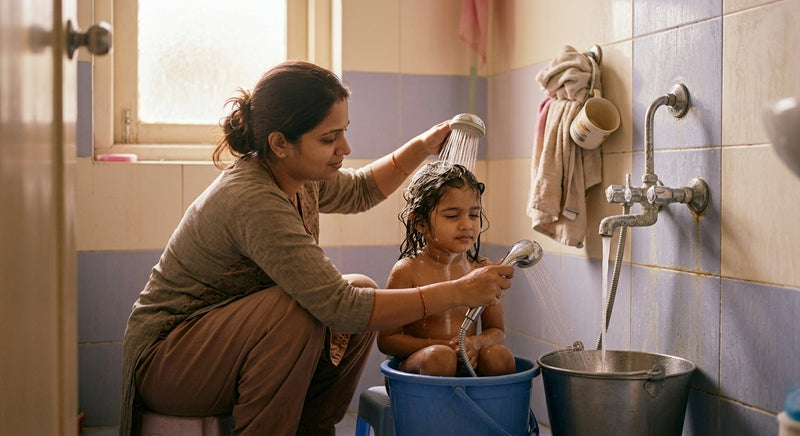
Eight in the evening, Nagpur, monsoon air you could wring out like a cloth. One knot at the nape of your toddler's neck has decided to become a personality. She's crying. You're sweating. The comb is stuck.
The short answer: detangle on damp, conditioned hair — never dry, never soaking — working from the ends upward in small sections with a wide-tooth comb, holding the hair above the knot so the tugging never reaches her scalp. That's the technique, and it doesn't change. What changes is why the hair knotted today. A monsoon knot and a January knot are not the same problem, and they don't respond to the same fix.
I've done this with my own children. I've heard about it from parents across the country for years. Below is what actually works, month by month. If you want the wider picture on washing, oiling and cradle cap, start with our complete guide to baby and toddler hair care, then come back here for the tangles.
At a glance
- Detangle damp — not dry, not dripping. Dry hair snaps. Wet hair stretches and breaks.
- Bottom-up, always: ends, then mid-lengths, then roots.
- Hold the section above the knot. Then she feels the comb, not the pull.
- Monsoon means frizz and swelling. Winter means static. Summer means sweat-glued knots at the nape.
- Hard water leaves a mineral film that makes hair feel rough and grabby. There, conditioner isn't optional.
Why does my toddler's hair tangle more in some months than others?
A tangle is friction. Two strands with roughened outer surfaces catch on each other, wrap, and lock. So anything that roughens that outer layer gives you more knots — swelling from humidity, static from dry air, salt from sweat, mineral deposits from hard water. And toddler hair is finer and softer than ours. It takes very little to tip it into a bird's nest.
This is why the same shampoo can feel wonderful in October and useless in July. Nothing changed in the bottle. Everything changed in the air.
Monsoon: frizz, swelling and the nape knot
In high humidity, hair pulls in moisture from the air and swells slightly. The outer cuticle lifts, the strand roughens, and hair that was smooth at the school gate is a halo of frizz by four in the afternoon. Then comes the sweat, the headrest of the school bus, the car seat on the way to her grandmother's. What you're left with is the classic monsoon knot: a dense, felted lump sitting right at the nape.
What actually helps:
- Don't skip conditioner because it feels heavy. Humidity doesn't moisturise hair. It only swells it. A light conditioner smooths the cuticle so strands slide past each other instead of gripping.
- Braid or loosely tie her hair before play, before naps, before any car journey. A soft plait prevents most of the nape mess before it starts. Keep it loose — you should be able to slide two fingers under it.
- Dry her hair before bed. Damp hair rubbing a pillow all night in wet air is how a two-minute detangle becomes a twenty-minute one.
Summer: sweat, dust and salt
Through April and May, a toddler's scalp sweats far more than we give it credit for. The sweat dries and leaves salt behind. Salt plus street dust makes a gritty film that sits on the strand. Hair feels stiff, looks dull, grabs the comb.
So summer needs slightly more washing than winter, not less — with a genuinely mild, tear-free formula, so you're not stripping the scalp on the way. If you're not sure how often is right, we've gone through the evidence on how often to shampoo baby hair. My working rule for an active toddler in an Indian summer: plain-water rinse daily after outdoor play, shampoo two or three times a week.
Winter: static, dry air and heater burn
A north Indian winter and an air-conditioned bedroom do the same thing. Both pull moisture out of the air, and then out of the hair shaft. Dry hair carries a static charge, so strands repel, fly apart, and re-tangle on the way down. Dry hair also snaps. This is the season where forcing a comb costs you real breakage, not just tears.
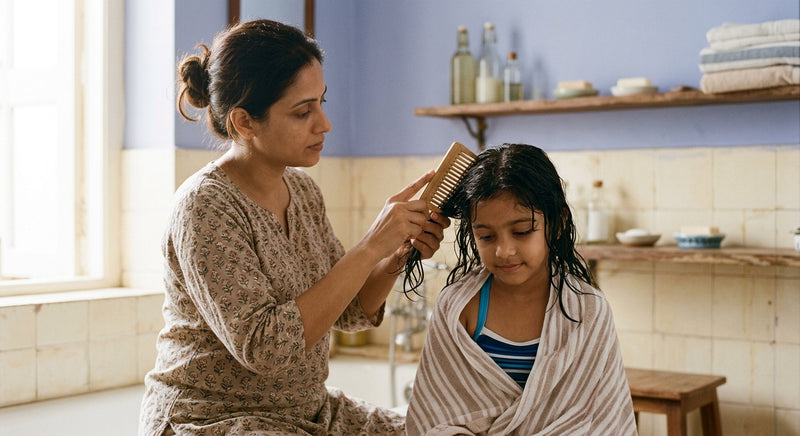
So in winter, never detangle bone-dry hair. Mist it first with plain water from a spray bottle, or work a little leave-in conditioner through the mid-lengths and ends. A comb with wide, smooth wooden teeth builds up less static than a cheap plastic one, and you'll feel the difference on the very first pass.
Which season needs what?
| Season | What's causing the tangles | What to change |
|---|---|---|
| Monsoon | Humidity swells hair; sweat felts the nape | Loose braid before naps and car rides; always condition; dry fully before bed |
| Summer | Sweat salt + dust roughen the strand | Plain-water rinse after outdoor play; mild wash 2-3x a week |
| Winter / AC | Dry air, static, brittle strands | Never comb dry hair; mist or use leave-in; wooden wide-tooth comb |
| Hard-water areas | Mineral film makes hair rough and grabby | Final rinse with stored/filtered water; conditioner every wash |
Does hard water make toddler hair tangle more?
It does, and almost nobody accounts for it. Across much of Maharashtra, Rajasthan, Delhi NCR and Tamil Nadu, what comes out of the tap carries a heavy load of calcium and magnesium. Those minerals settle on the hair as a fine film. The hair feels squeaky-rough instead of soft, and the comb catches every few centimetres, the way a fingernail catches on raw silk.
Keep a jug or a small bucket of filtered or stored water aside for the last rinse. Even one mug poured over her head at the end makes a difference. And condition every wash. Every one, no exceptions. If the hard water is also making your child's skin itch and flake, our piece on hard water and baby skin deals with the shower-filter question properly.
What you want in a conditioner is slip. Something that coats the strand so the comb glides rather than catches. Light plant oils, glycerin and gentle conditioning agents give you that cushion; a toddler's fine hair doesn't need silicones to get there. Our Rejuvenating & Detangling Conditioner is what we made for exactly this evening — enough slip to get through a monsoon knot, light enough that soft baby hair doesn't go flat under it.
The tear-free detangling routine, step by step
- Sit her down with something to do. A screen, a snack, a mirror to make faces in. Standing toddlers squirm. Seated ones negotiate.
- Work on damp hair. After the bath, squeeze it in a towel until it stops dripping. Not dry.
- Conditioner on mid-lengths and ends only, never the scalp. Pea-sized for fine hair, hazelnut-sized for thick.
- Wait 60 seconds. Let it soften the knot. Sing something. This is the step everyone skips.
- Divide into 2-4 cm sections and clip the rest away, out of the fight.
- Start at the very ends. Comb the last 3 cm until it runs clean, then start 3 cm higher. Work upward. Never begin at the roots.
- Anchor above the knot. Grip the section firmly between her scalp and the tangle with your free hand, so the comb pulls against your fingers instead of her head. Do this and most of the crying stops.
- Use your fingers on the worst knot. Ease it apart into two smaller knots. Two small knots are easy. One big one isn't.
- Rinse, squeeze in a cotton tee, plait loosely.
Once you've got the hang of it, three or four minutes. The first few evenings will run longer, and they should — you're teaching her that the comb isn't the enemy.
What about a matted lump that has already formed?
Don't go at it dry. Saturate that one section with conditioner and leave it alone for five minutes while she plays. Then fingers only, teasing the mat into smaller pieces from the outside edge inward. The comb comes in last, once the thing is already loose. And if the mat sits close to the scalp and pulls painfully, cutting is the kind and correct answer. Nobody will notice by next month.
One thing worth ruling out first: is it really a tangle? Scaly, stuck flakes near the crown in a younger child may be cradle cap rather than a knot — it tends to loosen with oil and a soft brush rather than a comb, and the gentle removal methods here are safer than combing at it. If you're unsure what you're looking at, ask your paediatrician. And if you're pulling visible amounts of hair out of the comb each evening, our honest look at baby hair fall in the first year sets out what is normal shedding and what isn't.
When to see a doctor
Tangles are cosmetic. These aren't. Speak to your paediatrician or a dermatologist if you notice a defined bald patch with broken hairs, or a scaly ring on the scalp — which can be a sign of a fungal infection, common in Indian humidity, and which a doctor can assess and treat. Also worth a visit: an intensely itchy scalp, especially with tiny white specks stuck to the hair shaft; thinning along the hairline or the part where you tie her hair; redness, weeping or sores on the scalp; or sudden, heavy hair loss over a few weeks. Hair that stays unusually dry and brittle, and snaps close to the scalp, needs a professional look rather than a new comb.
When the knots come back with the rains, a conditioner with real slip does most of the work for you. Our Rejuvenating & Detangling Conditioner is the one to keep by the bucket.
In summary
- Detangle on damp hair, from the ends upward, holding the section above the knot so the tug never reaches the scalp.
- Match the method to the month: braid against monsoon frizz, rinse off summer sweat salt, and never comb dry, static-prone winter hair.
- In hard-water cities, condition at every wash and use stored or filtered water for the final rinse.
- Ease a stubborn mat apart with conditioner and fingers first; cut it out rather than force a comb through it.
- See a doctor for bald patches, broken hairs, scaly rings, an intensely itchy scalp or sudden heavy shedding.
Frequently asked questions
Should I detangle toddler hair wet or dry?
Damp — neither dripping nor bone-dry. Soaking wet hair is at its most fragile and stretches before it breaks. Completely dry hair has no slip and snaps under the comb, especially in winter. Towel-squeeze until it stops dripping, apply conditioner to the mid-lengths and ends, wait a minute, then comb from the ends upward in small sections.
Why does my toddler's hair tangle so much in the monsoon?
Humid air swells the hair strand and lifts its outer cuticle, so strands roughen and catch on one another. Sweat at the nape then felts them together, usually against a car seat or pillow. Condition every wash, loosely braid hair before naps, play and car journeys, and make sure hair is fully dry before bed.
Can I use a conditioner on a two-year-old's hair?
Yes, provided it is formulated for children — mild, tear-free, free of harsh cleansing agents, and dermatologically tested. Apply it only to the mid-lengths and ends, never massaged into the scalp, and rinse well. In hard-water areas a conditioner is genuinely the difference between a three-minute detangle and a twenty-minute one.
Does hard water cause tangles in kids' hair?
It contributes. Calcium and magnesium in hard tap water leave a fine mineral film on the hair, which roughens the strand and increases friction, so the comb catches. Keep a jug of filtered or stored water for the final rinse, and condition at every wash. Hair should feel soft after rinsing, not squeaky and rough.
What kind of comb is best for toddler hair?
A wide-tooth comb with smooth, rounded teeth. Wooden combs generate less static than cheap plastic ones, which matters in dry winter air and air-conditioned rooms. Check the teeth for moulding seams or rough edges with your thumbnail before use. Fine-tooth combs and bristle brushes are for smoothing already-detangled hair, not for working through knots.
How do I get out a knot that will not budge?
Saturate that section alone with conditioner and leave it for five minutes. Then use fingers only, teasing the mat apart from its outer edge into smaller knots before any comb touches it. Hold the hair above the knot so the pull never reaches the scalp. If it still will not release after about ten patient minutes, cut it out with blunt-nosed scissors.