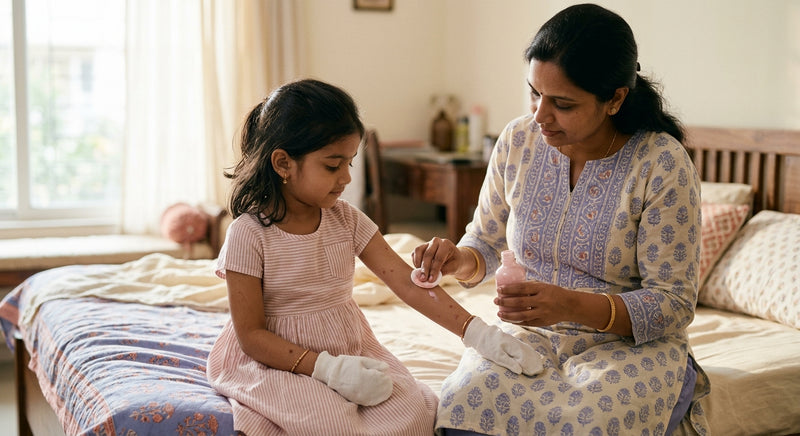
The best diaper rash cream does one main job: it puts a breathable barrier between your baby's skin and the wetness, friction and irritants inside a nappy. For that, look for a cream built around a protective barrier base (like zinc oxide, or a rich balm of butters and safe occlusives) plus gentle soothing ingredients — and free of fragrance, harsh preservatives and alcohol. Everything else on the label is detail.
But labels are confusing, especially at 2am when the redness is fresh and you're squinting at a tube in dim light. This guide walks through what each ingredient actually does, what to skip, and how to read a label in under a minute. It sits alongside our complete guide to diaper rash, which covers causes, prevention and treatment in full.
At a glance
- The hero job of any diaper cream is a breathable barrier — zinc oxide or a rich butter/occlusive base.
- Soothing extras like panthenol, oat and calendula help calm the look of redness.
- Skip fragrance, alcohol, parabens and harsh dyes on broken or sensitive skin.
- A baby's skin is 20-30% thinner than an adult's, so fewer, gentler ingredients are better.
- Apply to clean, fully dry skin — a thin, even layer at every change.
What does a diaper rash cream actually need to do?
A nappy is a warm, damp, closed environment. Urine raises the skin's pH, stool brings enzymes, and the diaper rubs with every wriggle. That combination breaks down the skin's natural barrier — and once the barrier is compromised, you see the classic red, sore patches.
So a good cream has two roles. First, protect: sit on top of the skin and keep moisture and irritants out. Second, soothe and support: calm the look of irritation and help the skin's own barrier recover. The ingredients below map onto those two jobs.
The barrier ingredients (the non-negotiable part)
This is the heart of the cream. You want at least one ingredient whose job is to form a physical, breathable shield.
Zinc oxide
The most studied barrier ingredient in diaper care. It's mildly astringent, sits on the skin as a protective layer and is gentle enough for most babies. Creams range from light (around 10%) to thick, paste-like formulas (20%+) for very sore skin. The trade-off: high-percentage zinc pastes can be hard to wipe off, so many parents leave a thin layer in place rather than scrubbing at each change.
Rich butters and safe occlusives
Shea butter, cocoa butter and similar plant butters, often combined with petrolatum or beeswax, create a softer, more spreadable barrier that also conditions dry skin. A well-formulated balm of butters and occlusives can protect and moisturise — useful if your baby's skin tends to be dry as well as rash-prone. This is the route a barrier balm takes rather than a stiff zinc paste.
The soothing ingredients (the helpful extras)
These don't replace the barrier, but they help calm the look of redness and support recovery.
- Panthenol (pro-vitamin B5) — helps skin feel soothed and supports hydration.
- Colloidal oat — a long-trusted, gentle soother for itchy, irritated skin.
- Calendula — a traditional botanical valued for comforting sensitive skin.
- Glycerin — a humectant that helps skin hold onto moisture without feeling heavy.
- Allantoin — helps skin feel smooth and comforted.
What to skip on a diaper rash cream
On broken or already-irritated skin, the wrong ingredient stings or makes things worse. For the diaper area specifically, be cautious of:
| Avoid / be cautious | Why |
|---|---|
| Added fragrance / parfum | A common irritant and sensitiser on thin baby skin. |
| Alcohol (denat.) | Drying and stinging on sore, broken skin. |
| Harsh dyes / strong colours | No skin benefit; another needless irritant. |
| Strong essential oils | "Natural" doesn't mean gentle; many sensitise. |
| Steroids or antifungals (unless prescribed) | These are medicines — only on a paediatrician's advice, not in a daily cream. |
That last point matters. If the rash isn't an ordinary friction-and-wetness rash, the cream alone won't fix it — and a fungal rash needs a different approach entirely. If you're unsure which you're dealing with, our explainer on how to tell diaper rash and a fungal infection apart walks through the tell-tale signs.
How to read a diaper cream label in under a minute
You don't need to memorise chemistry. Run this quick check next time you're in the pharmacy aisle:
- Is there a clear barrier ingredient high in the list (zinc oxide, or butters + occlusives)?
- Are the soothing extras gentle and recognisable (panthenol, oat, calendula, glycerin)?
- Is it fragrance-free and free of alcohol and harsh dyes?
- Is the overall list reasonably short?
- Does it say dermatologically tested and suit your baby's age?
If a cream passes those five, it's a sensible choice. The exact brand matters less than the fundamentals being right.
Why "made it itself" is worth checking
One thing parents rarely think to ask: who actually makes the cream? A lot of baby products are white-labelled — formulated and filled by a third party, then branded. When a company owns its formulation and manufacturing, it can stand behind exactly what's inside and test it properly. At Janma, our barrier balm is made in our own GMP-certified facility, the formula is dermatologically tested and in-vivo tested, and it's free of added fragrance. That's the kind of transparency worth looking for, whichever brand you choose.
How to apply it well (the part most people get wrong)
Even the best cream underperforms if applied to damp or unclean skin. A simple routine:
- Clean gently with water or a fragrance-free wipe; pat — don't rub.
- Let the skin air-dry fully. Trapped moisture under cream is what worsens rashes.
- Apply a thin, even layer over the whole nappy area at each change.
- For sore skin, leave the previous layer mostly in place rather than scrubbing it off.
- Build in a few minutes of nappy-free time daily so skin can breathe.
This routine matters as much as the cream itself. For the gentle, science-backed version of the full approach, see our piece on calming diaper-area redness — and in hot months, our summer prevention guide covers the heat-and-humidity angle specific to Indian weather.
When to see a doctor
Most ordinary diaper rashes settle within a few days with a good barrier cream and frequent changes. See your paediatrician if the rash doesn't improve in 3-4 days, looks like it's getting worse, has open or weeping skin, shows signs of infection (pus, blisters, spreading bright-red dots), or comes with fever or unusual fussiness. These can signal a fungal or bacterial infection that needs a prescription — a daily cream alone won't be enough. When in doubt, a quick check-up is always the safer call.
If you'd like a single product that brings the barrier butters and soothing ingredients together for sore, sensitive diaper-area skin, our Hydra Healing Moisturizing Balm is formulated for exactly that — fragrance-free, dermatologically tested, and gentle enough for newborn skin.
In summary
- Choose a cream built around a breathable barrier — zinc oxide or a rich butter-and-occlusive balm.
- Look for gentle soothers like panthenol, oat, calendula and glycerin as helpful extras.
- Skip fragrance, alcohol, harsh dyes and strong essential oils on sensitive diaper-area skin.
- Apply a thin, even layer to clean, fully dry skin at every nappy change.
- See a paediatrician if the rash blisters, weeps, spreads or doesn't improve in 3-4 days.
Frequently asked questions
What is the most important ingredient in a diaper rash cream?
A barrier ingredient. Zinc oxide is the most studied — it sits on the skin and shields it from wetness and irritants. A rich balm of plant butters and safe occlusives like shea and petrolatum does the same job while also moisturising. Whichever route the cream takes, that protective barrier should be high on the ingredient list; everything else is a helpful extra.
Is zinc oxide or a butter-based balm better for diaper rash?
Both work; they suit different skin. Thick zinc oxide pastes give a strong shield for very sore, weepy skin but can be hard to wipe off. Butter-and-occlusive balms are softer, easier to spread and also condition dry skin, so they suit babies whose skin is dry as well as rash-prone. Many parents keep both and choose by how the skin looks that day.
What ingredients should I avoid in a baby diaper cream?
On thin, often-broken diaper-area skin, avoid added fragrance, alcohol (denat.), harsh dyes and strong essential oils — all common irritants. Steroids and antifungals shouldn't be in a daily cream either; those are medicines for a doctor to recommend if needed. A short ingredient list built around a gentle barrier is far safer than a long one full of actives.
Can I use a regular moisturiser instead of a diaper cream?
Not as a substitute. A regular lotion hydrates but doesn't form the breathable barrier that keeps urine and friction off the skin, which is the whole point in a nappy. A dedicated barrier cream or balm is designed to stay put and protect. Some all-ages barrier balms do both — moisturise and shield — which is why they work well in the diaper area.
How often should I apply diaper rash cream?
Apply a thin, even layer at every nappy change — roughly every 2-3 hours, and always after a poo. The key is applying it to clean, fully dry skin; cream over trapped moisture can make a rash worse. For very sore skin, leave the previous layer mostly in place rather than scrubbing it off, and add a few minutes of nappy-free time daily so the skin can breathe.