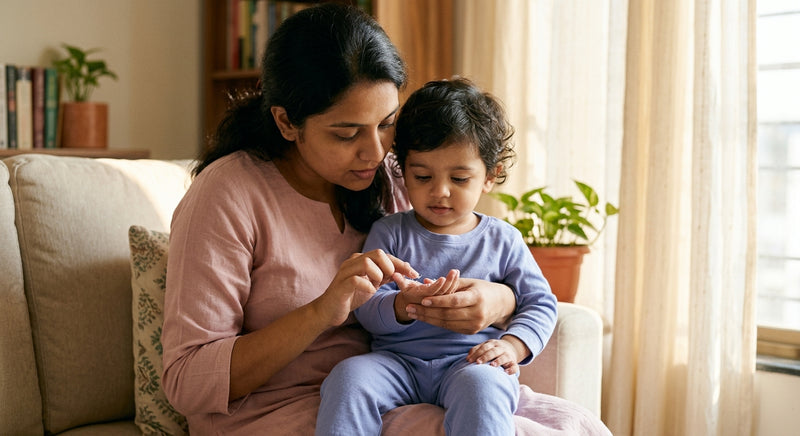
It comes up almost every week. A mother settles into the chair with a ten-month-old on her lap, two shiny new bottom teeth on show, and asks the thing she has been turning over since 1am. She has read that fluoride is essential. She has also read that fluoride is a poison. Both articles looked convincing. So: how much fluoride is actually safe for a baby in India?
For most Indian babies the answer is small and boring. A rice-grain smear of ordinary fluoride toothpaste (1000–1450 ppm), twice a day, from the day the first tooth appears. It is safe, and it is the single most protective thing you can do for those teeth. What you put on the brush matters far more than the number printed on the tube. There is one real exception in India, and it has nothing to do with toothpaste. It is groundwater with naturally high fluoride. That one is a genuine decision, and I will take you through it.
At a glance
- Start brushing the day the first tooth erupts. Not at age one. Not "when there are enough teeth".
- Under 3 years: a rice-grain smear. Age 3–6: a pea-sized blob. That is the entire dose rule.
- A "safe to swallow", fluoride-free baby toothpaste cleans, but it does not make enamel more decay-resistant. It is a taste, not a treatment.
- Safety is decided by the dose your baby swallows, not by the ppm on the box.
- If your drinking water is naturally high in fluoride (parts of Rajasthan, Andhra, Telangana, Karnataka and eastern Vidarbha), get it tested before you add any fluoride at all.
- Fluoride drops or tablets for babies: not something I prescribe, and not something you should buy on your own.
Why fluoride is even on the table for a baby
Milk teeth have thinner enamel than adult teeth. They decay faster. Once decay starts in a two-year-old it can move through a tooth in months rather than years. Fluoride works on the surface: it sits on the enamel and makes the crystal structure harder to dissolve in acid. A topical effect, nothing more mysterious than that. Which is exactly why the toothbrush is the delivery system that matters.
Every major paediatric dental body shifted its advice about a decade ago for the same reason. "Wait until they can spit" became "start fluoride toothpaste at the first tooth, in a tiny amount." Early childhood caries turned out to be far more common than the cosmetic risk of too much fluoride. If you want the fuller picture of how baby teeth develop and what to do at each stage, we have put it all together in our complete guide to baby oral care.
What "too much fluoride" actually looks like
The thing parents are frightened of has a name: dental fluorosis. Permanent teeth form under the gums from roughly birth to age six, and across those years a consistently high daily intake of fluoride can change how the enamel mineralises. It surfaces much later, as faint white flecks or chalky lines on the adult teeth. In its mild form it is cosmetic rather than a disease, and those teeth are actually slightly more decay-resistant. The severe form, the kind you see in India's endemic fluorosis belts, leaves enamel pitted and brown-stained. That comes from drinking high-fluoride water every day for years. A smear of toothpaste does not do it.
Here is how I put it to the mother in front of me. A rice-grain smear holds a very small quantity of fluoride. Even if your baby swallows all of it, twice a day, it sits well inside the safe range for a child's body weight. Now picture the way toothpaste appears in every advertisement: a fat ribbon lying along the whole length of the brush. That is several times as much. And that is the mistake I actually see in the chair, week after week. The quantity, never the tube.
Your four real options, with the marketing stripped out
Whatever the chemist's shelf looks like, you are choosing between four things.
| Option | What it really is | What it does for you | Where it falls short | Who it suits |
|---|---|---|---|---|
| Plain brush + water | No paste at all | Zero fluoride intake, and it still does the mechanical job of lifting plaque off the teeth | Nothing to defend the enamel against acid attack. You are cleaning, not strengthening | The first few days while your baby gets used to a brush. Not a long-term plan |
| Fluoride-free "safe to swallow" baby paste | Usually a flavoured gel, sometimes with xylitol or herbal actives | Genuinely harmless if swallowed. Makes brushing pleasant, which is worth a lot with a toddler learning the routine | Does not make enamel more decay-resistant. Most parents believe it does. Of everything in this article, that is the misunderstanding I meet most often | Babies in a confirmed high-fluoride water area, or where a dentist has advised avoiding fluoride |
| Low-fluoride paste (around 500 ppm) | Marketed for kids; a diluted version of the adult product | Less fluoride per gram, so a swallowed dose is smaller | Evidence for cavity protection below ~1000 ppm is weak. And parents compensate by squeezing out more paste, which defeats the whole point | Very few children, if I am honest. It is a compromise that satisfies neither goal |
| Standard fluoride paste (1000–1450 ppm), rice-grain smear | An ordinary family toothpaste, correctly dosed | The dose with real evidence behind it for protecting milk teeth. It is probably already in your bathroom | Needs your discipline on quantity, every single time. Adult mint can be too strong for a baby, so use a kids' version at the same ppm | Most Indian babies and toddlers |
What I would actually do
Hand me your ten-month-old and ask me to decide, and you get this: a kids' toothpaste with 1000–1100 ppm fluoride, a rice-grain smear, twice a day, starting tonight. Turn the tube over and find the ppm before you buy. Plenty of Indian children's toothpastes in bright cartoon packaging carry no fluoride at all, and the box rarely says so out loud. No ppm number printed anywhere? Assume there is none in the paste.
Only one thing would change my mind. Your water.
The India-specific question: what's in your water?
This is where imported advice stops being useful. Large parts of India sit on groundwater with naturally high fluoride: Rajasthan, Andhra Pradesh, Telangana, parts of Karnataka, Gujarat, Haryana, and closer to home for us in Nagpur, the eastern Vidarbha districts. BIS sets the acceptable limit for drinking water at 1.0 mg/L, with 1.5 mg/L as the outer permissible limit where no alternative source exists. A family drinking borewell water above that, day after day, is already carrying a substantial fluoride load before any toothpaste enters the picture.
So two households, two different answers.
- Municipal supply, or a borewell tested below 1 mg/L: use fluoride toothpaste as above. Nothing more is needed.
- Borewell or handpump water in a known fluorosis belt, untested: test it before you decide anything. The district public health laboratory and the state ground water board test water cheaply, and several private labs will do it for a few hundred rupees.
- Confirmed above 1.5 mg/L: the drinking water is now the problem, not the toothpaste. An RO unit, or an alternative source. Switch the baby to a fluoride-free paste and tell your dentist the number on the report.
- Using RO-filtered water: RO strips fluoride out almost entirely. Your toothpaste is doing more of the work here, so this is the last house that should be skipping it.
And one firm instruction from me. Do not start fluoride drops or tablets on your own. Supplements are the single route where a real overdose is possible. They are rarely justified in a country with this much fluoride already in the ground, and they belong with a dentist who has read your water report. Not on a pharmacy shelf, sitting beside the vitamin syrups.
How to actually brush a wriggling one-year-old
The dose rule is the easy half. The hard half is applying it to a baby who clamps his mouth shut the moment he sees the brush. What works:
- Sit on the floor with the baby lying down, his head in your lap, looking up at you. From there you can see every surface. Standing in front of a bathroom mirror with a toddler is a losing battle, and we go into the positions and tricks in detail in our guide to brushing a toddler's teeth when they won't sit still.
- Smear of paste across the bristles. Brush every surface, especially the line where tooth meets gum, and the biting surfaces of the back molars once they arrive.
- Wipe the excess foam out afterwards with a clean muslin cloth. A baby cannot spit. This is your substitute for spitting.
- Do not rinse with water afterwards, at any age. Rinsing washes away the thin film of fluoride that was about to do the actual work. Spit, or wipe, and leave it at that.
- The night brush is the one that counts. Saliva flow drops during sleep, so whatever is left sitting on the teeth stays there for hours.
- Keep the tube out of reach. A toddler who finds a sweet-tasting tube and eats a third of it is the one fluoride scenario worth a call to your doctor.
Toothpaste is only half of this, and I would rather say the other half plainly: a bottle of milk in the mouth at 2am will outrun any toothpaste on earth. Sugar frequency, and overnight milk above all, drives early childhood decay more than anything else does. If your baby still feeds through the night, read our piece on night feeds and tooth decay before you spend another evening worrying about ppm numbers.
When to see a dentist
Book an appointment if you notice any of these. Do not wait for pain, because decay in milk teeth is often painless until it is deep.
- Chalky white lines or dull white patches along the gumline, especially on the upper front teeth. This is the earliest sign of decay, and caught here it can often be arrested rather than drilled.
- Any brown or black spot, however small.
- Your water comes from a borewell in a fluorosis-prone district. Bring the test report if you have one.
- Mottling, pitting or brown staining on an older sibling's permanent teeth. That is a signal that the whole family's fluoride exposure needs looking at.
- Your child has swallowed a large quantity of toothpaste in one go, with nausea or stomach upset. Call your paediatrician the same day.
Ideally none of this is your first visit. A dental check-up is recommended by the first birthday, or within six months of the first tooth, and we have explained what that appointment actually involves in our guide to your baby's first dental visit. It is also the right place to put your specific water question. If the first tooth has not arrived yet, gum-wiping is where you begin, which we cover in cleaning baby gums before the first tooth.
The thing to hold on to
Fluoride safety for a baby comes down to a quantity you can see with your own eyes, not a chemistry you have to take on trust. Rice grain under three. Pea from three to six. Wipe, don't rinse. And find out what is in your water, because in India that one fact changes the answer more than any toothpaste on the shelf.
In summary
- Start brushing the day the first tooth appears, using a rice-grain smear of 1000-1450 ppm fluoride toothpaste twice a day.
- Switch to a pea-sized amount from age three to six; the quantity on the brush matters far more than the ppm on the tube.
- Fluoride-free baby pastes are harmless and pleasant but do not make enamel more decay-resistant, so don't mistake one for the other.
- Get borewell water tested if you live in a fluorosis-prone district, and treat water above 1.5 mg/L as the problem to fix first.
- Wipe away the foam instead of rinsing, protect the night brush, and never start fluoride drops or tablets without a dentist's advice.
Frequently asked questions
Is fluoride toothpaste safe for a 1-year-old baby in India?
Yes, in the right amount. A rice-grain smear of 1000-1450 ppm fluoride toothpaste, twice a day, is considered safe and is recommended from the first tooth. Even if your baby swallows the whole smear, the quantity is very small. The risk comes from large blobs used repeatedly over years, not from a correctly dosed smear. If your drinking water is naturally high in fluoride, discuss it with your dentist first.
What is the right amount of toothpaste for a baby or toddler?
Under three years, use a smear the size of a grain of rice. From three to six years, use a pea-sized amount. Squeeze the paste sideways across the bristles rather than along the brush head, so you can actually see how little is needed. The picture on the toothpaste box shows several times too much for a child.
Does fluoride-free baby toothpaste protect against cavities?
It cleans, but it does not strengthen enamel. Fluoride-free and safe-to-swallow pastes are pleasant, harmless and useful for teaching a child to accept brushing, but the cavity protection comes from fluoride. Many parents assume a premium baby toothpaste is doing more than it is. Check the back of the tube for a ppm number; if there isn't one, it has no fluoride.
My water comes from a borewell. Should I still use fluoride toothpaste?
Get the water tested first. Large parts of India, including Rajasthan, Telangana, Andhra Pradesh and eastern Vidarbha, have naturally high fluoride groundwater. BIS sets 1.0 mg/L as the acceptable limit and 1.5 mg/L as the outer permissible limit. Above that, your priority is changing the drinking water source, and a fluoride-free toothpaste makes sense. District public health labs test water cheaply.
Should I give my baby fluoride drops or tablets?
Not on your own. Fluoride supplements are the one route where a real overdose is possible, and they are rarely justified in India, where much of the groundwater already carries significant natural fluoride. They should only ever be prescribed by a dentist who has seen your child and knows your water fluoride level. Never buy them off a pharmacy shelf.
Should I rinse my baby's mouth with water after brushing?
No. Rinsing washes away the thin layer of fluoride that was about to do its work on the enamel. Since a baby cannot spit, simply wipe the excess foam away with a clean muslin cloth and stop there. The same rule holds for older children and adults: spit, don't rinse.