Sticky June night in Nagpur. The fan's on high and it's still not enough. Your baby's been grizzling for an hour, and when you lift the vest there's a spray of tiny red bumps across the neck and chest. Or a raw, angry patch exactly where the nappy sits. Or rough, itchy skin on the cheeks that keeps coming back no matter what you do. Same panic every time — but three completely different rashes. And the care that helps one can genuinely make another worse.
Fastest way to tell them apart: look at where the rash is, and how fast it changes. Heat rash sits where sweat pools — neck, chest, skin folds — and fades within a day of cooling down. Diaper rash stays inside the nappy zone. Eczema turns up on cheeks, elbows and knees, itches, and keeps coming back over weeks. That's the 30-second version. Now here's how to be sure, and what to actually do at 2am.
At a glance
- Location is your first clue: sweaty folds = heat rash, nappy zone = diaper rash, cheeks/joints = eczema.
- Speed is your second clue: heat rash clears in hours-to-a-day once cool; diaper rash improves with dry, open changes; eczema is a slow, repeating cycle.
- Heat rash needs less product and more airflow — thick creams can trap heat and make it worse.
- Diaper rash needs a barrier; eczema needs a moisturiser that supports the skin barrier.
- See a doctor for blisters, pus, fever, spreading redness, or a rash that won't settle in 3-4 days.
Where is the rash — and does that tell me what it is?
Mostly, yes. Location tells you more than anything else, because each of these rashes has a favourite spot.
Heat rash (prickly heat) lives where sweat gets trapped and can't evaporate: the neck creases, the upper chest and back, the folds of the armpits and groin, around the waistband. On a swaddled or over-layered baby it shows up on the covered skin first. So if your little one has been napping in a room with no AC, or bundled into a carrier for a mid-afternoon errand in the heat, and the bumps are sitting in those sweaty zones — that's heat rash. We go deeper into it in our guide to prickly heat in babies and gentle relief.
Diaper rash stays inside the nappy footprint — the buttocks, the genitals, the inner thighs, the lower belly. One reliable tell: classic irritant diaper rash usually spares the deep skin creases, because the folds don't touch wee and poo as much. If the redness is bright, sits on the raised surfaces, and stops where the nappy stops, it's diaper rash.
Eczema ignores the nappy entirely. In babies it favours the cheeks, the forehead, the outer arms and legs; as they grow it moves into the creases of the elbows and behind the knees. It's dry, rough, sometimes flaky, and — the real giveaway — it itches. A baby with eczema rubs and scratches. A baby with heat rash is more restless-uncomfortable than itchy.
What does each one actually look like, side by side?
This is the comparison I wish more parents had before their first 2am WhatsApp to the family doctor. And remember, babies come in every skin tone — on deeper Indian skin, "redness" often reads as a darker, dusky or purplish flush rather than bright pink. So trust texture and location as much as colour.
| Heat rash | Diaper rash | Eczema | |
|---|---|---|---|
| Where | Neck, chest, back, skin folds — anywhere sweaty | Nappy zone only — bottom, genitals, thighs | Cheeks, scalp, outer arms/legs; later elbow & knee creases |
| Looks like | Clusters of tiny clear or red pinhead bumps | Flat or raised red/dusky, sore-looking patches | Dry, rough, flaky patches that may weep if scratched |
| Itch? | Prickly, mildly itchy | Sore and stingy, not usually itchy | Very itchy — the main feature |
| Timing | Comes on fast in heat; clears within a day of cooling | Builds over hours of a wet/dirty nappy | Comes and goes over weeks; flares and settles |
| Main trigger | Heat, humidity, over-layering, blocked sweat | Wetness, friction, wee/poo on skin | Dry skin, a weak barrier, irritants, sometimes family history |
And here's the catch: a baby can have two at once. Eczema-prone skin often flares in the heat, and a sweaty nappy area can brew up heat rash and diaper rash together. When the picture is mixed, deal with the most obvious cause first — cool the baby, change the nappy — then look again in a day.
What do I actually do tonight for each?
This is where getting it right matters most, because the fix for one rash is the wrong move for another. The mistake I see most often: reaching for a thick cream on heat rash. Heat rash needs the skin to breathe and cool. Piling on an occlusive balm just traps more heat.
If it's heat rash
- Move your baby somewhere cool — a fan or AC room. Cooling the skin is the actual treatment.
- Strip back a layer. Loose, single-layer cotton, nothing synthetic against the skin.
- A quick lukewarm (not cold) bath, then pat — don't rub — fully dry, especially the folds.
- Leave the skin bare and open where you can. Skip heavy creams on active heat rash.
- It should visibly settle within a day. If it doesn't, rethink the diagnosis.
If it's diaper rash
- Change more often — a wet nappy is the whole problem. Aim for every 2-3 hours and straight after a poo.
- Clean gently with warm water and a soft cloth; let the area air-dry for a few minutes.
- Apply a protective barrier layer at each change to keep wetness off the skin.
- Give nappy-free floor time on a towel. Nothing else works quite as well.
For the how and why of this, our Janma Journal and diaper-care guides walk through the full change routine. A barrier that also comforts sore skin earns its place here — Janma's Hydra Healing Balm is formulated for exactly this diaper-area redness (in our in-vivo study, testers saw visible improvement in the look of diaper-area redness in 7 days, used twice daily).
If it's eczema
- Moisturise generously and often — a weak, dry barrier is the root of eczema, so the fix is consistent hydration.
- Bathe short and lukewarm with a gentle, fragrance-light wash; moisturise within 3 minutes of patting dry, while skin is still damp.
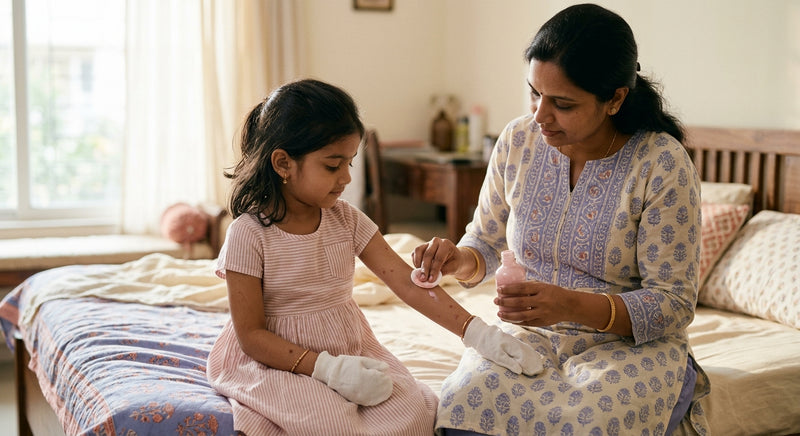
- Keep nails short and consider soft cotton mitts at night to limit scratching.
- Look for a moisturiser that supports the skin barrier, not just sits on top.
Because eczema is a barrier problem, ingredients matter more here than in any other rash. This is where my formulation side gets fussy: I want humectants to draw in water, emollients to smooth, occlusives to seal — plus barrier-supporting actives. Janma's Hydra Healing Balm was built around exactly this; in a lab study it helped support the skin barrier (increased Keratin-10 and Filaggrin expression), and in-vivo testers saw visibly calmer skin in as little as 1 day. For a fuller walk-through of an eczema care routine, our baby eczema guide in the Journal breaks it down step by step.
How do I know it's eczema and not "just" a heat rash that keeps coming back?
This is the question I get most, and the answer is the pattern over time. A heat rash is an event. It flares when it's hot and clears when things cool down, every single time. Eczema is a tendency. It comes and goes on a slower cycle, keeps returning to the same dry patches, and it's there in spirit even when it looks calm — the skin stays dry and rough between flares.
Three signs it's leaning towards eczema: the skin is dry and rough even where it isn't red; the itch is the dominant feature and wrecks sleep; and it keeps coming back to the cheeks or the crook of the elbows and knees rather than the sweaty folds. A family history of eczema, asthma or allergies tips the odds further. If cooling your baby down fixes it completely and it never returns, it was heat rash. If you're moisturising and it still cycles, it's worth a paediatrician's eye.
When to see a doctor
- Blisters, open sores, pus, yellow crusting, or a foul smell (possible infection).
- Fever, a baby who seems unwell or unusually sleepy, or spreading, hot, bright redness.
- A diaper rash with broken or bleeding skin, or one that won't settle in 3-4 days of good care.
- Eczema that's severe, weeping, keeping your baby from sleeping, or not improving with moisturising.
- Any rash in a newborn under a month that you're unsure about — get it checked early.
Telling these three apart isn't about being a dermatologist at 2am. It comes down to two things — where the rash sits and how fast it changes — and then matching what you do to the cause. Cool a heat rash. Dry-and-barrier a diaper rash. Moisturise eczema, and keep at it. And when skin just needs comforting and barrier support across all three, a gentle, dermatologically tested balm is a calm, reliable place to start.
In summary
- Check location first: sweaty folds mean heat rash, the nappy zone means diaper rash, and cheeks or joint creases mean eczema.
- Cool a heat rash with airflow and lighter clothing — skip thick creams, which can trap heat and worsen it.
- Treat diaper rash with frequent changes, gentle drying, nappy-free time and a protective barrier layer.
- Manage eczema with consistent moisturising and a barrier-supporting formula, since dry skin is the real cause.
- See a paediatrician for blisters, pus, fever, broken skin, or any rash that won't settle in 3-4 days.
Frequently asked questions
How can I tell heat rash from diaper rash?
Location is the clue. Heat rash appears where sweat gets trapped — the neck, chest, back and skin folds — and clears within a day of cooling your baby down. Diaper rash stays inside the nappy zone (bottom, genitals, thighs), looks sore rather than bumpy, and improves with more frequent changes, gentle drying and a barrier layer at each change.
Can heat rash and eczema look the same?
They can overlap, but two things separate them. Heat rash is a burst of tiny prickly bumps in sweaty areas that clears once it's cool. Eczema is dry, rough, very itchy skin on the cheeks, arms or joint creases that comes and goes over weeks and stays dry even between flares. If cooling fixes it completely, it was heat rash; if it keeps cycling despite moisturising, think eczema.
What should I not do for baby heat rash?
Don't slather on thick creams or heavy balms — heat rash needs skin to breathe and cool, and occlusive products can trap more heat and make it worse. Avoid synthetic fabrics, over-layering, and hot rooms. Instead, move your baby somewhere cool, remove a layer, give a lukewarm bath, pat the folds fully dry, and leave the skin open where you can.
Does diaper rash itch like eczema does?
Not usually. Diaper rash feels sore, stingy and warm rather than itchy — it's an irritant reaction to wetness and friction. Eczema's defining feature is the itch: babies rub and scratch, and it disturbs sleep. If your baby is scratching skin outside the nappy area, especially the cheeks or joint creases, that points to eczema rather than diaper rash.
When should I take my baby's rash to a doctor?
See a paediatrician if you notice blisters, pus, yellow crusting or a bad smell, a fever or an unwell baby, spreading hot redness, or broken, bleeding skin. Also go if a diaper rash hasn't settled in 3-4 days of good care, or eczema is severe, weeping or stopping your baby sleeping. For any rash in a newborn under a month, get it checked early to be safe.
Which rash needs moisturiser and which needs a barrier cream?
Eczema needs a moisturiser that supports the skin barrier, applied generously and often, because dry, weak skin is the root cause. Diaper rash needs a protective barrier layer to keep wetness off sore skin at each change. Heat rash needs neither in bulk — it mainly needs cooling and airflow, so keep products light and let the skin breathe.