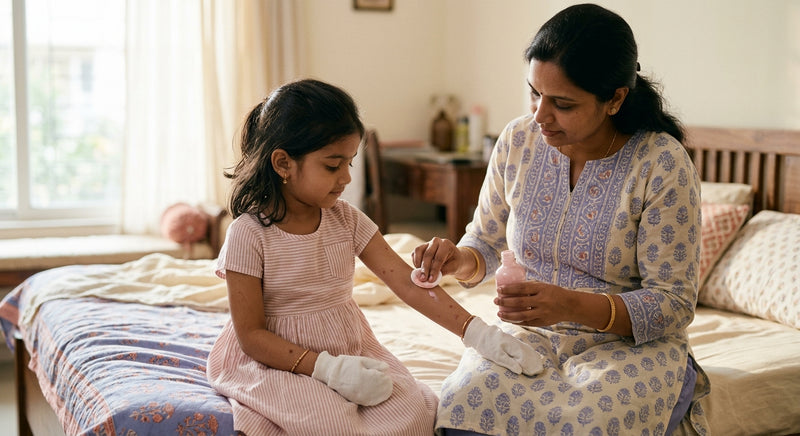
You're home. Somewhere between the third feed and the first round of relatives, you notice your baby's skin doing things nobody mentioned at the hospital — peeling at the ankles, blotchy patches that come and go, tiny white dots across the nose. So here's the short answer: in the first week at home, newborn skin needs almost nothing. Sponge baths every two or three days until the cord stump falls off, a fragrance-free moisturiser only where the skin looks dry, and firm protection from too many products and too much washing.
I say this as someone who formulates baby skincare for a living: the best week-one routine is mostly a list of things you don't do. A newborn's skin is still finishing a job it started in the womb — building its own barrier — and our role for these seven days is to stay out of the way while it works.
At a glance
- Sponge baths only, 2–3 times a week, until the umbilical cord stump falls off and dries.
- Peeling, blotchiness and tiny white spots (milia) are normal in week one — most settle without any product.
- Moisturise only visibly dry patches, with a fragrance-free formula; keep everything away from the cord stump.
- Say no to antiseptic soaps, talc, kajal and ubtan scrubs this week — however lovingly they're offered.
- Fever, spreading yellowness, pus at the cord or blistered skin mean a paediatrician visit, not a cream.
This piece is part of our newborn-skin-basics series — if you want the full picture from birth through the early months, start with our complete guide to newborn skin basics, then come back here for the week-one detail.
Why does my newborn's skin look nothing like the babies in ads?
Because ad babies are usually three months old. A real seven-day-old has just moved from nine months in warm amniotic fluid to dry air, ceiling fans and, in most Indian cities, hard water. The skin responds visibly. Flaking and peeling — especially at the wrists, ankles and belly — typically shows up between day three and day seven. That's the top layer shedding on schedule, not dryness you caused. Babies born past their due date often peel more, and it still means nothing is wrong.
Colour does strange things too. Hands and feet can look bluish when the room is cool; a crying baby turns beet red from head to toe; some babies show a lacy, marbled pattern for a few minutes after a nappy change. Most of this is a brand-new circulation system calibrating itself — we've written a full guide on which newborn skin colour changes are normal if you want to match what you're seeing. And those tiny white dots on the nose and cheeks? Almost always milia — small blocked keratin spots that clear on their own. They need no scrubbing, no cream, nothing. Please don't squeeze them; I know the temptation is real.
Your one job here is observation, not correction. Take a photo in daylight every couple of days. If something is spreading, oozing or clearly bothering the baby, that's a doctor question. If it's just sitting there looking odd, it's almost always week-one skin being week-one skin.
Should I bathe my baby in the first week at home?
Not in a tub — not yet. Until the umbilical cord stump falls off (usually between one and three weeks after birth), stick to sponge baths: a bowl of comfortably warm water, two soft cotton washcloths, and a warm, draught-free room. Face first with plain water, then the body, then the nappy area last. Work in sections and keep the rest of the baby wrapped, because a wet newborn loses heat surprisingly fast.
Two or three sponge baths a week is enough. A newborn doesn't sweat much or crawl through anything; over-washing strips the very lipids the skin is trying hard to organise. In many Indian homes there's warm, well-meaning pressure for a full daily bath with oil from day one — I understand the love behind it, and the tradition is worth keeping. It just starts a little later. Week one is the week to postpone, politely and firmly.
Does newborn skin need moisturiser or malish oil yet?
Only where it looks dry — and less than you'd think. A baby's skin is 20–30% thinner than an adult's, which means it loses moisture faster but also takes in whatever you apply more readily. That's why formulators get strict about week one: fragrance-free, no essential oils, and an ingredient list short enough to read aloud without stumbling.
If the peeling patches look tight or cracked, a thin layer of a bland, baby-specific moisturiser once or twice a day is fine and often kind. What to look for on the label: shea or kokum butter, cold-pressed plant oils, colloidal oat — emollients that sit on the skin and support the barrier rather than perfume it. This is the thinking behind our Hydra Healing Moisturizing Balm: in a lab study it increased Keratin-10 and Filaggrin expression — two proteins a baby's skin uses to build its own barrier. But the first rule stands: unbroken, comfortable skin needs no product at all in week one. When you do reach for the jar, our step-by-step guide on how to moisturise a newborn safely covers the how and the how-much.
As for malish: gentle strokes with clean, dry hands are lovely from day one — that's touch, and touch is good for both of you. Full-body oil malish is best saved for after the cord stump falls off, and every product stays away from the stump until then. When you do begin, pick a single plain, cold-pressed oil rather than a perfumed blend. Up to around 48.6% of babies experience atopic-type skin issues at some point, and added fragrance is the most avoidable trigger in the room — one you can strike off tonight just by reading the label.
What should a week-one skincare kit actually contain?
Far less than the gift hampers suggest. Here's the full list — everything on it earns its place:
- Two soft cotton washcloths and a hooded towel — your washing tools for the week.
- Cotton squares and plain lukewarm water for the face and nappy area.
- One fragrance-free baby moisturiser or balm, used on dry patches only.
- A barrier balm for the nappy area at the very first hint of redness — thin layer, every change.
- Soft, breathable cotton clothes, washed in a mild detergent and rinsed twice.
Notice what's missing: soap. A newborn doesn't need a cleanser in week one — plain water does the job on skin this new. When you do shop for a wash for the tub-bath weeks ahead, look past the front of the pack and check who actually makes it. I'll admit my bias here, since we manufacture our own formulations in our GMP-certified facility in Nagpur — but the principle holds for any brand you choose: a company that owns its formulation can tell you exactly what's in the bottle, why it's there, and what was deliberately left out. If a brand can't answer those three questions, keep walking.
When to see a doctor
Most week-one skin changes are normal, but a few things deserve a same-day call to your paediatrician:
- Yellowness (jaundice) that is deepening or spreading down to the tummy, palms or soles.
- Any fever in a baby under a month old — that is always a doctor visit, never a wait-and-watch.
- Redness, pus, bleeding or a bad smell around the cord stump.
- Fluid-filled blisters, broken or oozing skin, or any rash in a baby who seems unwell or unusually sleepy.
- Your gut saying something is wrong. In week one, that instinct is data — use it.
The first week asks very little of you on the skincare front, and that's the quiet relief of it: warm water, soft cloth, watchful eyes, and the confidence to say "not yet" to almost everything else. And when the cord stump falls off and real bath time begins, a tear-free, low-lather formula like our Head to Toe Baby Foam Wash is the one gentle upgrade worth having ready on the shelf.
In summary
- Stick to sponge baths every two to three days with plain lukewarm water until the umbilical cord stump falls off and dries.
- Expect peeling, blotchy colour changes and tiny white milia in week one — most settle on their own without any product.
- Moisturise only visibly dry patches with a thin layer of a fragrance-free baby formula, and keep everything away from the cord stump.
- Skip antiseptic soaps, talcum powder, kajal and ubtan scrubs in the newborn weeks, however warmly they're offered.
- Call your paediatrician the same day for spreading jaundice, any fever, pus or smell at the cord, or blistered, broken skin.
Frequently asked questions
Can I apply cream or oil on my newborn in the first week?
Only where the skin looks visibly dry or is peeling tightly. Use a fragrance-free baby moisturiser in a thin layer once or twice a day, and keep all products — including massage oil — away from the umbilical cord stump. Comfortable, unbroken skin needs nothing at all in week one; watching and waiting is more useful than applying.
When should a newborn's first proper bath be?
Wait until the umbilical cord stump falls off and the area has dried, usually one to three weeks after birth. Until then, sponge baths two to three times a week with plain lukewarm water are enough. Keep the room warm and draught-free, the water around 37–38°C, and the whole wash under ten minutes so your baby doesn't get cold.
Is it normal for a newborn's skin to peel in the first week?
Yes, very. Peeling around the wrists, ankles and belly between day three and day seven is the top layer of skin shedding as your baby adjusts from amniotic fluid to air. It usually clears on its own within a couple of weeks. A thin layer of fragrance-free moisturiser can comfort tight-looking patches, but no treatment is needed.
Can I start malish (baby massage) in the first week?
Gentle strokes with clean, dry hands are fine from day one and are wonderful bonding for you both. Save full-body oil malish for after the cord stump has fallen off, and keep oil well away from the stump until then. When you begin, choose a single plain, cold-pressed oil rather than a perfumed blend — fragrance is the easiest irritant to avoid.
Should I use kajal, talcum powder or antiseptic soap on my newborn?
No to all three in the newborn weeks. Traditional kajal can contain lead, talcum powder is a breathing risk near a baby's face, and antiseptic soaps are far too harsh for skin that is 20–30% thinner than an adult's. If relatives offer them lovingly, blame your paediatrician for the refusal — it works, and it keeps the peace.