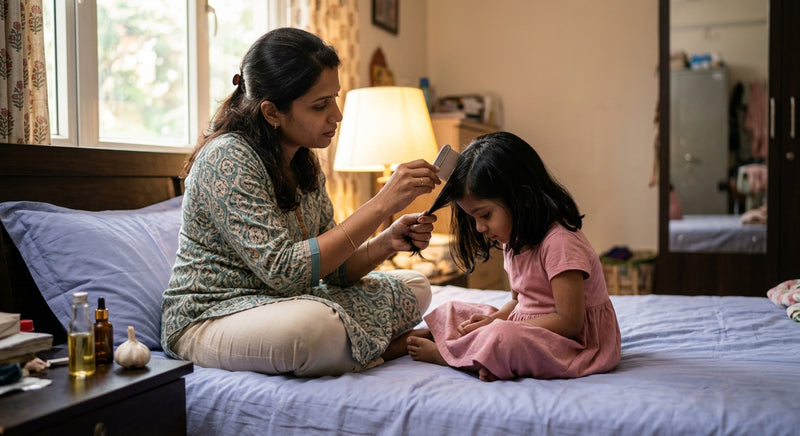
Her hair looked fine at 8am. By 4pm there's a knot the size of a marble sitting at the nape of her neck, and she's crying before you've even touched it. If that's your evening, the tangling isn't bad luck and it isn't her hair “being difficult”. Six things cause it. Each one has a different fix.
Children's hair tangles more than yours because the strands are finer, the cuticle is thinner, and the ends are drier than the roots. On top of that, kids spend all day manufacturing friction — pillows, school bags, car seat headrests, ponytail elastics. Sort out the friction and the moisture at the ends, and most of these knots never form.
At a glance
- Tangles are a friction + dryness problem, not a dirt problem — more shampoo usually makes it worse.
- Hair tangles when the cuticle scales lift and catch on the neighbouring strand. Smooth cuticle = fewer knots.
- Hard water (most of urban India) leaves mineral deposits that roughen the cuticle — this is a huge, under-recognised cause.
- Detangle bottom-up, in sections, on damp conditioned hair — never dry, never top-down.
- A satin pillowcase and a loose braid at bedtime removes a large share of the morning knots for free.
Why does my child's hair tangle so much more than mine?
Three structural reasons, and they compound.
Start with diameter. A child's hair shaft is finer than an adult's, and finer strands bend more easily. A knot needs a strand to bend back on itself — thin hair does that with almost no provocation.
Then the cuticle. Hair's outer layer is overlapping keratin scales, like roof tiles pointing down the shaft. Lying flat, two strands slide past each other. Lifted — by dryness, alkaline pH, mineral deposits, rough towelling — they catch. That catching is the tangle.
Third, the ends are old. Hair sitting on a 6-year-old's shoulders has been growing for three or four years and has survived hundreds of washes. The root is fresh. The last four inches are weathered, more porous, much rougher. Which is exactly why knots cluster at the bottom and at the nape, and almost never at the crown.
What are the 6 actual causes — and the fix for each?
1. Dryness at the mid-lengths and ends
This is the one I see most. Sebum from the scalp doesn't travel down a child's hair the way it does on shorter or straighter hair, so the ends run dry — and dry keratin is stiff and rough.
The fix: conditioner on the bottom two-thirds, every single wash. Not the scalp. The ends. Most parents skip conditioner on kids entirely, assuming it's a grown-up product, and correcting that changes more than anything else here. Give it a full minute before you rinse — the cationic conditioning agents need contact time to bind to the damaged, negatively-charged spots on the cuticle.
2. Friction while they sleep
Eight hours of a head rotating on a cotton pillowcase. Cotton is relatively high-friction and absorbent: it grips the hair and pulls moisture out of it at the same time.
The fix: a satin or silk pillowcase, plus a loose braid or a low ponytail held with a soft scrunchie. Free, thirty seconds, and for long-haired kids it's the highest-return change on this list. Keep it loose, though — tight overnight styles cause their own breakage at the hairline.
3. Hard water
Delhi, Chennai, Hyderabad, Jaipur, Nagpur, most of Gujarat — your tap water carries dissolved calcium and magnesium. Those minerals deposit on the shaft and react with the fatty acids in cleansers to form an insoluble film. Hair ends up rough, straw-like, squeaky even when it's clean. Parents usually describe it to me as “her hair just won't stay smooth”.
The fix: a final rinse with stored or filtered water. Keep a mug of it beside the bucket and pour it over as the last step. A shower filter does the same job if you use a shower. And be reliable with conditioner — that cationic film physically sits between the mineral roughness and the neighbouring strand.
4. Over-washing with the wrong cleanser
Harsh anionic surfactants at an alkaline pH swell the shaft and lift the cuticle. Hair is happiest around pH 4.5–5.5. Wash a child's hair daily with a high-foam, high-pH cleanser and you get squeaky-clean, maximally-tangled hair.
The fix: two to three washes a week for most school-age kids — more in peak summer, more after swimming — with a mild, tear-free, pH-appropriate shampoo. Look for gentle surfactant systems: coco-glucoside, decyl glucoside, sodium cocoyl isethionate. Not a run of sulphates high on the label. Janma's Loving & Balancing Shampoo is built on that kind of mild, tear-free base for exactly this reason.
5. Towel-drying and rough handling
Rubbing wet hair vigorously with a terry towel is the fastest way to lift a cuticle there is. Wet hair is at its most vulnerable — the keratin structure is temporarily swollen and its ability to resist stretching drops sharply.
Do this instead: squeeze, don't rub. Press the water out with an old cotton T-shirt or a microfibre towel. Then detangle while it's still damp and slippery with conditioner. Never bone dry. Never soaking wet either — that's when it snaps most easily.
6. Wind, sweat and the school day
Open hair on a scooter. A school bag strap rubbing the same spot for six hours. Sweat drying and stiffening the shaft through a Nagpur May — sweat is salty, and as it evaporates it leaves salt crystals that roughen the surface.
The fix: hair tied back for school and travel. A braid, not a tight high pony that stresses the hairline. And on the really sweaty days, a plain water rinse in the evening is plenty. You don't need to shampoo.
How do I actually get a bad knot out without a fight?
The order matters more than the tool. Most parents start at the top with a fine comb, which drags every tangle in the length down into one dense mass at the ends. Work the other way.
- Apply conditioner or a detangling spray to damp — not dripping — hair, focused on the bottom two-thirds.
- Divide into 3–4 sections and clip them. One section at a time is the difference between five minutes and twenty.
- Hold the section firmly a few inches above the tangle so the pull never reaches the scalp. This removes almost all the pain.
- Start at the very ends. Comb the last two inches clear, then move up an inch. Repeat.
- Wide-tooth comb or a flexible detangling brush. Never a fine-tooth comb on knots.
- Stubborn knot? Fingers first. Add a drop more conditioner and give it 30 seconds.
- Finish with a light oil or leave-in on the ends only.
Does conditioner actually do anything, or is it just for adults?
Damaged hair carries a net negative charge on its surface. Conditioners work on cationic — positively charged — ingredients (behentrimonium chloride, cetrimonium chloride, or gentler esterquats on the label) that are drawn to precisely those damaged spots and deposit there. They lay the lifted scales back down and drop the friction between strands dramatically. That friction drop is the entire mechanism of detangling. The fatty alcohols — cetyl, cetearyl — give slip and body; despite the name, they're not the drying kind of alcohol.
So no, it isn't a cosmetic nicety for kids with long hair. It's the functional half of the routine. Shampoo removes. Conditioner is what makes the comb move.
| Hair type | Where tangles form | What to change first |
|---|---|---|
| Fine and straight | Nape of the neck, under the ponytail | Satin pillowcase + bedtime braid |
| Thick and wavy | Mid-length, all over | Conditioner every wash, sectioned detangling |
| Curly / coily | Ends, and wherever curls interlock | Detangle only while wet with conditioner in, fingers first |
| Any type, hard water | Everywhere; feels rough all over | Filtered final rinse + conditioner |
What about oiling — does malish help or make it worse?
Both, depending on when you do it.
Before a wash, oiling earns its place. Coconut oil has a straight-chain structure and low molecular weight that lets it penetrate into the hair shaft, and there's decent evidence it reduces the protein loss that happens during washing. Warm a little, work it through the scalp and lengths, leave it 30–60 minutes, wash it out. The traditional practice holds up; the science backs it.
It goes wrong when heavy oil goes onto already-tangled dry hair, which then gets plaited tight for the day. The oil weighs everything down and glues loose shed strands into the mass. Come wash day, it all comes out as one felted lump. So: detangle first, oil second, and don't leave it in for days.
When to see a doctor
Tangling itself is a cosmetic issue, not a medical one. But see your paediatrician or a dermatologist if you notice: sudden patchy hair loss or bald spots; hair that breaks off at the same length across the head; persistent scalp itching, flaking or sores; visible nits or lice; or hair that has abruptly changed in texture, become brittle, or is coming out in noticeably larger quantities than usual. A child who pulls their own hair out repeatedly also needs a proper assessment rather than a hair product.
The routine that stops tangles forming
Run this for two weeks before you judge it. The ends need time to recover.
- Wash 2–3 times a week with a mild, tear-free shampoo. Not daily.
- Conditioner on the bottom two-thirds every single wash. One full minute, then rinse.
- Final rinse with stored or filtered water if your area has hard water.
- Squeeze dry with a T-shirt. No rubbing.
- Detangle damp, sectioned, from the ends upward.
- Loose braid at night, satin pillowcase if you can.
- Trim the ends every 8–12 weeks — split ends catch on each other and no product fixes that.
If you add one thing to your child's bath shelf this week, make it a proper conditioner — our Rejuvenating & Detangling Conditioner was formulated for exactly this job: slip through the mid-lengths and ends, so the comb moves without a fight.
In summary
- Tangles come from friction and dryness, not dirt — washing more often usually makes them worse.
- Use conditioner on the bottom two-thirds of the hair at every wash and leave it on a full minute.
- Detangle damp, in sections, starting at the ends and working upward with a wide-tooth comb.
- If your tap water is hard, finish with a stored or filtered water rinse to stop mineral roughness.
- A loose bedtime braid and a satin pillowcase prevent a large share of morning knots for free.
Frequently asked questions
Why does my child's hair tangle so badly overnight?
Eight hours of head movement on a cotton pillowcase creates constant friction, and cotton also absorbs moisture from the hair. Dry, roughened strands catch on each other and knot, usually worst at the nape. A satin or silk pillowcase plus a loose braid or soft-scrunchie ponytail at bedtime removes a large share of morning tangles and takes half a minute to do.
Should I detangle my child's hair wet or dry?
Damp, with conditioner or a detangling spray in it. Dry hair has no slip, so the comb drags and snaps strands. Soaking-wet hair is at its weakest and stretches then breaks. Towel-squeezed damp hair is the sweet spot. Work in sections from the ends upward, holding the hair above the knot so the pull never reaches the scalp.
Does hard water really cause tangled hair?
Yes, and it's badly under-recognised in India. Calcium and magnesium in tap water deposit on the hair shaft and can form an insoluble film with cleanser residues. That roughens the cuticle so strands grip each other instead of sliding past. A final rinse with stored or filtered water, plus reliable conditioner use, makes a noticeable difference within a couple of weeks.
How often should I wash my child's hair to reduce tangling?
Two to three times a week suits most school-age children, more during peak summer or after swimming. Frequent washing with a harsh, high-pH cleanser swells the shaft and lifts the cuticle, which is precisely what makes hair catch and knot. Choose a mild, tear-free shampoo and always follow with conditioner on the mid-lengths and ends.
Is coconut oil good or bad for tangled hair?
Good before a wash, risky after. Applied 30 to 60 minutes pre-shampoo, coconut oil penetrates the hair shaft and helps reduce wash-related protein loss. Applied heavily to already-tangled dry hair and left for days, it weighs strands down and mats shed hairs into the length. Detangle first, then oil, then wash it out reasonably soon.
What kind of comb is best for a child's tangles?
A wide-tooth comb or a flexible detangling brush with staggered, forgiving bristles. Fine-tooth combs force every knot downward into a denser mass and cause most of the pain and breakage parents see. Fingers first on a stubborn knot, then the wide-tooth comb from the ends upward, an inch at a time, is the sequence that actually works.