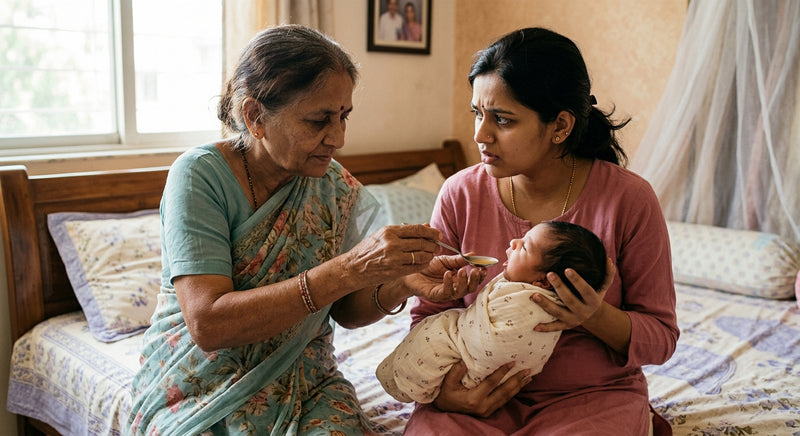
It's 11pm. You're standing in the kitchen, and your baby's cheeks and the backs of their knees have gone red and rough again. Your mother-in-law says rub a little ghee. The neighbour swears by a neem-and-turmeric paste. The chemist handed you a tube of cream this morning. So which one is actually safe?
The honest answer, first: for mild baby eczema, it isn't either-or. A plain, fragrance-free moisturizing cream is the daily backbone — it holds water in the skin — and a few ayurvedic practices, like a gentle oil malish on intact skin, can sit happily alongside it. What I'd steer you away from are raw pastes, lemon, camphor, and anything at all on broken or weeping skin. Eczema is a barrier problem. Whatever you do, the goal is the same three things: calm the itch, lock in moisture, don't irritate.
At a glance
- Eczema (atopic dermatitis) is a skin-barrier and inflammation issue, not dirt or a fungal infection.
- A fragrance-free moisturizer applied generously, twice a day, is the single most useful thing you can do.
- Some ayurvedic steps are fine on intact skin (plain oil malish); raw pastes, neem, turmeric, camphor and lemon on inflamed skin often make it worse.
- Indian weather changes the rules — dry winter and hard water flare it; sweat and prickly heat in summer mimic it.
- Weeping, crusting, fever or skin that's spreading fast means see a paediatrician, not a stronger home remedy.
What is baby eczema, really?
The skin's outer barrier is leaky and over-reactive. Water escapes too easily. Irritants and allergens get in too easily. The skin answers back with redness, dry patches, and that maddening itch. It likes the cheeks, the scalp, the backs of the knees, the inside of the elbows. And it's common — up to around 48.6% of babies have atopic-type skin issues at some point. If you're dealing with this, you're in very ordinary company.
Two things matter for the ayurveda-vs-cream question. First, a baby's skin is 20-30% thinner than an adult's, so it absorbs and reacts to whatever you put on it far more readily than yours does. Second, eczema skin is already inflamed — so anything sharp, fragrant or acidic lands much harder than it would on calm skin.
Ayurvedic remedy vs cream: the honest comparison
Here's what each option actually does on the skin, and where the safety catch hides.
| Approach | What it can do well | The safety catch |
|---|---|---|
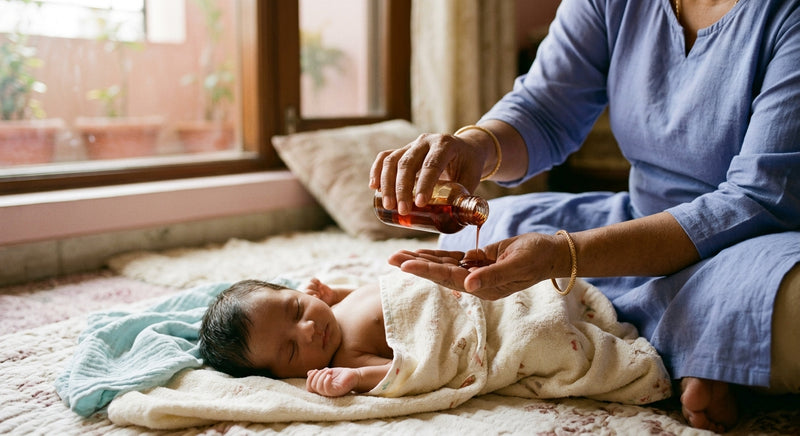
| Plain oil malish (coconut, sesame) | Acts as an occlusive — slows water loss, soothes dry, intact skin; the touch itself is calming | Only on unbroken skin. Cold-pressed, plain, patch-tested. Stop if it stings or reddens. Not a substitute for a moisturizer on active eczema |
| Ghee | Rich and occlusive; tradition runs deep here | Heavy and food-based — can trap heat and sweat in Indian summers, and may not suit milk-allergic babies. Patch-test, use sparingly |
| Besan / ubtan paste | Mild exfoliation on healthy skin | Abrasive on inflamed eczema — friction is the last thing an itchy barrier needs. Skip during a flare |
| Neem, turmeric, camphor, lemon | Popular as antiseptic folklore | Genuinely irritating or sensitising on broken baby skin; can sting, stain, and worsen redness. I'd avoid these on eczema entirely |
| Fragrance-free moisturizing cream / balm | Delivers humectants + occlusives in a stable, pH-balanced, tested base; consistent dose every time | Read the label — avoid added fragrance, essential oils, and harsh preservatives. Choose one made for sensitive, eczema-prone skin |
There's a pattern worth seeing here. The ayurvedic idea — seal moisture in, be gentle — is sound. It's the very same idea a good cream is built on. The trouble is almost never the philosophy. It's the raw, unstandardised, fragrant version landing on skin that's already broken. A formulated cream isn't "the opposite" of ayurveda. A thoughtfully made one borrows the same occlusive, soothing botanicals and puts them in a base that's pH-balanced, preservative-safe and dosed the same way every single time. If you want the longer argument on whether traditional ingredients can stand up to modern testing, I wrote a whole piece on whether ayurvedic baby skincare can be dermatologist tested.
Why the Indian season changes everything
Eczema doesn't behave the same in Nagpur in May as it does in a Delhi December. Climate is half the story here, so your routine has to move with it.
Dry winter (the classic flare)
Cold, dry air pulls water out of the skin, and a barrier that's already leaky gives way fast. This is peak season. Moisturize more often, switch from a light lotion to a richer balm, keep baths short and lukewarm. A thin layer of ghee over intact patches is one tradition that genuinely earns its place in winter — as long as the skin isn't broken.
Summer heat and sweat
This one catches parents off guard. In a hot, sweaty summer, heavy ghee or thick oils can trap sweat and heat and set off a flare — or prickly heat that looks just like eczema. Go lighter. Loose cotton. Don't over-occlude. Cool water, not cold.
Monsoon humidity
Damp skin folds and slow-drying creases are an open invitation to irritation and fungal trouble. Pat the neck and knee folds properly dry, and keep moisturizing anyway — humid air does not mean a hydrated barrier.
Hard water (year-round, much of India)
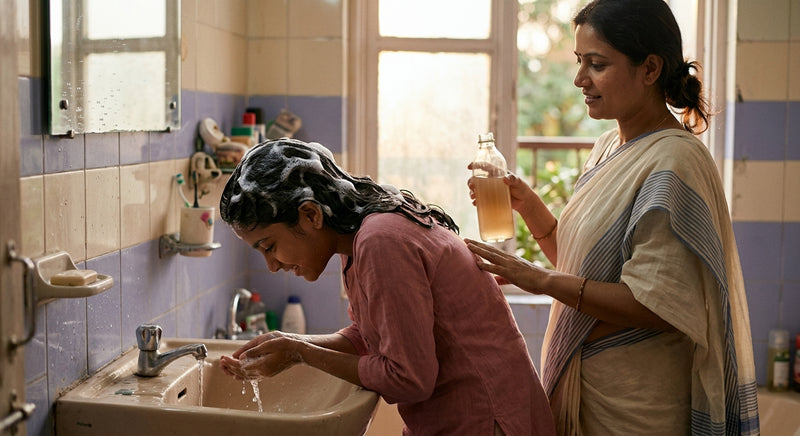
People rarely think of this one. Hard water leaves a mineral and soap residue that's drying and irritating on eczema skin. Use a gentle, soap-free wash, keep baths under 10 minutes, and moisturize within three minutes of patting dry — while the skin is still slightly damp. A mild, tear-free head-to-toe foam wash is far kinder here than a regular soap bar.
A safe, do-this-tonight routine
You don't need ten products. You need a few gentle ones, used the same way every day.
- Bathe in lukewarm water, once a day, kept under 10 minutes — no hot water, no scrubbing.
- Use a fragrance-free, soap-free cleanser; skip besan, ubtan and antiseptic pastes during a flare.
- Pat dry gently, leaving skin slightly damp.
- Within three minutes, apply a generous layer of fragrance-free moisturizer — more than feels necessary.
- Re-apply at least once more through the day, and after every wash.
- Dress baby in soft cotton; wash clothes in a mild, fragrance-free detergent and rinse twice.
- Keep nails short and consider cotton mittens at night to limit scratching.
- Patch-test anything new — including a plain oil — on the inner forearm for 24 hours first.
What to look for in a cream (and what to avoid)
Here's where I'll get specific, because for eczema-prone baby skin the back-of-pack label matters far more than the marketing on the front.
Look for: a clear "fragrance-free" claim, humectants like glycerin, occlusives and emollients that seal water in, and ingredients shown to support the skin barrier. In our own lab work, formulations that increased Keratin-10 and Filaggrin expression are doing exactly that — building up the very proteins a leaky eczema barrier is short on. Dermatologically tested, on a sensitive-skin base, made in a facility that actually controls its formulation. That's the bar.
Avoid: added fragrance or "parfum", essential oils (still fragrance), strong preservatives, and anything promising to "cure" eczema. No topical product cures atopic dermatitis. A good one helps soothe and supports the skin's natural barrier — the steady daily foundation eczema-prone skin needs most. A well-made balm should comfort dry, sensitive skin and visibly calm the look of redness — never sting.
When to see a doctor
Home care handles mild, dry, itchy patches. See your paediatrician if you notice any of these: skin that's weeping, oozing yellow crusts or has pus (a sign of infection); a flare with fever; patches spreading quickly or not improving after a week or two of consistent moisturizing; eczema that's clearly disturbing your baby's sleep and feeding; or any reaction that worsens after a remedy. Broken, infected skin needs medical treatment — not a stronger paste.
So, which is safe — ayurveda or cream?
Both can be, and the smartest routine usually takes the best of each. Keep the gentle, time-tested practices — a short malish on intact skin, the slow, soothing touch of it, lighter oils in summer. Drop the raw, fragrant, abrasive remedies on inflamed skin. And let a properly formulated, fragrance-free moisturizer do the daily heavy lifting, because consistency and a stable base are what an eczema barrier needs most. Season-adjusted, that combination is both safe and genuinely effective for most Indian homes.
If you want one product to anchor it all, a fragrance-free, barrier-supporting balm built for dry, eczema-prone skin — like the Janma Hydra Healing Moisturizing Balm — is the steady daily layer I'd reach for.
In summary
- For baby eczema, use a fragrance-free moisturizer as your daily backbone and keep ayurveda to gentle practices on intact skin.
- Skip raw pastes, neem, turmeric, camphor and lemon on inflamed or broken skin — they often worsen redness.
- Adjust to the season: richer in dry winter, lighter in summer heat, dry the folds in monsoon, gentle wash for hard water.
- Follow soak-and-seal: short lukewarm bath, pat dry, moisturize generously within three minutes.
- See a paediatrician for weeping, crusting, fever, or skin that spreads or won't improve after consistent care.
Frequently asked questions
Is ghee safe to use on baby eczema?
Plain ghee on intact, dry skin is a reasonable winter occlusive and a long tradition. But it's heavy and food-based, so it can trap heat and sweat in Indian summers and may not suit a milk-allergic baby. Never apply it to broken or weeping skin, patch-test first, and use it sparingly — not as a replacement for a proper fragrance-free moisturizer.
Can I put neem or turmeric paste on my baby's eczema?
I'd avoid both during a flare. On already-inflamed, thin baby skin, neem, turmeric, camphor and lemon often sting, stain and worsen redness rather than soothe it. Their antiseptic reputation is for intact skin, not a broken eczema barrier. Stick to a gentle, fragrance-free moisturizer and see a paediatrician if the skin is weeping or infected.
Which is better for baby eczema — oil massage or cream?
They do different jobs. A plain oil malish on intact skin slows water loss and is calming, but a fragrance-free cream delivers humectants and barrier ingredients in a stable, consistent dose, which is what active eczema needs daily. Use the cream as your backbone and keep gentle oil massage for unbroken skin, lighter in summer and richer in winter.
Does Indian weather make baby eczema worse?
Yes, season changes the rules. Dry winter air and hard water are classic flare triggers, so moisturize more and bathe shorter. Summer heat and sweat can trigger prickly heat that mimics eczema, so go lighter on oils. Monsoon humidity irritates damp skin folds, so dry creases well. Adjust your routine to the season rather than using the same approach year-round.
How often should I moisturize eczema-prone baby skin?
At least twice a day, and after every bath or wash — more during dry winters. The key timing trick is the soak-and-seal method: after a short lukewarm bath, pat the skin slightly dry and apply a generous layer of fragrance-free moisturizer within three minutes, while skin is still damp. This locks bath water into the barrier instead of letting it evaporate away.