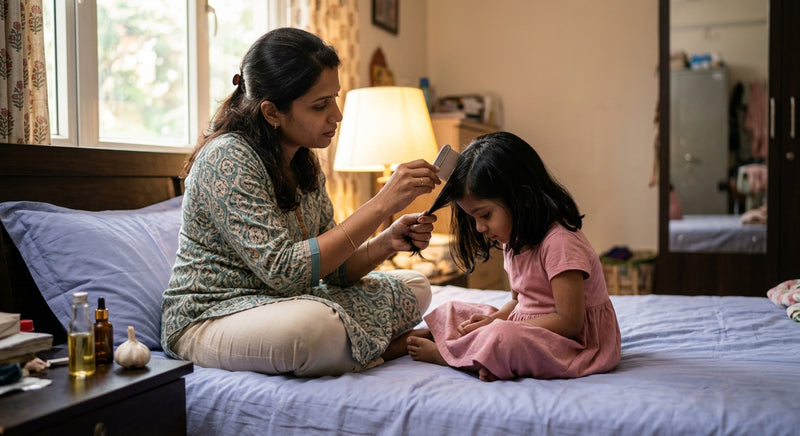
It's 9pm. She's fed, she's dry, the fan is on low so she isn't too warm. And she's pulling her knees up to her chest with a cry that sounds nothing like the hungry one. Her tummy feels tight as a drum. Someone in the family has already said "arre, malish karo na", and now you're kneeling on the bed wondering which direction, how hard, and whether you'll make it worse.
Short version. The "I Love You" stroke is a three-part tummy massage. A straight I stroked downward on your baby's left side. Then an inverted L, across the top and down that same left side. Then an inverted U that travels up the right, across, and down the left. The path isn't decorative. It follows the large intestine in the direction wind and stool already move, so you're nudging the gut along its own route instead of against it. Bare tummy, roughly 30–45 minutes after a feed, warm oiled hands, six to ten slow passes per letter.
It will not cure colic. Nothing does. Colic is a phase; it usually peaks around six weeks and settles by three or four months. What a calm, warm, rhythmic tummy massage can do is help trapped wind move, and give you something steady and useful to do at the exact hour of the evening when the helplessness is the hardest part of it. New to malish in general? Start with our complete guide to baby massage and malish, then come back to this stroke once the basics are in place.
At a glance
- The I-L-U sequence follows the colon: down the left, across and down, then up-across-down. Always that direction. Never the reverse.
- Wait 30–45 minutes after a feed. Full stomach plus tummy pressure equals spit-up on your knee.
- Warm hands, warm room, a few drops of a mild oil. Cold hands make a baby tense, and a tense tummy won't release.
- Six to ten slow passes per letter. The whole thing takes 2–3 minutes. Finish with bicycle legs and knees-to-tummy.
- Skip the tummy altogether if the cord stump hasn't healed, or if there's fever, vomiting, a hard swollen belly, or a lump in the groin. See a doctor first.
Why clockwise? What the direction actually does
Sit or kneel at your baby's feet, facing her. From where you are, her left side is on your right. Almost every parent gets this backwards the first time, so fix it in your head before you put a hand down.
The large intestine runs in a loop: up the right side (ascending), across under the ribs (transverse), then down the left towards the rectum (descending). Trapped wind sits somewhere in that loop. Stroke in the same order the loop runs and you're encouraging things towards the exit. Stroke the other way and you're pushing against traffic. That's the whole logic of it, and it's also why the letters go I, then L, then U. You clear the last stretch of pipe first, then the middle, then the full run. Empty the end before you push from the beginning, and the pushing has somewhere to go.
The routine, step by step
Print it, or keep it open on your phone with the brightness right down. Everything after the checklist is just detail.
- Pick the window. 30–45 minutes after a feed, before the evening bath. Not on a screaming, over-tired baby. You'll both lose.
- Warm the room and your hands. Fan off or on low, no direct draught. Three or four drops of oil in your palm, then rub for a good ten seconds until it's blood-warm.
- Lay her down flat and firm. A folded cotton sheet on the bed or the floor works. Roll the nappy down so the lower tummy is bare; the U stroke ends below the navel and a waistband gets in the way.
- Ask permission. Both palms flat on the tummy, still, for ten seconds. Eye contact. It sounds soft, but it lets a startled baby settle, and you will feel the abdomen let go under your hands.
- Stroke the I. Flat finger pads, straight down her left side, from just under the ribcage to the hip bone. One direction only. Lift, return to the top, go again. Six to ten times.
- Stroke the L. Start under the ribs on her right. Glide across the top of the tummy to the left, turn, and travel down the left side to the hip. An upside-down L. Six to ten times.
- Stroke the U. Start low on the right hip. Up the right side, across under the ribs, down the left to the left hip. An inverted U. Six to ten times.
- Bicycle the legs. Hold both ankles and cycle, one leg in as the other extends, for about 30 seconds. Keep it slow. Speed only makes her brace.
- Knees to tummy. Press both knees gently up towards the belly, hold five seconds, release. Three times. This is the step that most often produces an audible result.
- Finish still. One hand resting flat on the tummy for a minute. Then bath, or feed, whichever your evening runs on.
Which oil, and how much
Far less than you'd think. About a teaspoon for the whole tummy sequence. Enough that your hand glides instead of dragging the skin, not so much that she's slippery and cold by the end of it. A baby's skin is 20–30% thinner than an adult's, so an oil that sits fine on your own hands can still be too pungent or too sensitising for a newborn's abdomen.
Cold-pressed sesame is the classic Ayurvedic choice for tummy work. Coconut suits humid coastal weather. Sweet almond is mild and popular, though it carries a nut-allergy caveat worth knowing before you start, which we've set out plainly in our guide to almond oil for babies. Whichever one you land on, patch test a 10-paise-sized dab on the inner thigh 24 hours before it goes anywhere near the tummy.
Indian home remedies for gas: what we'd keep, what we'd skip
| What's commonly done | What we'd actually do |
|---|---|
| Hing (asafoetida) paste on the navel | It's in most Indian homes and it goes back generations, so you'll be offered it. But undiluted hing can irritate thin newborn skin, and it must never reach the mouth. Warm-palm pressure on the same spot does the comforting part with none of the risk. |
| Warm ajwain potli on the tummy | Fine in principle. The risk is the temperature, not the seed. Hold the potli against your own inner wrist for five seconds first. If it feels warm to you, it is far too warm for her. |
| Gripe water, janam ghutti, ajwain water | Nothing but breastmilk or formula for the first six months. Ask your paediatrician before any oral remedy, however traditional it is. |
| Vigorous rubbing to "push the gas out" | No. Firm-but-gentle is the ceiling. A baby who braces against your hand is tightening the exact muscles you're trying to relax, so pressing harder gets you nowhere. |
| Massage straight after a feed | Skip it. Wait 30–45 minutes, unless you fancy changing two sets of clothes. |
When to do it, and when not to
Most families settle into twice a day: once mid-morning, once in the early evening, before the fussy hour rather than in the middle of it. Wind is much easier to head off than to chase.
Leave the tummy alone until the umbilical cord stump has fallen off and healed. Usually one to two weeks, longer for preterm babies. We've covered the timing and the preterm exceptions in when to start baby malish. Limbs and back are fine before then. The abdomen isn't.
Then the question everyone asks. Massage first, bath after. The oil gets its contact time, the warm water relaxes whatever's left, and a warm damp baby takes moisturiser well. If you're still working out your own order, malish before or after bath goes into the reasoning for Indian homes and Indian weather.
After the bath, if the oil has left the skin feeling stripped, or the AC is going to run all night, seal that damp in with something simple on the tummy and limbs. Short ingredient list, no fragrance, an occlusive that actually holds water in. Our Hydra Healing Moisturizing Balm was built for that job, and is tested to help support the skin barrier.
How long before it helps?
Some babies pass wind right there during knees-to-tummy. That's the satisfying one, and it's also the exception. Most don't respond that fast. Judge it across a week rather than a session: fewer minutes of the tight-kneed cry, an easier settle afterwards. If you've done it consistently for ten days and nothing has shifted at all, the problem probably isn't trapped wind. That's a conversation with your paediatrician, not a reason to press harder.
When to see a doctor
Trapped wind is common and it passes on its own. These don't, and they need a paediatrician rather than a massage:
- Crying that is inconsolable for hours, high-pitched, or clearly different from your baby's usual cry
- Vomiting that is green, projectile, or repeated
- Blood or mucus in the stool
- Fever in a baby under three months, at any level
- A tummy that stays hard and swollen between crying spells
- Poor weight gain, fewer wet nappies, or refusing feeds
- A bulge in the groin or at the navel that appears with crying
Take a two-day note of feeds, cries and nappies with you. It turns "she cries a lot" into something a doctor can actually work with.
And when the massage is over and the oil needs to come off without stripping that just-calmed skin, a mild, tear-free wash is all she needs. Our Head to Toe Baby Foam Wash is made for this last bit of the evening.
In summary
- Do the strokes in order — I down the left, inverted L, inverted U — because that follows the colon's own direction.
- Wait 30–45 minutes after a feed, and work on a bare tummy in a warm room with warm, lightly oiled hands.
- Six to ten slow passes per letter, then bicycle legs and three knees-to-tummy holds to finish.
- Keep pressure at eyelid level: the skin should glide under your hand, never dent — harder is not faster.
- Skip the tummy entirely before the cord stump heals, and see a paediatrician for fever, green vomiting, blood in stool or a hard, swollen belly.
Frequently asked questions
Which direction should I massage my baby's tummy for gas?
Always clockwise from your view when you face your baby: up their right side, across under the ribs, then down their left side. That follows the large intestine in the direction wind and stool already travel. Stroking the opposite way works against the gut. The I, L and U strokes are simply three ways of covering that same path, done in that order.
How long after a feed can I do the I Love You massage?
Wait about 30 to 45 minutes. Pressing on a full stomach usually brings the feed straight back up, which upsets everyone and teaches your baby to dislike tummy time on their back. Mid-morning and early evening, before the fussy hour rather than in the middle of it, tend to work best for most families.
Can I do this massage on a newborn?
Not on the tummy until the umbilical cord stump has fallen off and the navel has healed, which is usually one to two weeks and longer for preterm babies. Before that, massage the legs, arms and back only. Once the navel is fully healed and dry, the I-L-U sequence is fine with gentle pressure and warm hands.
How much pressure is safe on a baby's tummy?
Rest your fingers on your own closed eyelid and press until you feel contact but no discomfort. That is the maximum. You should see the skin glide under your hand rather than dent. A baby's skin is 20 to 30 percent thinner than an adult's, and harder pressure does not release wind faster. If your baby stiffens or arches, stop.
Does the I Love You stroke cure colic?
No, and be wary of anything that says it does. Colic is a phase that usually peaks around six weeks and settles by three to four months. A warm, rhythmic tummy massage can help trapped wind move and comfort an unsettled baby, but it is a comfort measure, not a treatment. Persistent, inconsolable crying should be checked by your paediatrician.
Is hing on the navel safe for baby gas?
It is a widespread Indian practice, but undiluted asafoetida can irritate thin newborn skin and must never get near the mouth. If you use it, keep it well away from broken skin and use very little. Honestly, resting a warm palm on the same spot gives the same soothing pressure with none of the irritation risk.