Short answer: yes, you can still swaddle at 35°C. But the swaddle has to become the layer instead of sitting on top of two others. One thin, loose-weave cotton muslin over a bare chest or a sleeveless vest. No cap. No socks. No second blanket, no jersey-knit wrap. And you check the nape of the neck, not the hands, to know if it's working.
I get this question every May, usually around 11pm. Fan on three. The phone says the room is 34-35°C. The baby is still in the thick hospital wrap that came home with you in a kinder month. She won't settle unwrapped. She's sweaty wrapped. Both of those are true at the same time, which is exactly why it feels unsolvable at midnight. It isn't.
At a glance
- At 35°C, swaddle in ONE thin cotton muslin over bare skin or a sleeveless vest. That is the entire outfit.
- Check the temperature at the nape of the neck or the chest. Cool hands and feet are normal and tell you nothing.
- A damp hairline, flushed cheeks and pinprick bumps on the neck and upper back mean it's too warm. Unwrap and cool down.
- Skip the night oil malish under a swaddle in peak summer. Occlusion plus sweat is how prickly heat starts.
- Keep the wrap firm across the chest (two fingers should slide in) and loose at the hips.
This one sits inside our complete guide to sleep and skin. In an Indian summer the two are one conversation. Most of what wakes a baby at 3am in June is a skin problem in disguise.
Is it actually safe to swaddle a baby at 35°C?
Safe, with conditions. The risk in hot weather is not the wrapping. It's the stack. A swaddled baby can't kick a layer off, can't push a blanket down, can't fling an arm out to dump heat. Whatever you put on her at 10pm is what she is still wearing at 2am, when the room is at its stuffiest and the fan has stopped feeling like it's doing anything. And if the power goes at 2am, that stack is what she is stuck in.
So stop counting whether she's swaddled. Count layers instead. The old rule still holds and it's a good one: a baby needs about one more layer than you're comfortable in. At 35°C you are comfortable in one thin cotton kurta. So she gets one thin cotton layer, and if the muslin is that layer, there is nothing under it but a nappy.
Fabric decides more of this than most parents expect. A single-layer cotton muslin has an open, loose weave that lets air and water vapour through. It's the cloth you can hold up and see the tubelight through. A stretchy jersey "swaddle pod", a polyester-blend wrap, a double-gauze folded twice: all of those do the opposite, holding a still layer of warm, humid air against the skin. Velvet, fleece and quilted wraps have no business in an Indian summer bedroom at all, however soft they feel in the shop.
| Room temperature | What to swaddle in |
|---|---|
| Above 34°C | Single cotton muslin over a bare chest + nappy. No cap, no socks, no vest. Consider arms-out or a sleeveless muslin sack instead. |
| 30-34°C | Single muslin over a sleeveless cotton vest. Bare head and feet. |
| 26-30°C (AC on) | Muslin over a short-sleeve cotton bodysuit. Feet can stay bare. |
| Below 26°C | Muslin or a light cotton wrap over a full-sleeve bodysuit. |
How do I know if my swaddled baby is too hot?
Slide two fingers down the back of her neck, between the shoulder blades. Or lay your hand flat on her chest. That skin should feel warm and dry, about the temperature of your own forearm. Damp, clammy, or hotter than your hand means she is overdressed.
Please stop using the hands and feet. Everyone in the house reaches for the feet first, and the feet are the one part that will mislead you. Cold fingers and cool toes are completely normal in a young baby, because peripheral circulation is still settling in the first months. I have watched anxious parents add a whole extra layer to a baby who was already too warm, purely because the toes felt cool. Feet lie. The nape doesn't.
The other signs, roughly in the order they show up:
- A damp hairline and sweat in the neck crease, especially at the back of the neck.
- Flushed, hot cheeks with the rest of the body pale.
- Faster, shallower breathing than her usual sleeping rhythm.
- Restlessness that settles within minutes of unwrapping. That's the most useful test of all.
- Tiny pinprick bumps or clear little blisters on the neck, upper back, shoulders and behind the ears. In a hot room that pattern is often prickly heat (miliaria), though only your paediatrician can say for sure what a rash is — either way, it's a sign the night ran too warm.
Sweating by itself isn't automatically a problem. Babies sweat in Indian summers, and most of it is ordinary. We've written separately on when baby night sweats are normal and when they're worth a doctor's opinion, because the line matters and it isn't obvious at 2am.
What should go on her skin before a swaddle in this heat?
Most of the avoidable summer rashes I see start in the ten minutes after the evening bath. At heart it's a formulation problem.
Moisturisers work in three broad ways. Humectants (glycerin, honey, aloe) pull water into the upper layers. Emollients (light plant oils, esters) sit between the corneocytes and make skin feel smooth. Occlusives (petrolatum, heavy butters, most malish oils) lay down a physical film that slows water loss from the surface. In a dry Nagpur winter, that film is exactly what you want. Under a muslin wrap at 35°C it turns on you. Sweat has nowhere to evaporate to, the eccrine sweat ducts get plugged, and you wake up to a rash across the shoulders and neck.
Three changes for peak summer, then:
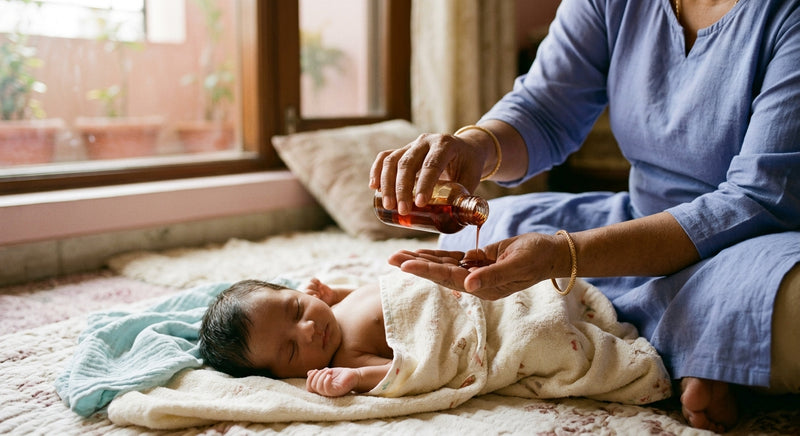
- Move the malish to the morning. Oil massage before a morning bath, not before a night swaddle. If you do massage in the evening, wipe the excess off with a soft damp cloth before you wrap.
- Go humectant-forward and light at night. A thin lotion absorbs and leaves the surface free to breathe. A heavy balm all over the body does not.
- Keep balms for spots, not surfaces. Dry cheeks, ankle creases, wrist folds, an eczema-prone patch behind the knee. A small amount of a barrier product like the Hydra Healing Moisturizing Balm on those specific areas, applied about an hour before sleep so it has time to sink in, comforts dry, sensitive skin without sealing up the whole torso.
Dry the folds properly after the evening bath. Under the chin, the neck creases, both armpits, the groin. Trapped bathwater plus fabric plus 35°C is macerated skin by morning. Pat rather than rub. A baby's skin is 20-30% thinner than an adult's, and towel friction on a hot, damp neck fold does real damage.
One more thing worth doing: look at your laundry routine. Hard borewell water plus a heavy scoop of detergent leaves surfactant residue in the weave. Fabric softeners deposit cationic quaternary compounds onto the fibres by design, because that is how they make cloth feel slippery. Both can irritate thin skin under a warm, damp wrap. Use half the detergent you think you need, run an extra rinse, and skip the softener on anything that touches your baby. Muslin that feels a little stiff after two rinses is kinder than muslin that feels silky after one.
My baby only sleeps swaddled. What do I do instead?
Don't go cold turkey on a hot night. You'll get a worse night and conclude the swaddle was the only thing working. Step down instead:
- One arm out for three or four nights, then both. This keeps the chest-firm feeling that settles the startle reflex while opening the biggest heat-dumping surfaces.
- Half swaddle. Wrap only from the chest down, arms completely free, hips loose enough for the legs to bend up and out.
- Sleeveless cotton muslin sleep sack, the thinnest weight you can find. Same containment, far less trapped air, and nothing over the head.
- Stop the arms-in swaddle as soon as she shows any sign of trying to roll. That's standard safe-sleep guidance and it isn't negotiable, heat or no heat.
If it's the scratching rather than the startle that needs containing, a wrap is the wrong tool in summer anyway. Sleepsuits, mittens and scratch sleeves each solve a different version of that problem, and the cotton ones breathe far better than a full swaddle. And if the waking is a flare rather than heat, our piece on breaking the 3am eczema flare will be more use to you than any change of wrap.
When to see a doctor
Call your paediatrician if your baby feels hot to the touch on the chest along with unusual floppiness, poor feeding, fewer wet nappies, or breathing that looks fast or laboured even after you've unwrapped her and cooled the room. Any fever in a baby under three months needs same-day medical advice, full stop. A heat rash that spreads, turns into yellow-crusted or pus-filled spots, or comes with a fever needs to be seen rather than managed at home. That pattern can mean infection, and infection is a doctor's job, not a cream's. I'm a cosmetologist, not a paediatrician. Anything with a fever in it belongs to them.
The five-minute version for tonight
- Lukewarm bath, gentle cleanser, pat dry. Especially the neck, armpits and groin.
- Thin lotion on the body. Balm only on the two or three genuinely dry spots.
- Nappy, nothing else, then one cotton muslin. No cap, no socks.
- Two fingers between wrap and chest. Hips free to bend and spread.
- Fan on, angled at the wall rather than the cot. Check the nape at your own bedtime, and again at the first feed.
If the evening bath is where your routine starts, a mild, tear-free wash like the Head to Toe Baby Foam Wash makes that first step easy on hot, sweaty summer skin.
In summary
- At 35°C, swaddle in one thin cotton muslin over a bare chest and nappy — no cap, no socks, no extra blanket.
- Check the nape of the neck or chest for damp, hot skin; cool hands and feet are normal and mean nothing.
- Move oil massage to the morning — occlusive oils under a wrap in heat are a common cause of prickly heat.
- Keep balms for specific dry patches and use a light, breathable lotion elsewhere on hot nights.
- Step down to arms-out or a sleeveless muslin sack in extreme heat, and stop swaddling once your baby tries to roll.
Frequently asked questions
What temperature is too hot to swaddle a baby?
There isn't one exact cut-off, but above about 34°C most babies do better with an arms-out swaddle or a sleeveless muslin sleep sack than a full wrap. What matters more than the number is the layer count: at 35°C the muslin should be the only thing on her besides a nappy. If the nape of her neck feels damp or hot, she has one layer too many whatever the thermometer says.
How do I check if my swaddled baby is overheating?
Slide two fingers onto the back of her neck or flat on her chest. That skin should feel warm and dry, roughly like your own forearm. Damp, clammy or noticeably hot means she's overdressed. Ignore hands and feet — they run cool in young babies and regularly fool parents into adding a layer. A flushed face, damp hairline and settling within minutes of being unwrapped all point the same way.
Can I use oil massage before swaddling in summer?
Better not to, in peak heat. Malish oils are occlusive — they form a film that slows water loss, which is helpful in dry winter but works against you under fabric at 35°C, because sweat can't evaporate and ducts get plugged. That's a common route to prickly heat across the shoulders and neck. Move the massage to the morning before a bath, or wipe the excess off with a damp cloth before wrapping.
What is the best swaddle fabric for Indian summer?
A single-layer cotton muslin with a loose, open weave — the thinner and more washed-soft, the better. Avoid stretchy jersey pods, polyester blends, double-gauze folded over, velvet and fleece; they hold warm, humid air against the skin. Wash new muslins with half the usual detergent, run an extra rinse for hard water, and skip fabric softener, whose residue can irritate thin skin under a warm wrap.
Should I stop swaddling if my baby gets prickly heat?
Loosen or drop the wrap and cool the room first — miliaria is essentially plugged sweat ducts, so the fix is less heat, less occlusion and more airflow rather than more product. Move to arms-out or a sleeveless cotton sack, remove any cap or socks, keep the skin dry in the folds, and use only light, breathable moisturiser. If the bumps spread, crust or come with a fever, see your paediatrician.
When should you stop swaddling a baby altogether?
Stop the arms-in swaddle as soon as your baby shows any sign of trying to roll — that's standard safe-sleep guidance and applies regardless of the weather. Many babies also outgrow the need once the startle reflex fades. Step down gradually: one arm out for a few nights, then both, then a sleeveless muslin sleep sack, which keeps the contained feeling without the trapped heat.