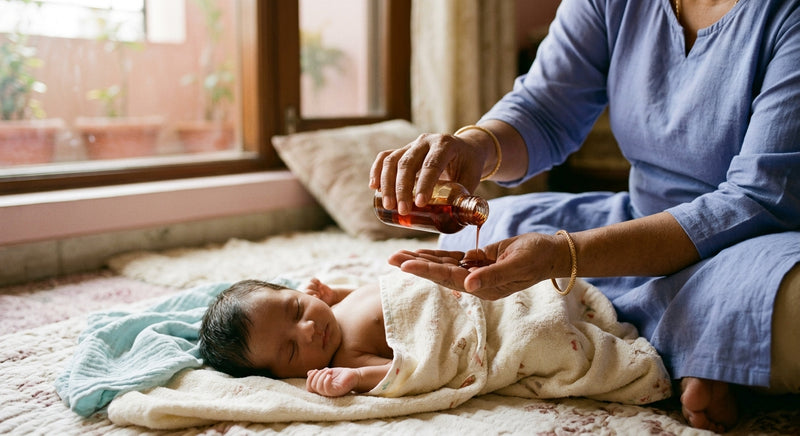
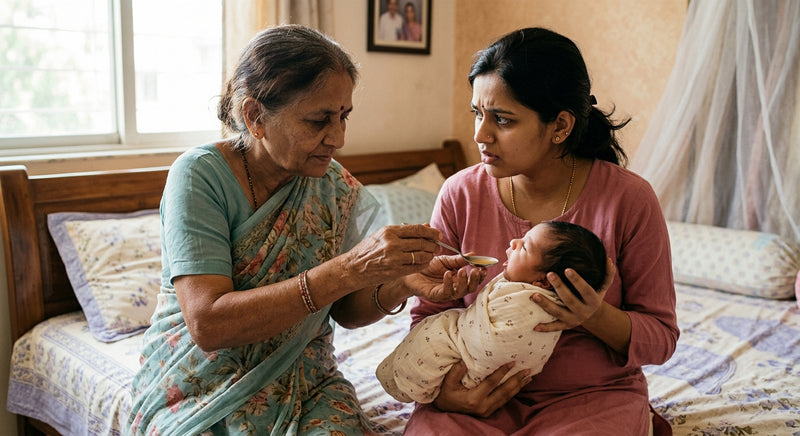
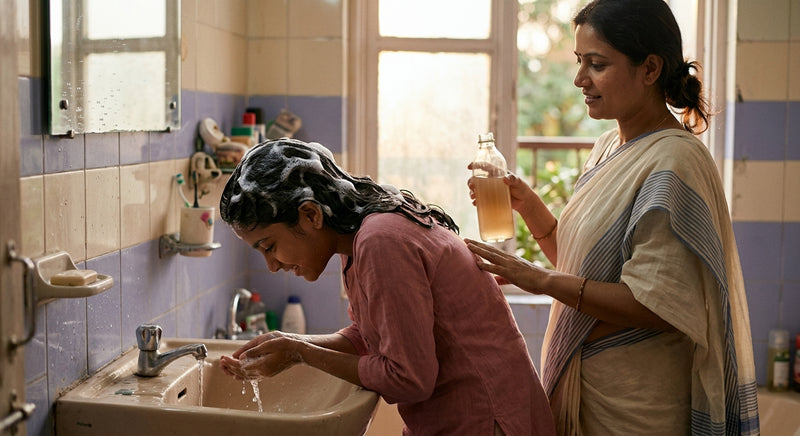
"Thoda garam paani daalo, thand lag jayegi." I have heard that sentence in almost every Indian bathroom I have stood in — from my own mother, from grandmothers, from well-meaning maushis. Come May the instinct simply flips. The tap runs warm, so someone tips in a mug of cold to thanda it down.
The honest answer is that bath water for a baby should sit at about 37–38°C — roughly body temperature — in December and in May alike. It should feel neutral on your inner wrist. Not warm. Not cool. The seasons don't change the water. They change the room, the length of the bath, and what you do in the three minutes after the towel.
Both halves of the old belief have a grain of sense in them. One half is quietly damaging your baby's skin barrier.
At a glance
- Aim for 37–38°C year-round. It should feel neutral — not warm — on the inside of your wrist or elbow.
- Hot water doesn't keep a baby warm for longer. It strips skin lipids faster and leaves the skin cooler once they're out.
- The seasonal fix is the room temperature (26–28°C, no direct fan or AC draught), not the bucket.
- Summer is when scalds actually happen in India — overhead tank water in the afternoon can come out dangerously hot.
- Moisturise within 3 minutes of the towel, every season.
Myth 1: "Hotter water in winter keeps the baby warm"
True for the six minutes they're in the tub. Not true for the hour afterwards — and the hour afterwards is the part that matters.
Warm water feels comforting because it dilates the tiny blood vessels near the skin's surface. But blood at the surface is blood losing heat. Lift a baby out of a 42°C bath and that flushed skin is also wet, and evaporation pulls the heat away fast. Babies carry a large surface area for their body mass, so they cool quicker than we do. A very hot bath often ends in more shivering, not less.
What parents don't see is what the heat is doing to the wash. Surfactants are my day job, so bear with me for two sentences. A cleanser lifts oil by lowering the surface tension of water and packing that oil into micelles — tiny spheres that carry it away down the drain. Warmer water thins the oil, wets the skin better, and speeds the whole thing up. Which means the same mild wash strips more lipid at 42°C than it does at 37°C. You haven't changed the formula. You've changed how efficiently it works on your baby's own barrier lipids.
Skip the cleanser altogether and hot water still does it. It solubilises and softens the lipids of the stratum corneum, and trans-epidermal water loss climbs once the bath is over. You know the feeling — the tight, squeaky skin after a long hot shower. On a baby it shows up two days later as flaky cheeks and dry shins, and everyone blames the weather.
Myth 2: "Cool water cools the baby down in summer"
This one worries me more.
Cold water on a newborn sets off a startle and a cold-stress response — they burn energy just to hold their temperature. It constricts the surface vessels too, which is why a cold bath can leave a baby looking mottled. Lukewarm water cools a hot, sticky baby perfectly well; it doesn't need to be cold. And if prickly heat is your actual problem, a lukewarm bath and a dry, breathable set of clothes will do far more than cold water ever will.
The bigger summer danger runs the other way. In most Indian homes the water sits all day in a black plastic tank on an open terrace, in direct sun. By three in the afternoon in Nagpur or Ahmedabad, the water coming out of the "cold" tap can be genuinely hot. Hot enough to scald. And because a baby's skin is 20–30% thinner than an adult's, it burns at a lower temperature and in less time than yours would. Parents have told me, quite reasonably, that they never touched the geyser — so they never checked the water. Check it anyway.
How to actually check the temperature (30 seconds)
A bath thermometer is the easy answer, and a cheap one earns its keep. But the elbow test is genuinely reliable if you do it properly, and it costs nothing.
- Cold water first, then hot. Always. Pour hot into an empty bucket, get distracted by a phone call, and you have built a scald.
- Stir hard. This is the step everyone skips. Hot water is less dense, so it sits on top of the bucket in layers. The mug you dip off the surface can be several degrees hotter than the water underneath.
- Use your elbow or the inside of your wrist — not your hand. Palms are calloused. They lie to you.
- It should feel like nothing. Neutral. If it feels pleasantly warm to you, it is too warm for your baby.
- Test again just before the baby goes in, not when you started filling. A bucket in a cold January bathroom loses heat surprisingly fast.
Season by season: what changes, and what doesn't
The water stays put. Everything around it moves. This is the table I'd tape to a bathroom door.
| Season | Water | What actually changes | Watch out for |
|---|---|---|---|
| Winter (Nov–Feb) | 37–38°C | Warm the room to 26–28°C first. Close the window. Keep the bath to 5 minutes. Towel and clothes ready and within arm's reach. | The urge to make the water hotter as the room gets colder. Also: heaters and blowers dry the room air out — moisturise generously. |
| Summer (Mar–Jun) | 37–38°C — lukewarm, not cold | Bath can be a touch shorter. A second quick rinse-off in the evening is fine on very hot days. | Overhead-tank water running hot in the afternoon. And direct fan or AC air on a wet baby. |
| Monsoon (Jul–Sep) | 37–38°C | Drying, not water. Humidity keeps the folds — neck, groin, behind the knees — damp long after the towel. | Skipping the bath because it's "already damp". Sweat and damp folds are exactly where rash starts. |
| Post-monsoon / early winter (Oct) | 37–38°C | The air turns dry before anyone notices. This is when the flakiness quietly begins. | Still bathing on summer habits — long baths, more lather — in a drier climate. |
If you want the full sequence — undressing, holding, rinsing, drying — we've laid it out in our complete guide to baby bath time, and there's a step-by-step for the first few months in sponge bath vs tub bath for newborns.
Myth 3: "Hard water is the problem, so make it hotter"
Understandable, and backwards. Most of India bathes in hard water — dissolved calcium and magnesium. Those ions react with soap and with some surfactants to form an insoluble scum that clings to skin and to fabric. Heat doesn't dissolve that scum. If anything, heat drives more calcium out of solution and onto surfaces. What reduces the residue is using less product, a milder surfactant system that tolerates hardness, and a proper rinse.
So: lukewarm water, a small amount of a gentle wash, and rinse for longer than you think you need to. A pea-sized amount of a foaming wash covers a whole newborn. Parents routinely use four times that and then rinse for eight seconds. The residue left behind is a bigger irritant than any single ingredient in the bottle.
On the shelf, look for a syndet or mild non-soap surfactant base — soap is alkaline, and hardness makes it worse — a pH close to the skin's own, a tear-free profile, and no need for hot water to make it lather. We built our Head to Toe Baby Foam Wash to foam properly in lukewarm, hard Indian water, precisely so that nobody is tempted to reach for the geyser. If hardness is your daily reality, we've written a fuller piece on hard water and baby skin.
The three minutes after the bath matter more than the bath
Whatever the season, skin loses water fastest in the minutes right after the towel, while it is still slightly damp. That is your window. Pat — never rub — until the skin is barely damp, then moisturise the whole body, folds included.
In winter, and in homes that run the AC hard, reach for something richer and more occlusive; a balm or butter cream sits on the surface and slows that water loss. Our Hydra Healing Moisturizing Balm was made for exactly that job — it helps support the skin barrier, and in a lab study we saw increased Keratin-10 and Filaggrin expression, two of the proteins the skin uses to build and hold its own barrier. In peak summer humidity a lighter lotion is usually enough. The frequency doesn't change. The texture does.
And if bath time is currently a battle rather than a routine, rule the temperature out first. Water even slightly too warm is one of the commonest reasons a baby suddenly starts protesting. We've written about that in how to bathe a baby who hates bath time, and about the evening version in the bath routine that helps a baby sleep.
When to see a doctor
Take your baby to a paediatrician if you see any of the following: skin that stays red, blistered or peeling after a bath (a possible scald — cool it under running lukewarm water and get it seen the same day); skin that turns red and itchy after every bath despite lukewarm water and a mild wash; a rash that is spreading, weeping, or crusting; or a baby who becomes limp, mottled or unusually cold after bathing. Nothing in this article is a diagnosis — if something looks wrong to you, get it looked at.
Get the water right, keep the bath short, moisturise while the skin is still damp. That is most of it. And if the wash you are using only lathers when the water is hot, change the wash rather than the temperature — no one in the house should have to reach for the geyser to get a bath clean.
In summary
- Keep bath water at about 37–38°C all year — it should feel neutral, not warm, on your inner wrist.
- Fill cold water first, add hot, stir the bucket hard, and re-test right before your baby goes in.
- In winter, warm the room to 26–28°C and shorten the bath instead of heating the water.
- In Indian summer, check the "cold" tap too — sun-heated overhead-tank water can scald a baby's thinner skin.
- Moisturise within three minutes of the towel, using a richer balm in winter and a lighter lotion in humidity.
Frequently asked questions
What is the correct bath water temperature for a newborn?
About 37–38°C — close to body temperature. Test it with your inner wrist or elbow, not your hand: it should feel neutral, neither warm nor cool. A bath thermometer removes the guesswork. Fill cold water first, add hot, stir well, then test again just before your baby goes in, since a bucket loses heat quickly in a cold bathroom.
Should I use hotter water for a baby's bath in winter?
No. Keep the water at 37–38°C year-round and warm the room instead — around 26–28°C, with the window closed and no draught. Hotter water strips skin lipids faster and leaves a baby cooler once they're out, because wet, flushed skin loses heat rapidly. Shorten the bath to about five minutes and have the towel ready within arm's reach.
Can I bathe my baby in cold water during Indian summer?
Lukewarm is better than cold. Cold water triggers a cold-stress response and makes a baby burn energy to stay warm. Lukewarm water at 37–38°C cools a hot, sticky baby perfectly well. The real summer risk is the opposite: water from a sun-heated overhead tank can run genuinely hot in the afternoon, so always run the tap, fill, stir and test first.
How long should a baby's bath be?
Five to ten minutes is plenty, and closer to five in winter. Longer soaks in warm water increase water loss from the skin and leave it drier once the bath ends. Keep everything you need beside you before you start, so the bath doesn't stretch out while you go looking for a towel or a fresh set of clothes.
Does hard water mean I should use hotter bath water?
No — heat doesn't fix hardness and can make residue worse. Hard water reacts with soap to leave a scum on the skin. Use lukewarm water, a small amount of a mild non-soap (syndet) wash formulated to work in hard water, and rinse longer than feels necessary. Under-rinsing leaves more irritating residue than most single ingredients ever would.
How soon after the bath should I moisturise my baby?
Within about three minutes, while the skin is still slightly damp. Pat dry rather than rubbing, then apply moisturiser over the whole body including the folds. Use a richer balm or butter cream in winter and in air-conditioned homes, and a lighter lotion in humid weather. The frequency stays the same across seasons — only the texture needs to change.