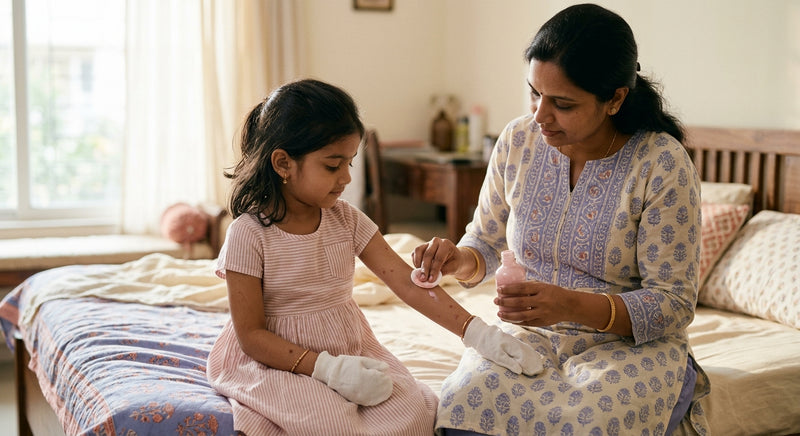
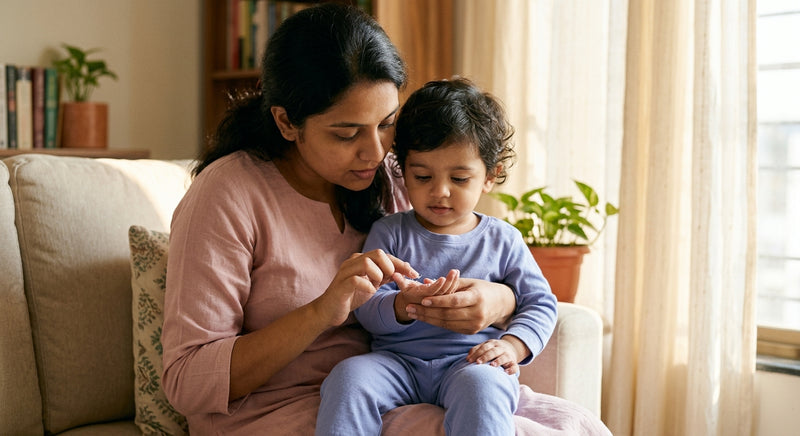
It's late, the baby's finally down, and you're looking at two rough red patches on those cheeks — worse after every feed, worse after every walk in the wind. Breathe first. Eczema on a baby's face is common, it's not your fault, and in most cases a gentle, consistent routine settles it down at home. The cheeks go first because the skin there is thin, exposed, and wet all day with drool, milk and wind. Nothing you did.
I'm Nidhi. I've spent a lot of hours in our formulation lab thinking about exactly this skin. What follows is the calm routine I'd give a friend at 2am, plus the honest what-to-look-for that actually matters. For the wider picture, this sits inside our complete guide to baby eczema and dry skin.
At a glance
- Baby eczema hits the cheeks first because facial skin is thin and constantly wet with drool, milk and wind.
- The fix is boring on purpose: a lukewarm short wash, a fragrance-free cleanser, and a thick balm on slightly damp skin.
- Moisturise the face at least twice a day — after the bath and again before bed.
- Skip fragrance, essential oils, besan/ubtan scrubs and hot water on an active flare.
- See a paediatrician if the skin weeps, crusts golden-yellow, or your baby is clearly miserable.
Why does eczema show up on the cheeks first?
A few things pile onto that little face at once. Start with the skin itself: a baby's skin is 20-30% thinner than an adult's, so it loses water faster and reacts sooner. Then there's the wetness — drool and spit-up sit on the cheeks, dry off, and drag moisture out with them, leaving the skin tight and cracked. Add friction on top: your shoulder, the cot sheet, a muslin cloth, over and over. Now put all of that in a dry North Indian winter or a cold AC bedroom, and the barrier simply gives way.
Eczema is a barrier problem far more than a dirt problem. The outer layer that's meant to hold water in and keep irritants out has gone leaky, so the skin dries, itches and inflames. Which is why the answer is almost never "wash it more" — it's "protect it better." If the cheeks are at their worst in a cold, dry room, what actually helps when AC dries out baby skin is worth reading alongside this.
What can I do tonight?
Here's the exact sequence. Under ten minutes, and you can start it at the next bath or nappy change.
- Wipe drool gently, don't rub. All through the day, pat the cheeks dry with a soft cotton cloth after every feed. Rubbing is friction; patting isn't.
- Wash short and lukewarm. Five minutes at most, water at body temperature — test it on the inside of your wrist, it should feel neutral, not warm. Hot water strips the very oils you're trying to keep.
- Use a fragrance-free, tear-free cleanser only where you need it. The face rarely needs soap at all. Plain water on the cheeks is usually enough; save a gentle wash for the body.
- Moisturise on damp skin. Within 2-3 minutes of the bath, while the cheeks are still slightly damp, press in a thick fragrance-free balm. Sealing damp skin traps the water instead of letting it float off.
- Re-apply before bed. That second layer at night is when most of the repair happens.
What should I look for in a face product for baby eczema?
This is the part I get most protective about, because a label can read "natural" and still be all wrong for an eczema cheek. Here's the checklist I'd actually use myself.
| Look for | Be cautious of |
|---|---|
| Fragrance-free (not "masking fragrance") | Added perfume or "parfum," even natural-smelling ones |
| Barrier ingredients: ceramides, oat, shea/kokum butter, safe humectants | Essential oils, menthol, camphor on a raw flare |
| A thick balm or butter texture for damaged skin | Thin, watery lotions alone during an active flare |
| Dermatologically tested, patch-test friendly | Gritty scrubs — besan/ubtan on inflamed cheeks |
Texture does more than parents expect. On calm, mildly dry skin, a lotion is lovely. On an active flare, the cheek needs an occlusive — a balm that physically seals — sitting over a hydrating layer. If you want the deeper reasoning, we broke down exactly what to look for in a moisturizer for baby eczema, ingredient by ingredient.
On the ingredient side, this is where making our own formulations in our GMP-certified facility in Nagpur genuinely changes things — we can leave fragrance out entirely and build in barrier support, instead of white-labelling whatever's cheapest. In our own lab study, the formulation showed increased Keratin-10 and Filaggrin expression, two proteins that help support the skin's natural barrier — which is the whole game with eczema-prone cheeks. In in-vivo testing on 24- and 36-month subjects, skin looked visibly calmer in as little as one day. A thick, fragrance-free balm like our Hydra Healing Moisturizing Balm is the kind of occlusive layer I mean — press a thin film onto the cheeks after the bath and again at night.
What makes baby eczema on the face worse?
Sometimes the routine is right and something in the day keeps undoing it. The usual suspects:
- Hot water and long baths. The mistake I see more than any other.
- Fragranced wipes and lotions. That "nice smell" is often the trigger itself.
- Wool and rough synthetics rubbing the cheeks — soft cotton is far kinder against that skin.
- Drool left to dry. Here a barrier balm earns its keep, sitting like a shield against the constant wetness.
- Dry air — a cold AC room, or a dry Nagpur winter afternoon, pulls moisture straight back out.
How long until the cheeks look better?
With a steady gentle routine, plenty of babies' cheeks look calmer within a few days to a couple of weeks. Eczema comes and goes, so the goal was never a one-time fix — it's keeping the barrier topped up so the flares stay smaller and further apart. Keep moisturising on the good days too. That's the bit that heads off the next flare, and it's the bit parents skip: the boring, twice-daily balm on clear skin does more than any "treatment" on a bad day.
When to see a doctor
Most facial eczema settles at home, but see your paediatrician if you notice any of these: the skin is weeping, oozing or crusting golden-yellow (a sign of infection), there are blisters or pus, your baby has a fever, the eczema is spreading fast or not improving after two weeks of gentle care, or your baby is so itchy and uncomfortable they can't sleep or feed. A doctor can rule out infection and, if needed, prescribe a short, safe treatment for the face — which is a very different thing from you reaching for something strong on your own. Trust your gut: you know your baby best, and asking is never an overreaction.
The routine that actually works is the calm, repetitive one — short lukewarm wash, fragrance-free balm on damp skin, twice a day, every day. If you want one gentle place to start tonight, a thick fragrance-free balm like our Hydra Healing Moisturizing Balm is made for exactly these thin, easily-chapped little cheeks.
In summary
- Baby eczema often hits the cheeks first because facial skin is thin, wet and rubbed all day.
- Keep baths short and lukewarm, and skip soap on the face where plain water will do.
- Seal in moisture with a thick, fragrance-free balm on damp skin, at least twice a day.
- Avoid fragrance, essential oils, hot water and besan/ubtan scrubs on an active flare.
- See a paediatrician if the cheeks weep, crust golden-yellow, or your baby can't settle.
Frequently asked questions
Can I put moisturiser on my baby's face for eczema?
Yes. A baby's cheeks are one of the most common places for eczema, and a fragrance-free moisturiser is one of the safest, most helpful things you can use. Apply it on slightly damp skin after the bath and again before bed. Choose a thick, tear-free, fragrance-free balm made for babies, and press it on gently rather than rubbing sore skin.
Why does my baby's eczema flare only on the cheeks?
The cheeks are thin-skinned and constantly wet with drool and milk, then dry out as that moisture evaporates. Add rubbing against your shoulder or the cot sheet, plus dry or air-conditioned air, and the skin barrier there breaks down first. It's very typical for baby eczema to appear on the face before anywhere else, and gentle, consistent moisturising usually settles it.
What should I not use on baby eczema on the face?
Avoid fragranced products and wipes, essential oils, menthol or camphor, hot water, long baths, and gritty scrubs like besan or ubtan on an active flare. Never use an adult steroid cream, fairness remedy or strong home remedy on a baby's face. If the skin is raw or weeping, keep the routine bland and see a paediatrician rather than experimenting.
How often should I moisturise my baby's face during an eczema flare?
At least twice a day, and more if the cheeks look dry. The two most important moments are within a couple of minutes of the bath, while skin is still damp, and again before bed when most repair happens. During a flare you can gently reapply a thin layer any time the cheeks look tight or dry. Consistency matters far more than the amount you use at once.
Is it eczema or just dry cheeks from the weather?
Simple weather dryness usually improves quickly with moisturiser and doesn't itch much. Eczema tends to be red, rough or scaly, comes and goes, often itches, and keeps returning to the same spots like the cheeks. If patches are persistent, itchy, or your baby is uncomfortable, treat it as eczema with a gentle routine — and see your paediatrician if it weeps, crusts or doesn't settle.