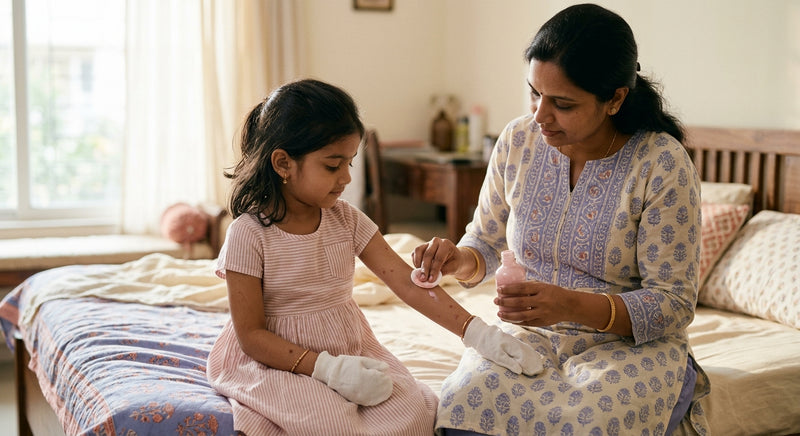
It's 2am. Your baby's been scratching at that same rough patch behind the knees, and you're on your phone typing "best moisturiser for baby eczema" — scrolling lists that contradict each other, half of them quietly selling you something. So let me shorten it. For eczema-prone baby skin, the right moisturiser is thick, fragrance-free, and built to hold water in and keep irritants out. That's the whole job. Everything else on the label is detail.
Here's why it matters: eczema isn't really a moisture problem, it's a barrier problem. The skin's outer wall is leaky, so water escapes and irritants slip in — which is why the right cream, applied often, does more than any single "miracle" ingredient. For the bigger picture on the condition itself, we've written a complete guide to baby eczema and dry skin that sits alongside this one.
At a glance
- Look for a thick cream or balm (not a thin, watery lotion) — more oil, less water.
- The label should say fragrance-free, not "unscented" — they're different.
- Seek emollients + occlusives (ceramides, shea/kokum butter, glycerin) that support the barrier.
- Skip added fragrance, essential oils, and long, alcohol-heavy ingredient lists.
- Apply within 3 minutes of a bath, generously, at least twice a day.
Why does baby eczema need a special kind of moisturiser?
A baby's skin really is more fragile than yours — about 20–30% thinner than an adult's. It loses water faster and reacts to things your barrier would shrug off. With eczema, that barrier is already compromised: the "mortar" between the skin cells is patchy, so moisture leaks straight back out. Up to ~48.6% of babies experience atopic-type skin issues at some point — so if this is you, you're in very ordinary company.
Which is why a thin lotion tends to let you down. Feels lovely for ten minutes, then the skin is tight and dry again. Eczema-prone skin needs a formula that does two jobs at once: pull in water, then seal it in — and, over time, help the barrier mend itself.
The three ingredient types that actually matter
Strip away the marketing and every good eczema moisturiser comes down to three kinds of ingredient, working as a team. I go deeper on these in our piece on why baby skin turns dry and flaky in winter; here's the short version.
1. Humectants — the ones that draw water in
Humectants pull moisture into the upper layers of skin and hold it there. On a label they show up as glycerin (glycerine), sodium hyaluronate/hyaluronic acid, or panthenol (pro-vitamin B5). Glycerin is the workhorse — cheap, gentle, very well studied on dry, sensitive skin. Left on its own, though, a humectant can do the opposite and pull water out of the skin — in a dry Indian winter, or a shut AC bedroom, that's a real risk. So it always needs company.
2. Emollients — the ones that soften and fill the gaps
Emollients are the oils and butters that settle into the cracked barrier and turn rough, scaly skin smooth. Look for ceramides (they replace exactly what eczema skin is short on), shea butter, kokum butter, colloidal oatmeal, almond oil, and organic ghee. Ceramides are the standout here — they're literally the same lipid your baby's barrier is missing.
3. Occlusives — the ones that seal it all in
Occlusives lay a breathable film over the top so the water you just put in can't evaporate off. This is where a balm beats a lotion for eczema. The heavier the seal, the longer the relief holds between applications. On an angry, flaring patch, thicker really is better.
Lotion vs cream vs balm: which for eczema?
People throw these words around, but the difference is real, and it comes down to one thing: how much water sits against how much oil. Here's the honest ranking for eczema-prone skin.
| Format | What it is | Best for eczema? |
|---|---|---|
| Lotion | Mostly water, light, pumps easily | Fine for everyday, mildly dry skin — usually too light for a flare |
| Cream | Balanced water + oil, thicker | Good daily choice for eczema-prone skin |
| Balm / butter | Oil-rich, minimal water, sealing | Best for dry, flaring, rough patches and overnight |
If your baby only gets the odd dry spell, a good cream is plenty. During an active flare — rough, red, itchy patches — reach for a balm on those spots and keep a cream going everywhere else.
What to skip on the label
This is the part I feel strongly about, after years of formulating these things. A short, deliberate ingredient list is almost always safer for eczema than a long one that reads like a chemistry exam. Here's what I'd put straight back on the shelf:
- Added fragrance / parfum / "perfume" — the single most common eczema trigger in baby products. "Fragrance-free" and "unscented" are not the same thing; unscented can still hide a masking fragrance. We break this down in our note on what actually helps when AC dries out baby skin.
- Essential oils (lavender, tea tree, etc.) — "natural", yes, but common sensitisers on a broken barrier.
- Denatured alcohol high up the list — drying, and it stings broken skin.
- Harsh sulphates if it's a wash — they strip the very lipids you're trying to rebuild.
- Dyes and unnecessary botanical extracts — more ingredients, more chances to react.
What does "barrier support" actually mean?
"Strengthens the skin barrier" is on half the packs in the aisle. Worth knowing which claims to trust. What you actually want is evidence that a formula helps skin build more of its own barrier proteins — not just a line printed on the box. In our own lab work, the Hydra Healing Balm showed increased Keratin-10 and Filaggrin expression — those are two of the proteins eczema-prone skin is short on, so supporting them is meaningful, not marketing. It's the kind of proof I'd want to see before I trusted a moisturiser on my own child.
Exactly what to do tonight
You don't need ten steps. You need a few simple ones, done consistently. This is the routine I'd hand any parent just starting out.
- Lukewarm short bath — 5–10 minutes, water warm not hot. A gentle, fragrance-free, tear-free wash only where needed; skip soap on the dry patches.
- Pat, don't rub — leave the skin slightly damp, don't towel it bone-dry.
- Moisturise within 3 minutes — this traps the bath water in. Cream all over, a balm on the rough spots.
- Be generous — a thin smear does little. You want a light sheen, not dry skin peeking through.
- Repeat morning and night, and top up bare rough patches through the day.
- Soft cotton clothing, nails kept short, and a slightly cooler room so your baby sweats less.
Give it two weeks of daily use before you decide whether a product works. Eczema care rewards consistency far more than any single hero cream. If you'd like the fuller picture on spotting and managing flares, our guide to baby eczema symptoms and a gentle care routine walks through it calmly.
When to see a doctor
Moisturising handles a lot, but not everything. Please see your paediatrician if the skin is weeping, crusting yellow, or looks infected; if your baby is losing sleep or plainly miserable from the itch; if the eczema is spreading fast or hasn't budged after a week or two of diligent care; or if there's a fever alongside the rash. A doctor can prescribe a short course of the right treatment when a moisturiser alone isn't enough — and that isn't a failure, it's just good care.
And if you want a moisturiser built for exactly this — fragrance-free, barrier-supporting, and gentle enough for eczema-prone baby skin — our Hydra Healing Moisturizing Balm was formulated and tested in our own facility with this problem in mind.
In summary
- Choose a thick, fragrance-free cream or balm over a thin, watery lotion for eczema-prone baby skin.
- Look for humectants, emollients and occlusives together — glycerin, ceramides, shea or kokum butter.
- Avoid added fragrance, essential oils and long, alcohol-heavy ingredient lists on a broken barrier.
- Patch test any new product for 24 hours, then apply generously within three minutes of a bath.
- See a paediatrician if skin is weeping, infected, spreading fast, or not improving after a week or two.
Frequently asked questions
What is the best type of moisturiser for baby eczema?
A thick, fragrance-free cream or balm is best for baby eczema, because eczema-prone skin needs plenty of emollients and occlusives to hold water in and seal the barrier. Thin, watery lotions feel nice briefly but rarely last through a flare. Look for ceramides, glycerin, shea or kokum butter, and a short ingredient list with no added fragrance.
Is fragrance-free really necessary for baby eczema?
Yes. Added fragrance is one of the most common triggers for eczema flares in babies, and a compromised barrier is far more likely to react. Choose products labelled fragrance-free rather than unscented, since unscented items can still contain masking fragrance. Essential oils count as fragrance too, so avoid those on eczema-prone skin even though they sound natural and gentle.
How often should I moisturise my baby's eczema?
At least twice a day, and more if needed. Always moisturise within about three minutes of a bath to lock in the water while skin is still damp, then reapply morning and evening. During an active flare or in dry winter and AC air, top up bare, rough patches through the day. Consistency matters far more than any single product.
What ingredients should I avoid in a baby eczema moisturiser?
Skip added fragrance or parfum, essential oils, denatured alcohol high on the list, harsh sulphates in washes, and unnecessary dyes or botanical extracts. Each extra ingredient is another chance for a sensitive, broken barrier to react. A short, deliberate list built around gentle emollients and humectants is almost always safer than a long, complicated one for eczema-prone skin.
Can I use a regular baby lotion for eczema?
A light everyday lotion is often too thin for eczema, especially during a flare. It adds water but doesn't seal it in, so skin dries out again quickly. A richer cream for daily use and a balm on rough, flaring patches works far better. If a lotion is all you have, apply it generously and frequently, but a thicker format usually helps more.