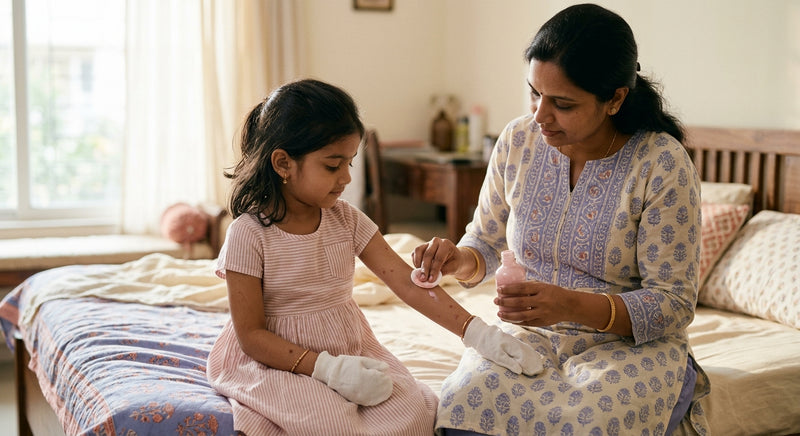
You change your baby's vest and there they are — tiny angry red bumps across the neck folds, upper back, sometimes the forehead. In most Indian homes we call it ghamori (or ghamoriyan): prickly heat. Here's the reassuring bit first, because you're probably reading this at 2am with a fussy baby on your shoulder: ghamori is not dangerous, it isn't an infection, and it usually settles within a couple of days once you cool the skin down. You don't need a strong cream. You need less heat, less sweat, and a few careful choices.
At a glance
- Ghamori (prickly heat) happens when blocked sweat glands trap sweat under a baby's skin — pure heat and humidity, not dirt or an allergy.
- The real remedy is cooling, not covering: shade, a fan, thin cotton, and short lukewarm baths.
- Skip thick talc mountains, heavy oil malish in peak heat, and "cooling" powders with strong fragrance.
- A cool cotton compress calms the sting faster than most creams.
- See a doctor if bumps turn into pus-filled spots, the baby has a fever, or it hasn't cleared in 3–4 days.
What is ghamori, really?
Sweat glands are how the body cools itself. On a sticky Indian afternoon a baby sweats a lot — and their sweat ducts are narrow and still forming, so they clog easily. The sweat gets trapped just under the surface and leaks into the skin, which reads it as an irritant. That's the prickle. That's the rash.
So this is a plumbing problem, not a hygiene one. Scrubbing harder or bathing five times a day won't fix it, and can leave the skin more raw. If you want the full picture of why it starts and how the skin mends, our complete guide to prickly heat through the Indian seasons walks through it slowly. For the plain-language version of causes and relief, this piece on prickly heat in babies and gentle relief is a good companion read.
One thing to hold on to: a baby's skin is 20–30% thinner than an adult's. It heats up faster, and it reacts faster. It also cools faster — which is exactly why plain cooling works so quickly here.
The three faces of ghamori
Not every prickly-heat rash looks the same, and reading which one you've got tells you how gentle to be.
| What you see | What it usually is | What it needs |
|---|---|---|
| Tiny clear, water-drop blisters, no redness | The mildest form — trapped sweat very close to the surface | Just cooling; often gone in hours |
| Small red bumps that prickle or itch (neck, back, chest) | The classic ghamori most Indian babies get | Cooling + a soothing compress |
| Bumps with yellow pus tips, warmth, spreading redness, fever | Possibly a secondary infection — not simple ghamori | See a paediatrician |
Home remedies that actually help tonight
Everything below does one job: lower the skin's temperature and cut the sweat.
- Cool the room first. Fan on, cross-ventilation open, or AC at a comfortable 24–26°C. A slightly cool room does more than any product.
- Cool cotton compress. Dip a soft cotton cloth in plain cool (not ice-cold) water, wring it, and lay it on the rash for a few minutes. Repeat 2–3 times. The prickle usually eases almost at once.
- Short, lukewarm baths. One or two quick baths a day, lukewarm and leaning cool. Skip hot water — it reopens the flush. Pat dry, don't rub, and give the skin creases a minute to air-dry fully.
- Dress light and loose. Thin, breathable cotton only. No synthetic onesies, no double layering "to be safe." A sweaty vest is the number one cause of a next-day flare.
- Change out of damp clothes fast. After a feed, a nap, or play — if the vest is damp, change it. Trapped moisture is the enemy.
- Keep folds dry. Neck, underarms and thigh creases hold sweat. Dab them dry gently through the day.
Traditional Indian remedies: keep, and skip
Every family has a ghamori remedy handed down from a grandmother. Some are lovely. A few do more harm than good in today's heat, so let me be honest about them.
Worth keeping
- Cool water baths and cotton. Nani was right about this one — it still works.
- A thin chandan (sandalwood) or multani mitti paste can feel cooling for older babies — applied thinly, kept well away from the face and eyes, rinsed off gently, and only if the skin isn't broken. Patch-test first. Never let a thick clay mask dry hard on a baby.
Better to skip or go easy on
- Mountains of talcum powder. A thin dusting on dry skin is one thing. Caked powder on sweaty skin turns to paste, blocks the glands further, and can be inhaled. Less is more.
- Heavy oil malish in peak heat. A rich mustard or coconut oil massage is beautiful in a Nagpur winter, but a thick oil layer on a sweating baby traps the heat. Save the full malish for cooler hours, or lighten it during a heat wave.
- Strongly fragranced "cooling" powders and sprays. Menthol-heavy products can sting thin baby skin. Fragrance is a common irritant.
Ghamori by Indian season
May isn't the only culprit. Ghamori wears a different face in each season, so your response has to move with the weather.
- Peak summer (Nagpur, Delhi, most of the plains). Dry, brutal heat. Lean on shade, hydration (breast milk or water as age-appropriate), fans, and the lightest possible clothing.
- Monsoon. This is the sneaky one. The temperature drops but the humidity shoots up, sweat won't evaporate, and ghamori can be worse than in summer. Keep the skin dry, run a dehumidifier or fan, and change damp clothes often.
- Coastal and humid cities (Mumbai, Chennai, Kolkata). Humidity here barely lets up, so ghamori can turn up even in "winter." Breathable cotton is a 12-month habit in these homes.
Is it ghamori — or something else?
Parents mix these up all the time, and the care differs. Heat rash sits where sweat pools; a diaper rash sits under the nappy; eczema is dry, rough and long-running. If you're second-guessing, our honest breakdown of how to tell heat rash, diaper rash and eczema apart lays out the differences clearly.
A gentle wash routine that doesn't strip the skin
Don't over-wash irritated skin — but a cool, clean bath genuinely helps ghamori. The trick is a mild, tear-free, fragrance-conscious cleanser used sparingly. Soap and hot water can leave prickly skin drier and angrier. Look for something made for a baby's thin skin, without harsh sulfates or heavy perfume. A short lukewarm bath with a gentle tear-free foam wash once a day, then careful patting-dry, keeps the skin clean without disturbing its barrier.
After the bath, resist the urge to slather a thick cream over an active heat rash — heavy occlusives can trap the warmth. Save richer barrier care for once the rash has settled, or for genuinely dry, cracked patches.
When to see a doctor
Most ghamori clears with cooling alone. Book a paediatrician visit if:
- The bumps develop white or yellow pus tips, or the area turns warm, swollen and increasingly red.
- Your baby has a fever, is very unsettled, or feeding poorly.
- The rash hasn't improved in 3–4 days of good cooling, or keeps coming back badly.
- Your baby is a newborn and the rash is widespread — younger skin deserves a quicker check.
A doctor can rule out an infection or a different rash entirely, and there's no prize for waiting it out at home when something looks off.
Ghamori is one of those parenting scares that looks alarming and then quietly resolves. Cool the skin, dress your baby light, keep the folds dry, and let those tiny sweat ducts open up again. And on the days when a gentle, cooling bath is what your baby needs, a mild tear-free foam wash is a calm, sensible place to start.
In summary
- Ghamori is trapped sweat, not dirt — the fix is cooling the skin, not scrubbing it.
- Use a cool cotton compress, a fan, and thin loose cotton to calm a flare tonight.
- Keep baths short and lukewarm, and change your baby out of damp clothes fast.
- Go easy on thick talc and heavy oil massages in peak heat and humidity.
- See a paediatrician if bumps turn to pus, a fever appears, or it lasts beyond 3–4 days.
Frequently asked questions
What is the fastest home remedy for ghamori in babies?
Cool the skin down. Move your baby to a fan or cooler room, lay a soft cotton cloth dipped in plain cool water on the rash for a few minutes, and change them into thin, loose cotton. A short lukewarm bath helps too. Cooling settles the prickle faster than any cream, usually within a day or two for simple prickly heat.
Can I use talcum powder for baby ghamori?
Only a light dusting on completely dry skin, and even then sparingly. Heavy powder on sweaty skin turns pasty, blocks sweat glands further and can be inhaled, which makes ghamori worse. Cooling the skin, breathable cotton and keeping folds dry work better and more safely than piling on powder.
Is ghamori and prickly heat the same thing?
Yes. Ghamori (or ghamoriyan) is the common Hindi and Marathi word for prickly heat, also called heat rash or miliaria. It's the same condition: blocked sweat glands trapping sweat under the skin during hot, humid weather, showing up as tiny red or clear bumps on the neck, back, chest and forehead.
Why does my baby get ghamori during the monsoon and not just summer?
Because ghamori is driven by humidity as much as heat. In the monsoon the temperature drops but the air is very moist, so sweat can't evaporate and stays trapped on the skin. That's why prickly heat can actually be worse during the rains. Keep skin dry, use a fan, and change damp clothes quickly.
Should I stop massaging my baby with oil if they have ghamori?
Not stop, but adjust. A thick oil malish on a sweating baby in peak heat traps warmth and can worsen prickly heat. Lighten the oil, do the massage during cooler hours of the day, or pause the heavy layer until the rash settles. Rich winter-style massages are better saved for cooler weather.
How long does ghamori take to clear in babies?
Simple prickly heat usually improves within a couple of days and clears in about 3–4 days once you cool the skin and reduce sweating. If it hasn't settled in that window, keeps returning badly, or the bumps develop pus, warmth or fever, it's time to see a paediatrician to rule out infection or a different rash.