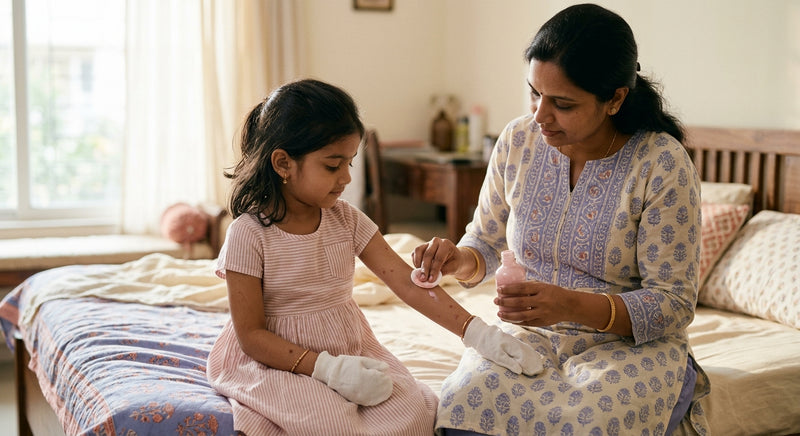
The first time I really turned a baby lotion bottle over and read the small print on the back — the bit most of us skip — I was standing in a chemist's aisle in Nagpur, pregnant, slightly overwhelmed. The front said all the lovely things: gentle, natural, dermatologist-something. The back had one tiny line: Manufactured by… a third-party name I'd never heard of, in a town I couldn't place. That gap — between the promise on the front and who actually made it on the back — is what GMP is about.
GMP (Good Manufacturing Practice) is the set of rules that decide how cleanly, consistently and safely a product is physically made — the water, the hygiene, the testing, the records. For something you'll rub onto newborn skin twice a day, that backstage process matters at least as much as the ingredient list on the front. If you're comparing baby brands, this fits into our complete guide to choosing baby & junior products in India — and below, I'll answer the four questions parents actually ask me about it.
At a glance
- GMP = how it's made, not just what's in it: hygiene, water quality, batch testing and traceability.
- It matters more for babies because their skin is 20–30% thinner than an adult's and absorbs more.
- Own facility vs white-label changes who controls quality — and who's accountable when something goes wrong.
- You can vet a brand in two minutes: look for a GMP-certified facility, a manufacturing licence, batch numbers and real testing.
- A clean label on a poorly-made product is still a poorly-made product.
What does GMP actually mean — in plain words?
GMP stands for Good Manufacturing Practice. Forget the jargon. It's a quality-control rulebook for the factory itself, not the recipe. It covers the boring-but-vital things: how clean the rooms are, the grade of water used, whether equipment is sanitised between batches, how raw materials are checked when they arrive, and — crucially — whether every batch is tested and recorded before it ships.
Think of it like a kitchen. Two cooks can use the identical recipe. One works in a spotless kitchen, washes hands, checks the dal isn't spoiled, and notes down what went into each pot. The other doesn't. Same recipe, very different outcome. GMP is the rulebook that keeps the first kitchen honest — batch after batch, not just on a good day.
In India, cosmetic manufacturing is regulated, and a credible baby brand will hold a manufacturing licence (often referenced as an FDA cosmetic-manufacturing licence) and follow BIS-aligned standards. Those aren't marketing words — they're verifiable. It's also why "natural" or "herbal" on the front tells you nothing about how cleanly the product was actually made. That's a separate question, and GMP is the answer to it.
Why does GMP matter more for baby products than adult ones?
Because a baby's skin isn't just a smaller version of yours — it's genuinely different. A newborn's skin is around 20–30% thinner than an adult's, its barrier is still maturing, and it has a higher surface-area-to-weight ratio. In plain terms: whatever you put on absorbs more readily, and there's less margin for error. Up to roughly 48.6% of babies experience atopic-type skin issues, so a lot of these tiny faces are already a bit reactive to begin with.
Then there's what poor manufacturing can introduce — the part you'll never see on the label. Microbial contamination from unclean water or equipment. Preservative levels that swing the wrong way (too little and it spoils, too much and it irritates). A "good" batch and a "bad" batch of the same product, because nobody tested between runs. On adult skin, a sub-par batch might mean a stinging cheek. On a baby, the stakes — and the worry at 2am — are higher.
It's why I push parents to read both sides of the bottle. A thoughtful ingredient list (the kind I walk through in our real checklist for choosing a baby moisturizer) is only half the story. The other half is whether the factory can be trusted to make that formula the same, safely, ten thousand times.
Own facility vs white-label: does it really change anything?
Honestly? Yes — more than most parents realise. "White-label" or contract manufacturing means a brand designs (or buys) a formula and pays a third-party factory to produce it under the brand's name. It's completely legal and common. The catch is control. The brand on the front often doesn't own the formula, can't always see day-to-day quality decisions, and may share a production line with a dozen other unrelated products.
When a brand makes its own products in its own GMP-certified facility — which is the path we chose at Janma, in our own unit in Nagpur — the brand and the maker are the same people. We own our formulations, so there's no "that's the factory's problem" when a question comes up. Accountability and the recipe sit under one roof. That's not a moral high ground; it's just a different, more traceable structure. Here's the honest comparison:
| Question | White-label / contract | Own GMP facility |
|---|---|---|
| Who owns the formula? | Often the factory, or shared | The brand |
| Who controls daily quality? | Third party | The brand itself |
| Traceability if there's an issue | Can be a paper trail across companies | One roof, one record |
| Production line | Often shared with other brands | Brand's own line |
| Who's accountable to you? | Sometimes unclear | The name on the front |
Does white-label automatically mean unsafe? No — plenty of contract manufacturers run excellent GMP facilities. And owning a facility doesn't automatically make a brand good either; it has to actually run to standard. So this isn't "own = good, white-label = bad." It's that you should know which one you're buying, and what proof backs it.
How do I check if a baby brand actually follows GMP?
You don't need to be a chemist. You need about two minutes and a healthy bit of scepticism. Here's the exact check I'd run before buying anything for a newborn:
- Find the maker. Read the back. Does it name a real manufacturing facility and a licence number (e.g. an FDA cosmetic-manufacturing licence)? Vague or missing = a flag.
- Look for a batch number and expiry. Real batch testing leaves a paper trail. No batch code is a quiet red flag.
- Check for GMP / quality certification. Genuine brands say so plainly and can show it — not just "made in a state-of-the-art facility."
- Separate "tested" from "natural." "Herbal" is a recipe word, not a safety word. Look for what "dermatologically tested" actually means and real, specific testing.
- Read the claim carefully. "Clinically tested" and "in-vivo tested" are meaningful; vague phrasing often isn't — here's how to read "clinically proven" on a label without being fooled.
- See if accountability is clear. Can you tell who to contact, and is the brand the same entity that made it?
To show you what real proof looks like: our own products are made in our GMP-certified facility, are BioCert Organic and FDA-licensed for cosmetic manufacturing, BIS-compliant and dermatologically tested — and where we make a claim, it's backed by testing (for example, our balm helps support the skin barrier, shown by increased Keratin-10 and Filaggrin expression in a lab study). I'm not listing that to boast. I'm showing you the shape of evidence to ask any brand for. If a brand can't point to anything that specific, that tells you something too.
So what should you do tonight?
Pick up the two or three baby products already in your bathroom and turn them over. Find the maker, the batch number, the licence, the testing. You're not trying to fail anyone — you're just learning to read the back of the bottle as carefully as the front. Do it a few times and it becomes second nature, and the marketing on the front loses its grip on you.
The brands worth your money are the ones that make it easy to check. They tell you where it's made, who made it, and what was tested — because they have nothing to hide and everything documented. That's the whole quiet promise of GMP: not a louder claim, but a cleaner, more honest way of making the thing you trust on your baby's skin.
When you want a daily moisturiser that embodies all of this — made in our own GMP facility, barrier-supporting and gentle enough for all ages — our Hydra Healing Moisturizing Balm is the one I'd reach for first.
In summary
- GMP governs how cleanly and consistently a product is made — the process, not just the ingredient list.
- It matters more for babies because their thinner, more absorbent skin leaves little margin for error.
- Know whether you're buying white-label or own-facility, and look for real proof either way.
- Vet any brand in two minutes: check the maker, licence, batch number, certification and testing.
- Treat a missing maker name or batch code as a quiet red flag, and read the back as carefully as the front.
Frequently asked questions
What does GMP mean for baby products?
GMP stands for Good Manufacturing Practice — the rules governing how cleanly and consistently a product is physically made, including hygiene, water quality, batch testing and record-keeping. For baby products it's especially important because a baby's thin, absorbent skin leaves little margin for contamination or inconsistent batches. GMP is about the factory and process, separate from the ingredient list on the front of the pack.
Is GMP the same as 'natural' or 'herbal' on a label?
No — they're completely different things. 'Natural' or 'herbal' describes ingredients, while GMP describes how safely and consistently the product was manufactured. A herbal product made in an uncontrolled facility can still carry contamination or batch-to-batch inconsistency. Always check both: a clean ingredient list and credible manufacturing standards. The marketing word on the front tells you nothing about the process on the back.
Why does GMP matter more for babies than adults?
Because a baby's skin is around 20–30% thinner than an adult's, its barrier is still maturing, and it absorbs more of what's applied. Up to roughly 48.6% of babies experience atopic-type skin issues, so many are already reactive. Poor manufacturing can introduce contamination or inconsistent preservative levels you'll never see on the label — and on delicate baby skin, the consequences and worry are simply higher.
Is a white-label baby product unsafe?
Not automatically. White-label (contract) manufacturing is legal and common, and many contract factories run excellent GMP facilities. The real issue is control and accountability — the brand may not own the formula or oversee daily quality, and lines are often shared. Owning a facility doesn't guarantee quality either. The point is to know which model you're buying and to look for real proof of standards behind it.
How can I check if a brand follows GMP before buying?
Turn the pack over. Look for a named manufacturing facility and licence number, a batch number and expiry, a clearly stated GMP or quality certification, and specific testing language like 'clinically tested' or 'dermatologically tested' rather than vague claims. If you can't tell who made it, find a batch code, or see any verifiable certification, treat that silence as a red flag and choose a more transparent brand.