In most Indian homes, the daily nahana isn't up for debate. Grandmother oils the baby, the bath water heats on the stove, and skipping a day feels almost like neglect. So when a paediatrician says, “you don't need to bathe a newborn every day,” most parents just blink at her.
Here's the honest answer: a newborn needs a full bath only 2–3 times a week. Babies and toddlers can usually be bathed daily if it's short, gentle and lukewarm — but daily isn't a rule, it's an option. Over-bathing strips the thin, still-forming skin barrier faster than most parents expect. A lot of the dryness and irritation I see starts right there, quietly, before anyone connects it to the bath.
I'm Sneha, a cosmetologist at Janma. My work is the boring, granular stuff — how water, cleansers and skin barriers actually behave. So let me lay out what the belief gets right, where the evidence disagrees, and a routine you can follow tonight. For the wider picture, this sits inside our complete guide to baby bath time.
At a glance
- Newborns (0–1 month): 2–3 full baths a week is plenty. Top-and-tail on other days.
- Babies (1–12 months): Daily is fine if baths are short and lukewarm — but not required.
- Toddlers & juniors: Daily suits Indian heat and play, especially in summer.
- Water temperature and bath length matter more than frequency.
- Moisturise within 3 minutes of every bath — that one step protects everything the bath took away.
The myth: “a baby must be bathed every single day”
I understand where this comes from. For much of the year our weather is hot and sticky, the malish oil has to come off somewhere, and the morning bath is how the whole house agrees the day has started. None of that is silly.
The problem is the “no matter what” part. A baby's skin is 20–30% thinner than an adult's. It loses water faster, and the protective barrier — the layer that keeps moisture in and irritants out — is still maturing right through the first year. Warm water and any cleanser lift off a little of the skin's own oil each time. On you or me, that's nothing. On a two-week-old, done daily with the wrong product, it leaves skin dry, flaky and quick to react.
The fact: frequency depends on age, not habit
Paediatric bodies are far more relaxed about this than the average grandmother. For newborns, 2–3 baths a week covers hygiene — the nappy area, the face and neck get wiped far more often anyway, and those are the parts that actually need it. Here's how I'd map it for an Indian household.
| Age | Full baths | Why |
|---|---|---|
| Newborn (0–1 month) | 2–3 / week | Barrier still forming; over-washing dries skin. Top-and-tail daily instead. |
| Baby (1–12 months) | Daily optional | Fine if short, lukewarm & gentle. Skip a day in dry winters if skin looks tight. |
| Toddler (1–3 yrs) | Daily | Active, sweaty, on the floor — daily makes sense, especially in summer. |
| Junior (3+ yrs) | Daily | School, play, Indian heat. Daily is normal and helpful. |
Does the season change how often to bathe a baby?
Yes — and this is where Indian homes get most tangled up. Our weather isn't one thing. It swings hard, and a baby's skin swings with it.
- Peak summer (Nagpur, Delhi, the plains): heat rash and sweat are real problems. A daily bath — even a quick evening rinse — keeps babies and toddlers comfortable. Keep the water lukewarm, not straight from the cold tap.
- Monsoon: humidity plus damp everything. Bathe as usual, but dry the skin folds properly — neck, groin, behind the knees. Trapped moisture is what irritates, not the bath.
- North Indian winter: this is when daily bathing does the most harm. The dry, cold air is already pulling water out of the skin. Drop a newborn to 2–3 baths a week; for older babies, keep baths short and moisturise generously.
Why bath length and cleanser matter more than the count
How you bathe matters more than how often. You can bathe a baby every day and keep their skin soft. You can bathe them twice a week and still dry them out. It comes down to three things.
Water temperature. Hot water feels wonderful to us and is rough on baby skin. It swells the skin and lifts the barrier lipids that hold water in. Go lukewarm — around body temperature. Test it on the inside of your wrist or elbow; it should feel like nothing, neither warm nor cool.
Bath length. A long soak in warm water dries skin out, it doesn't hydrate it. Five to ten minutes is plenty. Parents assume more water means more moisture. It's the reverse.
The cleanser. This is the part I obsess over at work. Ordinary soap sits at a high, alkaline pH — often 9–10 — while a baby's skin wants to stay mildly acidic, around 5.5. Every alkaline wash knocks the barrier off balance. A well-made syndet or tear-free foam wash is built at that skin-friendly pH, with gentle surfactants that clean without stripping. If you want to know what actually makes a wash gentle, I've broken it down in how to choose a gentle baby body cleanser in India. And for the many babies who cry through every bath, our gentle, tear-free bath routine walks through the calming steps.
On most bath days a newborn doesn't need cleanser everywhere — plain lukewarm water cleans a young baby well. Save the gentle wash for the nappy area, the scalp and any oily malish residue.
A gentle bath routine you can do tonight
- Warm the room and gather everything first — towel, clean clothes, nappy, moisturiser — so baby isn't left cold and wet.
- Fill with lukewarm water; test on your inner wrist.
- Keep it to 5–10 minutes. Support the head and neck the whole time.
- Use a small amount of a tear-free, pH-balanced wash — mainly on scalp, nappy area and folds. Water alone is fine elsewhere.
- Rinse gently, pat (don't rub) dry — especially the neck, underarm and groin folds.
- Moisturise within 3 minutes, while skin is still slightly damp, to lock in water.
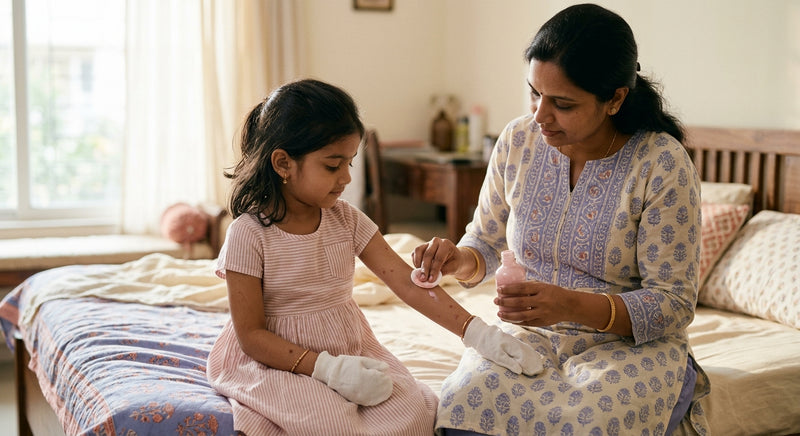
Miss the bath count if you must, but don't miss that last step. Bathing takes some natural oil off; a good moisturiser gives the barrier what it needs to hold water again. For dry patches, eczema-prone skin or that winter tightness, a richer balm on the driest spots after the bath makes a real difference — in in-vivo testing, some babies showed visibly calmer skin in as little as 1 day. A tear-free head-to-toe baby foam wash in the bath, moisturiser straight after — for a healthy baby, that's genuinely all it takes.
When to see a doctor
Bathing frequency is rarely a medical problem by itself, but check with your paediatrician if you notice: persistent dry, cracked or weepy patches that don't settle with moisturising; widespread redness or rash; skin that looks infected (yellow crust, swelling, warmth); or a baby who seems distressed at every bath despite a gentle routine. For a newborn whose umbilical cord stump is still on, ask your doctor before the first full tub bath — sponge baths are usually advised until it heals.
Trust what you see. If your baby's skin stays soft, calm and comfortable, your routine is working — whatever the frequency.
And if bath time leaves your little one's skin a touch dry, start with the simplest fix: a gentle, tear-free wash that respects a baby's natural pH. Our Head to Toe Baby Foam Wash was formulated for exactly that.
In summary
- Bathe newborns just 2–3 times a week; top-and-tail on other days to protect the barrier.
- Daily baths are fine for older babies and toddlers if they're short, lukewarm and gentle.
- Adjust for the season — daily in summer heat, less often for newborns in dry winters.
- How you bathe (temperature, length, cleanser pH) matters more than how often.
- Moisturise within three minutes of every bath to lock in water and support the barrier.
Frequently asked questions
How often should you bathe a newborn in India?
A newborn only needs a full bath 2–3 times a week. Their skin barrier is still developing and over-washing dries it out. On other days, "top-and-tail" instead — clean the face, neck folds, hands and nappy area with a soft damp cloth. The face and nappy area naturally get cleaned far more often anyway.
Is it okay to bathe a baby every day in Indian heat?
Yes, for babies over a month and especially toddlers, daily bathing suits Indian summers and keeps sweat and heat rash at bay. The key is to keep baths short (5–10 minutes), use lukewarm water, use a gentle pH-balanced wash sparingly, and moisturise within three minutes afterwards to replace lost oils.
Does daily bathing dry out a baby's skin?
It can, if the water is hot, the bath is long, or the cleanser is a harsh alkaline soap. Done gently — lukewarm water, a short bath, a tear-free skin-pH wash, and prompt moisturising — daily bathing won't dry a baby out. In dry North Indian winters, though, reducing frequency for newborns helps.
Should I bathe my baby less in winter?
Yes. Cold, dry winter air already pulls moisture from the skin, so daily hot baths can leave a baby flaky and tight. For newborns, drop to 2–3 baths a week in winter; for older babies, keep baths short and lukewarm, and moisturise generously right after every bath.
What water temperature is right for a baby's bath?
Lukewarm — around body temperature, roughly 37°C. Test it on your inner wrist or elbow; it should feel neutral, neither warm nor cool. Hot water feels comforting to adults but swells and strips a baby's thin skin barrier, which is the most common cause of post-bath dryness I see in Indian babies.