A raw-material rep slid a sample across my desk in Nagpur one afternoon. "Sir, this is trending. Everybody is putting it in baby creams this year." He meant it kindly. It was also the fastest possible way to get his ingredient rejected. We don't choose ingredients because they're trending. We choose them because they clear seven specific gates — safety data, Indian climate, hard water, how it feels on a baby at 2am, stability at 42°C in a Delhi delivery van, the honest dose, and evidence we can actually defend.
This is the screen we run inside our own factory, written out plainly. A shortened version fits in your head, and you can use it on any label, from any brand, standing in a shop tonight. That's why it's published.
At a glance
- "Natural" and "chemical-free" are not selection criteria. Safety data, dose and stability are.
- A baby's skin is 20-30% thinner than an adult's. That shrinks the margin for error on an actives dose. It doesn't widen it.
- Hard water, monsoon humidity, dry winter heating, 40°C+ transport — an ingredient has to hold up through all of it.
- We ask for the dose a supplier's study used, not just the ingredient name.
- If it can't clear stability and preservative-efficacy testing, it doesn't ship. However lovely it sounds.
If you want the wider picture — the facility, the testing, the decisions we've made and the ones we've reversed — it's collected in our complete guide to how Janma is made. This piece is one narrow slice of it: the ingredient gate.
Why can't we just pick "natural" ingredients and be done?
Because "natural" tells you where a molecule came from. It says nothing about what that molecule does to a four-month-old's cheek. Lemon juice is natural. So are undiluted essential oils. Neither belongs anywhere near infant skin.
The number that keeps us honest is this one: a baby's skin is 20-30% thinner than an adult's, and the barrier is still assembling itself. Thinner barrier, so more of whatever you apply gets through, and faster. Which is why our questions are boring and specific. At what percentage is this safe on infant skin? What's the sensitisation record? What pH does it work at? And what has it quietly turned into after six months on a shelf above the bucket, in a Chennai bathroom, in July?
Owning the plant changes how those questions get answered. White-label, and what arrives is a finished formula and a price. Make it yourself — the decision we made early and would make again — and you can strike one ingredient on a Tuesday morning without reopening a contract. On a baby product, that is worth more than any hero ingredient.
The seven-step ingredient screen we run
Herbal, synthetic, licensed active, somebody's grandmother's recipe: same order, every time. Nothing skips a step for being fashionable.
- Step 1 — Ask what job it does. One function, stated in one sentence: humectant, emollient, occlusive, preservative, chelator, active. If nobody at the bench can say what it's for, it's decoration. And decoration on baby skin is just exposure with nothing attached to it.
- Step 2 — Pull the safety data, not the marketing deck. We want the dossier: sensitisation and irritation data, the concentration range it was assessed at, and any age-specific guidance. "Used since ancient times" is not a dossier. Nor is a folder of studies run at ten times the dose we'd ever use.
- Step 3 — Check the dose, then halve the ambition. This is where most hero-ingredient stories collapse. An extract can look excellent at 3% in a lab study and be tolerated on infant skin at a fraction of that. If the safe infant dose sits below the dose that actually does something, we're finished — it's out. Honest answer: this kills a lot of exciting botanicals.
- Step 4 — Pressure-test it against Indian reality. Hard water across most of the North and West. Monsoon humidity. Dry winter heating. A supply chain that routinely sees 40°C+. Anything that separates, discolours or loses potency in those conditions is a lovely idea and a bad product.
- Step 5 — Check what it does to pH and to the barrier. Healthy baby skin sits on the mildly acidic side. Anything that drags a formula alkaline gets hard scrutiny, because that's the door dryness and irritation walk through. What we're hunting for is the opposite: combinations that support the barrier rather than strip it. In our own lab work, a barrier-supporting blend showed increased Keratin-10 and Filaggrin expression — that's the kind of signal worth chasing.
- Step 6 — Put it on skin. Properly, with consent, under supervision. In-vivo testing on the finished formula, not a clean claim borrowed off an ingredient sheet. It's slow, it costs real money, and it's the only part of the process that tells you the truth. We've written separately about what "clinically tested" actually means on a baby label, because the phrase gets thrown around far too loosely.
- Step 7 — Prove it survives the shelf. Stability at elevated temperature, preservative-efficacy (challenge) testing, packaging compatibility. A cream that is beautiful on day one and contaminated on day ninety is a safety failure, and we've eaten the cost of that lesson rather than argue with it. If it doesn't clear this, it doesn't ship — whatever we've already spent getting it this far.
What we ask the supplier vs what the label shows you
Most parents read the label as the whole story. It's the summary. Here's the gap, honestly.
| What we ask a supplier | What ends up on the label | What you can infer |
|---|---|---|
| Exact % used, and the % it was safety-assessed at | Just the ingredient name | Position in the INCI list — anything after the preservative is usually below 1% |
| Sensitisation and irritation dossier | Sometimes "dermatologically tested" | Whether the brand tested the finished product or leaned on ingredient data |
| Extraction solvent, carrier, standardisation | "Extract" | Very little — which is why brand transparency matters |
| Stability + challenge test results | A shelf-life date and PAO symbol | Whether the preservative system is complete and sensible |
| Fragrance composition, allergen breakdown | "Parfum" or "Fragrance" | One word can hide dozens of components — for reactive baby skin, fragrance-free is the simpler bet |
The Indian-climate questions nobody asks in a formulation textbook
Hard water
Look at your geyser. If it wears a crust of scale, the bathwater is already doing something to your baby's skin before a product ever touches it. Add a high-pH cleanser and the two of them strip the barrier together. So when we screen a surfactant, the question isn't only "is it mild?" It's "is it still mild in 300+ ppm water?" Chelators earn their place in a formula for exactly this reason, and almost no parent has heard of them.
Sweat, not just dryness
Half of India's year is a sweat problem. An occlusive that is perfect for a Delhi January turns into a heat-rash risk by a Mumbai June, on the same baby, in the same fold of skin. Texture has to move with the season. "One cream for everything" is usually a decision taken in a marketing meeting rather than a lab.
Malish, ubtan, ghee
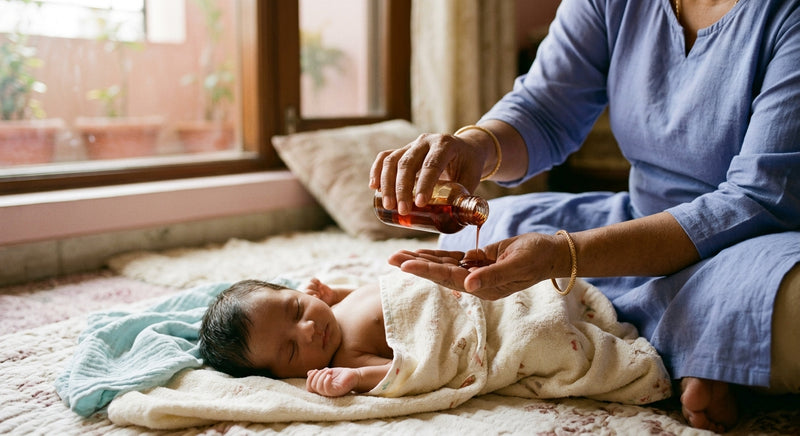
These traditions aren't the enemy. Half our formulation instincts came out of them, and out of watching our own mothers. But respect and exemption are different things. A traditional oil still has to answer the comedogenicity question, the rancidity question, and the one nobody enjoys: what happens when it's warmed on a stove and applied a little too hot. We treat tradition as a hypothesis worth testing.
How to run a 60-second version of this screen tonight
No lab required. A phone torch and a bit of stubbornness will do. Turn the pack over — the back, not the front.
- Read the INCI list, top five. The first five ingredients are most of what's in the bottle. If you can't spot a function among them — water, an emollient, a humectant, an occlusive — be sceptical of the story printed on the front.
- Find the preservative. Usually near the end. Its presence is good news. An unpreserved water-based cream, sitting in an Indian bathroom through August, is a contamination risk. "Preservative-free" on a water-containing product deserves a question, not applause.
- Check where the hero ingredient sits. If the front of the pack shouts about an ingredient and you find it last, after the fragrance, you now know what it's doing there: selling.
- Look for "Parfum" / "Fragrance". Up to ~48.6% of babies experience atopic-type skin issues. On reactive or atopic-prone skin, fragrance-free removes an entire variable, free of charge.
- Check the manufacturer line. "Manufactured by" tells you who actually made it. A brand that makes its own product can change one ingredient. A brand that doesn't, mostly can't. If you want to see why that line matters, here's what a GMP baby skincare facility actually looks like from the inside.
- Patch test anyway. Coin-sized amount, inner forearm, once a day for two to three days, before it goes anywhere near the face or a large area. Every brand, every time. Ours included.
When to see a doctor
No ingredient screen replaces a paediatrician. See one if your baby's skin is weeping, crusting, bleeding or cracked; if redness spreads quickly or comes with fever; if a rash doesn't improve within about a week of gentle care; if your baby seems distressed or is sleeping badly because of itch; or if a new product triggers a reaction that doesn't settle within a day of stopping it. Products help skin feel comfortable. They don't diagnose, and neither should a label.
The honest summary
The best ingredient decision we make in a year is usually a removal. Something gets cut because the safe dose is too low to matter, or because it won't survive a Nagpur summer in the back of a truck, or because the data behind it turns out to be one small study on adult forearms. Nobody prints that on a bottle. It is still the reason a formula ends up quiet enough for skin that is only just learning how to be skin.
So the next time a pack shouts about a miracle ingredient, ask the one question that does any real work: at what dose, and who tested it on skin like my baby's? A brand that can answer that is worth your trust. A brand that can't has handed you an ingredient list that is really just poetry.
In summary
- Judge an ingredient by its dose and safety data, not by whether it sounds natural or trendy.
- Read the top five ingredients on the back of the pack — that's most of the formula.
- A hero ingredient listed after the preservative is there to sell, not to work.
- In India, hard water, humidity and 40°C+ transport decide whether a formula actually holds up.
- Patch test any new product on the inner forearm for two to three days — every brand, including ours.
Frequently asked questions
Are natural ingredients always safer for a baby's skin?
No. Natural describes origin, not safety. Undiluted essential oils and citrus juices are natural and can irritate infant skin badly. What matters is the safety dossier, the concentration used, the pH of the finished formula and whether the final product was tested on skin — not whether the molecule came from a plant or a lab.
How do I know if an ingredient is present at a useful amount?
Look at where it sits in the INCI list. Ingredients are listed in descending order of concentration down to 1%, after which order is flexible. If a hero ingredient appears near the very end, below the preservative, it is almost certainly present at a token level — enough for a front-of-pack claim, rarely enough to do anything meaningful.
Should baby products contain preservatives?
Any product containing water needs a preservative system. Without one, a cream sitting in a warm, humid Indian bathroom can grow bacteria and mould, which is a genuine safety risk for a baby. Preservatives are tested for efficacy in a challenge test. Being wary of a preservative name is understandable, but preservative-free water-based baby cream is the riskier option.
Why does Indian climate change which ingredients you choose?
Because the same formula behaves differently in a Mumbai monsoon, a Delhi winter and a 42°C delivery van. Hard water raises the bar for cleanser mildness. Humidity makes heavy occlusives feel suffocating and can worsen heat rash. Heat and transport test stability. An ingredient that works in a temperate lab may fail all three of those in real Indian use.
Are Ayurvedic ingredients used the same way in a modern formula?
They're treated as strong candidates, not automatic passes. We look for the same things we ask of any ingredient: a safe dose for infant skin, stability, no rancidity problem, and evidence beyond tradition. Many earn their place. Some don't survive the dose question — the amount that does something is higher than the amount that's comfortable on a baby.
What is the single most useful thing a parent can check on a label?
The first five ingredients and whether fragrance is present. The top five make up most of the formula and tell you what the product actually is. Fragrance, listed as parfum, is a common trigger for reactive skin and removes an easy variable if you avoid it. After that, patch test on the inner forearm for two to three days before wider use.