The stool is out on the veranda, the barber was booked three weeks ago, and somebody's dadi has already said it twice: ek baar mundan ho jaaye, phir baal ghane aayenge. You are holding a one-year-old who has decided this is the worst morning of his short life. And somewhere under all that noise you're wondering whether any of this actually does anything to his hair, or whether you're doing it because it is simply what your family does.
Straight answer first. Shaving a baby's head does not make hair grow back thicker, faster, darker or in greater quantity. The number of hair follicles your baby has was set before they were born. A razor works above the skin. The follicle sits below it, and nothing that happens on the surface reaches down to change what it has been programmed to do. Mundan can be meaningful. It can be tidy. It is completely fine to do. Just not for the reason most of us were given.
At a glance
- Shaving removes the hair shaft, not the follicle — so hair count, growth rate and eventual thickness stay the same.
- Regrowth looks thicker because every hair comes back at once with a blunt, cut tip instead of a fine, tapered baby tip.
- The real drivers of baby hair are genetics, age and general health — not a blade.
- The risks of mundan are on the skin, not the hair: nicks, razor burn, infection and a suddenly sun-exposed scalp.
- If you do it, insist on a fresh single-use blade or a sanitised clipper, and keep the scalp clean, moisturised and shaded for the next two weeks.
I have this conversation every mundan season, usually with the mother, usually while the grandmother listens from the other side of the room. It tends to end with everyone a little relieved. Skip the ceremony and you have not harmed your child's hair. Go through with it and you don't have to stand around afterwards waiting for a miracle. If you want the fuller picture of how baby hair behaves in the first few years, our complete guide to baby hair care walks through the whole arc: the newborn shed, cradle cap, washing, oiling, detangling.
Does shaving a baby's head really make the hair grow thicker?
No. But a flat "no" has never once convinced a family, so let me be specific about why.
A hair follicle is a small living factory rooted in the dermis, well below anywhere a blade can go. It decides three things: how many hairs it can produce, how coarse each one is, and how long that hair grows before it rests and sheds. All three are set by genes and by your baby's stage of development. Cutting the visible shaft is trimming grass. You change what shows above the ground. The root never gets the message.
The other belief that rides along with mundan is that it "cleans" the scalp of whatever the baby carried out of the womb. Half true, and worth saying so. A shave does make the scalp far easier to see and to wash, especially if there is stubborn cradle cap flaking on the crown. But whether those flakes stay away depends on how the scalp is cared for over the following weeks, not on the razor that passed over it.
Then why does hair after mundan look so much thicker?
Two reasons, and both of them are tricks of the eye. Then a third that nobody thinks to credit.
The tip changes shape. A baby's first hairs are fine and taper away to a soft, nearly invisible point. Cut one partway along and the new tip is blunt and flat. A whole head of blunt tips catches light differently, and it feels coarser under your palm. The hair is no wider at the root. It has simply stopped being wispy at the end.
The regrowth also arrives all together. Newborn hair sheds unevenly across the first year, which is the baby hair fall almost every parent panics about, and it is normal. Take everything off in one morning and the entire head restarts from the same day. What comes back is one even, dense-looking crop rather than a patchwork of old hair and new.
Now the third thing, the one nobody counts. Mundan usually happens somewhere between the first and third birthday, which is exactly when a child's hair is maturing anyway, from fine baby hair into stronger, more pigmented hair. The blade takes the credit for a change that was already coming.
| What people expect from mundan | What actually happens |
|---|---|
| More hair follicles / denser hair | Follicle count is fixed before birth. Unchanged. |
| Thicker individual strands | Strand width is set by the follicle. Unchanged — the blunt cut tip only feels thicker. |
| Faster growth | Growth rate is unchanged. Regrowth just starts from a visible zero. |
| Darker hair | Pigment comes with age and genetics, not shaving. |
| A cleaner scalp | Genuinely easier to wash and see — but only good routine care keeps it that way. |
Is mundan safe for the scalp — and what should I insist on?
Here is where I would spend your worry, because the risk of mundan was never the hair. It is the skin.
A baby's skin is 20-30% thinner than an adult's. Stretch that over the bone of a small skull, then add a child who will not sit still for eleven seconds, and a straight razor gives you almost no margin. Small nicks are common. So is razor burn on the nape and behind the ears. And the setting most of us know by heart, a temple courtyard, a shared barber's kit, a blade wiped down on a cloth between customers, is exactly where infection finds its opening.
- A new blade, opened in front of you. Not "just sterilised". Not the one from yesterday. Single-use, unwrapped while you watch.
- Consider a clipper instead of a razor. A sanitised electric clipper with a guard leaves a few millimetres of stubble and almost eliminates nicks. The families I know who switched never went back.
- Feed the baby and settle them first. Hungry and overtired means jerking. Jerking is how a nick happens.
- Dry hair, or lightly damp. Never oiled. Oil makes the blade drag, and then slip. Save the malish for another day.
- Check that vaccinations are current, tetanus included, before any blade touches skin.
- Nothing goes on afterwards. No powder, no ash, no haldi, no paste. Every mundan season I hear about a paste patted onto a nick that turned into an angry, weeping patch. Skip it.
How do I care for the scalp that same evening?
Keep it boring. That is the whole trick, and it is not a hard one.
- Plain lukewarm water, nothing else. No soap and no shampoo on day one. Cup the water over the head, let the loose stubble rinse away, then pat dry with soft cotton. No rubbing.
- Look at the scalp in good light. Behind the ears, along the nape. A clean nick can be left alone. A dirty one gets a gentle rinse.
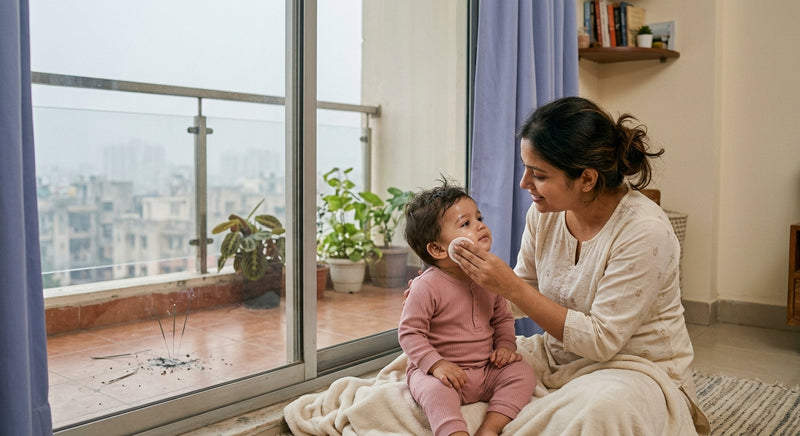
- Moisturise that same night. A freshly shaved scalp is bare and dries out quickly, especially under a fan or in AC. A thin layer of a bland, fragrance-free balm across the whole head keeps it comfortable, and keeps it from itching as the stubble pushes back through.
- Cover it outdoors. That head has never met direct sun. A soft cotton cap, and shade wherever you can find it, for the first few weeks. In an Indian summer this is not the step to be casual about.
- Gentle washing again from day three. Once any nicks have closed, a mild wash two or three times a week is plenty. We built our Head to Toe Baby Foam Wash for precisely this sort of undramatic, everyday cleaning: low-irritation, tear-free, and it rinses clean even in hard water, so nobody is scrubbing at a bare scalp to shift residue. If you're unsure how often is right, we've written about how frequently baby hair actually needs shampooing.
So what does influence how a baby's hair grows?
Genetics first, and it isn't close. Then age, because hair thickens on its own through the toddler years. Then nutrition and general health: a well-fed, well-growing child grows hair. After that, the honest list of things you can control is short, and a razor is on none of it.
A calm, clean scalp. Persistent cradle cap, fungal flaking, a scalp being scratched raw at night. None of that helps hair sit well. Keep it clean, keep it moisturised, and the rest largely sorts itself out.
The one I would actually worry about is mechanical stress. Tight rubber bands. A comb yanked through a knot. Brushing like you are angry at it. Traction damages a child's hair far more reliably than anything you did or didn't do at mundan, and if your toddler's hair tangles, our guide to detangling without tears through the Indian seasons is the practical fix.
Then there are the products, and here I will answer as a formulator rather than as a parent, because you deserve the blunt version. There is no topical product on earth, ours included, that adds follicles to a child's head. Any baby oil or shampoo promising "hair growth" is selling you a story your dadi tells for free. What a baby wash can honestly do is clean without stripping. Mild surfactants instead of harsh ones. A pH close to the skin's own. Minimal fragrance. A preservative system that is actually appropriate for a child. Those are the things we spec into our own formulations at our GMP-certified facility in Nagpur, where we make our products ourselves rather than white-labelling them, which is the only reason we get to choose any of it deliberately. Cleaning gently, and not irritating a scalp, is a useful and achievable goal. "Ghane baal" in a bottle is not.
When to see a doctor
Call your paediatrician if, after a mundan, you see spreading redness, warmth or swelling around a cut; any pus, yellow crusting or a foul smell; fever; or a nick that keeps bleeding. Check in too if bald patches appear with scaling or broken hairs, if the hair loss is patchy rather than even, or if your child is past three and hair growth still looks very sparse. Those deserve a proper look, not another shave.
Mundan is yours to keep or to skip. Do it because it means something in your family, not because you are buying hair. And when that small stubbly head comes back to you dry by evening, a thin layer of our Hydra Healing Moisturizing Balm is about the kindest thing you can put on it before bed.
In summary
- Shaving a baby's head at mundan does not add follicles, speed up growth or make strands thicker — the follicle sits below where any blade can reach.
- Regrowth looks fuller only because blunt cut tips replace fine tapered baby tips and everything grows back at once.
- If you do a mundan, insist on a fresh single-use blade or a sanitised clipper, feed and settle the baby first, and skip oil, powder, ash and haldi.
- Care for the bare scalp the same evening: plain water rinse, check for nicks, moisturise with a fragrance-free balm, and keep it capped or shaded in the sun.
- Hair growth is driven by genetics, age and general health — not a razor — so be sceptical of any baby product promising thicker or faster hair.
Frequently asked questions
Does shaving a baby's head make hair grow thicker?
No. Shaving removes the hair shaft above the skin, while the follicle that determines thickness, colour and growth rate sits below it and is unaffected. Regrowth only looks thicker because each hair returns with a blunt, cut tip instead of a fine tapered baby tip, and because everything grows back at once instead of patchily.
At what age is mundan usually done, and is there a right age?
Most Indian families do mundan somewhere between the first and third birthday, depending on community and family tradition. Medically there is no right or wrong age. What matters more is the state of the skin: postpone if your child has inflamed cradle cap, eczema, or any open or weepy area on the scalp, and make sure vaccinations, including tetanus, are up to date.
Is it safe to shave a newborn's head?
A newborn's scalp is very delicate, with soft fontanelles and skin 20-30% thinner than an adult's, so a razor near it carries real risk of nicks and infection. Most families wait until the baby is older and steadier. If a shave is done, insist on a fresh single-use blade or a sanitised clipper with a guard, and never apply powder, ash or paste afterwards.
What should I put on my baby's head after mundan?
For the first day, plain lukewarm water and a soft cotton cloth are enough. That night, apply a thin layer of a bland, fragrance-free moisturiser or balm to comfort the newly exposed skin as stubble emerges. Avoid haldi, ash, powder or herbal pastes on a freshly shaved scalp, especially over any nick. Keep the head shaded or capped outdoors.
Will my baby's hair grow back patchy after mundan?
Regrowth is usually even, because every follicle restarts from the same point on the same day. If patches appear with scaling, broken hairs or clearly bald areas, that is not a mundan effect and should be shown to a paediatrician. Overall hair density will match what your child's genes had planned, with or without the shave.
Do baby hair growth oils and shampoos work?
No topical product can add hair follicles to a child's head, so treat any baby oil or shampoo promising thicker or faster hair growth with scepticism. What a good baby wash can honestly do is clean without stripping: mild surfactants, a skin-friendly pH, minimal fragrance and an age-appropriate preservative system. Strong essential-oil blends on thin baby scalp skin often just irritate.