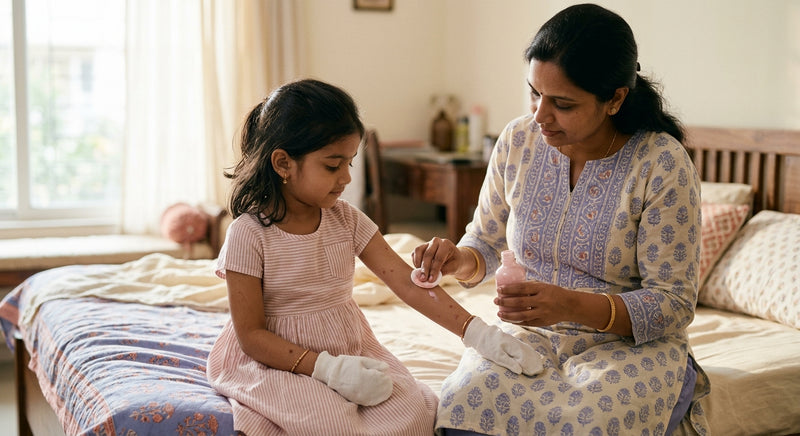
You've just bought a new lotion or oil for your baby. The label says gentle, the reviews are glowing, and your instinct is to slather it on after tonight's bath. Wait one night. A patch test — a small dab on a small patch of skin, watched for a day or two — is the single cheapest insurance you have against a red, itchy, miserable baby and a wasted weekend.
Here's the short version. Dab a pea-sized amount of the new product on a coin-sized patch of your baby's inner forearm or behind the ear, leave it on (don't wash it off), and check at 1 hour, 24 hours and 48 hours. Skin stays calm? It's reasonable to use more widely. Goes red, bumpy, or your baby keeps scratching it? Stop, wash gently, skip that product.
At a glance
- Patch test one new product at a time — never two together, or you won't know which one reacted.
- Test on the inner forearm or behind the ear; leave it on and check at 1 hr, 24 hrs and 48 hrs.
- A baby's skin is 20–30% thinner than an adult's, so it reacts faster and harder — testing matters more, not less.
- India's weather changes the read: summer sweat, monsoon damp and winter dryness can each mimic or mask a reaction.
- Mild redness that fades in an hour is usually friction; redness that grows or itches over a day is the product talking.
Parents ask me about this constantly. And honestly, most have never been told how to do it properly — only that they should. This sits right where careful, clinical skincare meets the gentle, traditional ingredients many Indian families trust; for the bigger picture, our complete guide to bridging clinical testing and Ayurvedic care walks through how the two fit together. This piece is just the practical bit: how to test, at home, tonight.
What is a patch test, really?
It borrows a simple idea from dermatology. Instead of exposing all of the skin to something new, you expose a tiny, controlled area first and watch it. If that small patch reacts, you've contained the problem to a 2-centimetre square instead of your baby's whole body. Same logic a skin doctor uses, scaled down for your bathroom.
And it isn't only for babies with known eczema or allergies. It's for any new thing — a moisturiser, a massage oil, a wash, a sunscreen, even a "100% natural" ubtan from a relative. Natural does not mean non-reactive. Mustard oil, besan, fragranced herbal blends, essential oils — these are some of the more common culprits I see, precisely because parents assume traditional equals safe.
How to patch test baby skincare at home, step by step
Do this on calm, intact skin — not on a patch that's already raw, broken or rashy, or you can't tell what's the product and what was there before. Pick a time when you can keep an eye on your baby for a day. Not right before you head out.
- Clean and dry the spot. The inner forearm is easiest for babies; behind the ear works too. Wipe with plain water, pat dry.
- Apply a small amount — roughly pea-sized — on a patch about the size of a one-rupee coin. A thin layer, the way you'd actually use it.
- Leave it on. Don't rinse, don't cover with a tight bandage. If you must cover it to stop your baby licking it, use a loose, breathable cotton — never cling film in Indian heat.
- Check at 1 hour. Immediate stinging, bright redness or hives means stop now and wash it off with lukewarm water.
- Check at 24 and 48 hours. A true irritant or allergic reaction often builds slowly — redness that's worse on day two, small bumps, dry flaking, or a baby who keeps rubbing that arm.
- If it's clean at 48 hours, it's reasonable to start using the product normally. Introduce the next new product only after this one's settled in.
Why India's weather changes what you see
Most guides skip this, and it's exactly what trips up Indian parents. The same product can read differently in a Nagpur summer than in a Pune monsoon, because the skin around your test patch is already being stressed by the climate. Knowing this stops you from blaming a perfectly fine product — or trusting one you shouldn't.
| Season | What it does to skin | How to patch test around it |
|---|---|---|
| Summer heat | Sweat and heat rash make skin pink and prickly on their own | Test in a cool part of the day; don't mistake heat-rash redness for a reaction. Keep the patch dry. |
| Monsoon humidity | Damp skin stays occluded; fungal and friction rashes are common | Dry the patch well first; watch longer (the full 48 hrs) as reactions can be slower to clear. |
| Dry winter | Already-dry, flaky skin can sting with anything, even water | Mild stinging may be dryness, not the product — moisturise the rest of the skin first, test on a less-dry patch. |
| Hard water | Leaves skin tight and slightly irritated after every bath | Test a few hours after a bath, not straight after, so hard-water tightness doesn't skew the read. |
Hard water gets its own line because so much of India has it. If your baby's skin always feels tight and a little angry after a bath, that's often the water, not the wash. So don't run a patch test in the ten minutes after a hard-water bath — you'll read the water's irritation as the product's.
Reading the result without panicking
Not every pink mark is an allergy. A little redness right under where you rubbed the product in, that fades within an hour, is usually just friction or warmth. What you're actually watching for is a reaction that grows: redness spreading beyond the patch, raised bumps or hives, dryness and flaking that wasn't there before, or your baby clearly bothered — rubbing, fussing, scratching.
There's a useful distinction between two kinds. An irritant reaction (the common one) shows up fairly fast and stays roughly where the product touched — too-strong fragrance, a harsh surfactant, an essential oil. A true allergic reaction can take 24–72 hours and may look more dramatic. Your move is the same either way: stop, wash gently, soothe with something you already know is safe, and don't reintroduce that product.
If a product passes its patch test but you still want to understand why it's gentle — what's actually in it, what the testing claims mean — it helps to learn how to read a baby skincare ingredient label properly and what a phrase like "clinically tested in-vivo" really means. A patch test tells you about your baby; the label and the testing tell you about the product. You want both.
A note on traditional oils and ubtans
I never want this to read as "new products good, old practices bad." That's not true, and it's not respectful of how most Indian families have cared for babies for generations. Malish with the right oil, a gentle ubtan, a steel-tumbler bath — these have their place. But "my mother used it on me" is not a patch test. Cold-pressed oils can go rancid, besan can be too rough on newborn skin, and some herbal blends carry strong essential oils. Patch test the traditional things exactly the way you'd patch test a bottle off the shelf. The skin doesn't know which is which.
When to see a doctor
For everyday redness that settles once you stop the offending product, you usually don't need a clinic visit. But if you're ever unsure, call your paediatrician — that's never the wrong move. You know your baby. Trust that.
What to reach for once a product passes
Once something's cleared its 48 hours, you can fold it into your routine with confidence. For dry, sensitive or eczema-prone patches — the skin most likely to react in the first place — a simple, well-tested barrier moisturiser does the heavy lifting day to day. If your patch testing keeps flagging problems and you want something formulated and tested for exactly this kind of sensitive, barrier-stressed skin, our Hydra Healing Moisturizing Balm is made for all ages and is a calm, dependable place to start — after its own patch test, of course.
In summary
- Patch test every new product — including natural oils and ubtans — before using it head to toe.
- Apply a pea-sized amount on a coin-sized patch of inner forearm and check at 1, 24 and 48 hours.
- Test only one product at a time, on calm intact skin, so you know exactly what reacted.
- Account for the season: heat, monsoon damp, winter dryness and hard water can all skew the result.
- Stop and see your paediatrician for facial swelling, breathing trouble, widespread hives or blistering.
Frequently asked questions
How long should I leave a patch test on my baby?
Leave a leave-on product (lotion, oil, balm) on the patch and check it at 1 hour, 24 hours and 48 hours. Reactions can build slowly, so the full 48 hours matters. For a wash or shampoo, lather on the patch, leave 1–2 minutes, rinse, then watch the same 24–48 hours since rinse-off products only touch skin briefly.
Where is the best place to patch test on a baby?
The inner forearm is easiest and easy to keep an eye on; behind the ear also works. Use calm, intact skin — never a patch that's already raw, rashy or broken, because then you can't tell what the product did versus what was already there. Clean and dry the spot first, then apply a small, pea-sized amount on a coin-sized area.
Do I need to patch test natural or Ayurvedic products too?
Yes. Natural does not mean non-reactive. Mustard oil, besan, fragranced herbal blends and essential oils are some of the more common causes of irritation precisely because parents assume traditional ingredients are automatically safe. Cold-pressed oils can also go rancid. Patch test a homemade ubtan or malish oil exactly the way you'd test a product off the shelf — your baby's skin can't tell the difference.
How does Indian weather affect a patch test?
The climate stresses the skin around your test patch, which can mimic or mask a reaction. Summer heat and sweat cause prickly redness on their own; monsoon damp slows reactions; dry winter makes skin sting with almost anything; and hard water leaves skin tight after a bath. Test in a cool part of the day, dry the patch well, and wait a few hours after a hard-water bath.
What does a bad patch test reaction look like?
Watch for a reaction that grows rather than fades: redness spreading beyond the patch, raised bumps or hives, new dryness or flaking, or your baby rubbing and fussing at the spot. Mild redness right under where you rubbed the product in that fades within an hour is usually just friction. If skin stays calm through 48 hours, the product is reasonable to use more widely.
Can I patch test two new products at the same time?
No — test one new product at a time. If you test two together and the skin reacts, you won't know which one caused it, and you'll have to start over. Clear one product through its 48-hour window before introducing the next. It's slower, but it's the only way to actually know what your baby's skin tolerates.