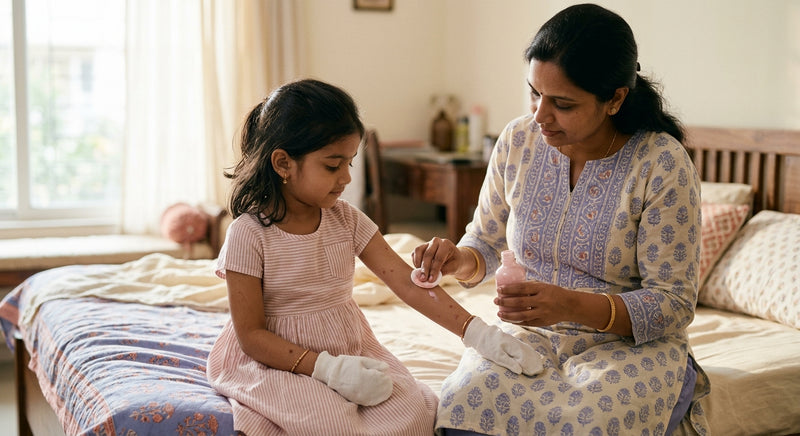
You're in the aisle, or scrolling at 1am with the baby finally down, and the label says "clinically tested in-vivo." Sounds serious. Sounds safe. But what does it actually mean — and is it any different from the dozen other phrases crowding the same box?
Short version: in-vivo means the product was tested on real, living human skin — actual volunteers, used the way you'd use it at home, watched over a set number of days by people trained to measure skin. "In-vivo" is Latin for "within the living." It's the opposite of in-vitro (cells in a dish) and in-silico (a computer's prediction). For a baby product, that one word does a lot of work.
At a glance
- In-vivo = tested on real human skin, in real use, over real time.
- In-vitro = tested on isolated cells/tissue in a lab dish; useful, but not the same as a baby's living skin.
- A solid in-vivo claim names who, how many, how often, how long — vague claims hide that.
- India's heat, monsoon damp and hard water stress skin in ways only real-use testing can catch.
- "Tested" tells you it was checked — it does not mean "cures." Read claims literally.
In-vivo vs in-vitro vs in-silico: what's the difference?
Three rungs of evidence. Each one answers a different question.
| Type | What's tested | What it tells you |
|---|---|---|
| In-silico | A computer model or database | An early prediction — is this ingredient likely safe/effective on paper? |
| In-vitro | Skin cells or reconstructed tissue in a dish | Mechanism — does this molecule do something to skin cells (e.g. boost a barrier protein)? |
| In-vivo | Real human volunteers, real application | Outcome — does the finished product actually help on living skin, in real use? |
Each rung has a job. In-vitro work is how we first spot that an ingredient nudges skin into making more of its own barrier proteins — that's real lab science, and it matters. But a dish can't sweat through a Nagpur May. It can't sit in a Mumbai monsoon. It can't tell you whether a cream feels sticky, or whether it actually settles the redness on a wriggling six-month-old. Only in-vivo testing puts the finished product on the thing it's made for: a real child's skin.
That's the whole idea behind our complete guide to bridging clinical testing and Ayurvedic tradition — a heritage ingredient earns trust not from its lineage, but from facing the same honest tests as anything else on the shelf.
Why does in-vivo matter so much for babies specifically?
Baby skin isn't just small adult skin. A baby's skin is 20–30% thinner than an adult's, the barrier is still forming, it loses water faster, and it soaks up more of whatever you put on it. So a cream that behaves beautifully on adult cells in a dish can behave quite differently on a real infant at 8pm after a hot, sticky day.
That's part of why so many of us are dealing with reactive skin in the first place — up to ~48.6% of babies experience atopic-type skin issues. When your audience is that sensitive, testing the finished product on real skin isn't a marketing flourish. It's the floor. If you want the deeper biology, I've written separately on how the baby skin barrier works with ceramides and herbal oils.
How do I read an in-vivo claim honestly?
A claim worth trusting gives you the details. A claim hoping you won't ask buries them. Here's what I look for as a cosmetologist — and what makes me raise an eyebrow.
- Who was tested? Real subjects, ideally in the age band the product is for (newborn, toddler, etc.) — not "tested" on the formulator's own arm.
- How many, and for how long? A specific subject count and a stated window ("twice daily, over 7 days") beats a floating "clinically tested."
- What was measured? A defined outcome — the look of redness, skin hydration, comfort — not a vague "works."
- Tested vs proven. "Tested" means it was assessed. No honest baby brand should say "clinically proven to cure" anything — skincare soothes and supports; it doesn't cure disease.
- Who ran it? Independent or properly documented testing, not a number with no method behind it.
This is a close cousin of two other phrases parents keep asking me about. "Dermatologically tested" usually means a skin specialist oversaw a safety assessment; "clinically proven" should mean a measured, documented outcome. They overlap, but they aren't the same thing — and "in-vivo" is the engine under all of them, telling you it happened on real skin.
What does a real in-vivo result look like — honestly?
Let me make this concrete with our own testing, because I'd rather show you than wave my hands. When we say our balm showed a visible improvement in the look of diaper-area redness in 7 days, that figure comes from an in-vivo study — a real 12-month-old subject, applied twice daily, observed over those seven days. When we say skin looked visibly calmer in as little as 1 day, that's in-vivo too, on 24- and 36-month subjects.
Notice what those sentences do and don't say. They say visible improvement in the look of redness — the honest, measurable thing. They don't say "cures rash." That precision isn't lawyer-speak. It's the difference between a tested claim and a fairy tale. Real testing produces careful sentences, because real skin is variable.
There's lab work behind the scenes too. One in-vitro study, for instance, shows certain ingredients help support the skin barrier by increasing Keratin-10 and Filaggrin expression — two proteins your skin uses to hold itself together. That's the in-vitro "mechanism" rung. The in-vivo "outcome" rung is what tells you it then helped a real child. Good products climb both.
What's the Indian-climate angle here?
This is the part a dish-only claim quietly skips. Indian skin doesn't live in a temperature-controlled lab. It lives through four punishing micro-seasons — sometimes in a single year.
Picture it on the ground. A moisturiser that performs beautifully in a dry European winter test can feel heavy and occlusive in a Chennai August, trapping the sweat it was meant to sit over. A wash that's fine in soft water can feel stripping in the hard water most Indian homes run on — those calcium and magnesium salts leave a residue, and skin can feel tighter and drier after the bath, not softer. None of that shows up in a petri dish. It only shows up when the finished product is used on real skin, in real conditions. Which is exactly what in-vivo testing is for.
So when you're choosing for an Indian baby, the question isn't only "was it tested?" It's "was it tested as a finished product, on real skin, for the kind of stress my child's skin actually faces?" It's also why I'm wary of a remedy that's only ever been tested by tradition and never on real skin under observation — I've written more on that in whether Ayurvedic baby skincare can be dermatologist tested, and in Ayurvedic remedy vs cream for baby eczema.
Do this tonight: a 4-step label check
- Flip the pack. Look past the front-of-box claim to the detail — does anything specify subjects, time, or what was measured?
- Read claims literally. "Helps soothe" and "supports the barrier" are honest. "Cures eczema" is a red flag — skincare doesn't cure.
- Match it to your season. Heavier balms for dry winter and cracked patches; lighter, breathable textures for sweaty summer folds.
- Patch test first. Real in-vivo testing happens on a group; your baby is an individual. Dab a little on the inner forearm, wait 24 hours, then use it more widely.
When to see a doctor
See your paediatrician if a rash is broken, bleeding, weeping or crusting; if it spreads quickly or comes with fever or poor feeding; if it hasn't improved in a few days of gentle care; or if your baby seems in real discomfort. "Clinically tested" on a moisturiser is about routine care and comfort — it's never a substitute for a doctor looking at your child.
For everyday barrier support across our hot, humid and hard-water seasons, a fragrance-light, in-vivo-tested balm like the Janma Hydra Healing Moisturizing Balm is the kind of tested-on-real-skin formulation worth keeping within arm's reach of the changing mat.
In summary
- In-vivo means tested on real living human skin in real use — not on cells in a dish or a computer model.
- Trust in-vivo claims that name who, how many, how often and how long, not vague "clinically tested" alone.
- Read claims literally: "tested" and "helps soothe" are honest; "cures" is a red flag, because skincare doesn't cure disease.
- Match the product to India's season and hard water — only real-skin testing catches how a finished formula behaves in heat, damp and dryness.
- A clinically tested cosmetic supports everyday care; a broken, spreading or feverish rash always needs a paediatrician.
Frequently asked questions
What does in-vivo testing mean in skincare?
In-vivo means the product was tested on real, living human skin — actual volunteers using it the way you would at home, observed over a set period by trained assessors. It's Latin for "within the living." It's different from in-vitro testing, which is done on isolated skin cells in a lab dish, and in-silico, which is a computer prediction. In-vivo tells you how the finished product behaves on real skin.
Is in-vivo testing better than in-vitro for baby products?
They answer different questions, so the best products use both. In-vitro (dish) testing reveals mechanism — whether an ingredient does something useful to skin cells. In-vivo (real skin) testing reveals outcome — whether the finished product actually helps a real child in real use. For babies, whose skin is 20–30% thinner and more reactive, in-vivo evidence on the finished product matters most.
Does "clinically tested" mean a product is proven to cure rashes?
No. "Tested" means the product was assessed and measured — not that it cures anything. Skincare soothes, comforts and supports the skin's barrier; it does not treat or cure a disease. Honest brands say things like "helps visibly reduce the look of redness," not "cures eczema." If a baby product claims to cure a condition, treat that as a warning sign and read every claim literally.
Why does the Indian climate matter for skincare testing?
Because Indian skin faces summer heat and sweat, monsoon humidity, dry winters and hard tap water — often in one year. A product tested only in a dish, or only in a mild dry climate, may feel heavy in humidity or stripping in hard water. In-vivo testing on real skin is the only way to know how a finished product actually performs under the conditions your baby lives in.
How can I tell if an in-vivo claim is trustworthy?
Look for specifics: who was tested (ideally the right age group), how many subjects, how often it was applied, how long, and what exactly was measured — like the look of redness or skin hydration. A claim that names a real number, a real timeframe and a measured outcome is doing the work. A bare "clinically tested" with no detail is a starting point, not a guarantee.