Your eight-year-old walks in from school with a faint grey ring around the collar, knees scuffed from the playground, and skin that feels a little tight after the evening bath. Multiply that by 200-odd school days a year. Add Indian dust, sweat, hard water and a brutal afternoon sun. Somewhere around age four, “just soap and water” quietly stops being enough.
School-going kids don't need a ten-step shelf of products, though. Three things, done consistently, cover almost everything: a gentle cleanse, moisturise within minutes, and sun protection for outdoor time. Everything below is just how to do those three well, for Indian conditions.
At a glance
- School-going kids (roughly 3–12) need a cleanse → moisturise → protect routine — morning and after school.
- Use a mild, soap-free, low-pH cleanser, not adult body wash or a harsh “antibacterial” soap.
- Moisturise within 3 minutes of towel-drying, while skin is still slightly damp.
- Hard water and daily sun are the two biggest reasons Indian kids' skin gets dry, dull or itchy.
- Sunscreen matters for outdoor play in children 3+ — every day, not just at the beach.
Why does a school-going child's skin need more care now?
Children's skin is thinner than adult skin and loses water faster, so it tips into dryness much more easily. Most parents first notice this the winter their toddler's cheeks go rough. By school age the barrier is sturdier — but the daily exposures get rougher. Long hours outdoors. Sweat trapped under a uniform. Gritty playground dust. And a bath in the genuinely hard, mineral-heavy water that runs through most Indian cities.
What catches most parents off guard is this: the problem is rarely “not clean enough.” It's usually over-cleansing with the wrong product. Standard bar soaps sit around pH 9–10 — alkaline. Young skin's surface likes to stay slightly acidic, around pH 5.5. Strip that acid mantle twice a day with a harsh soap and you get tight, itchy, ashy skin — which parents then try to fix with even more product. Fix the cleanser and a lot of the trouble simply stops.
The everyday routine for school-going kids
The after-school version does the heavy lifting; the morning one is lighter. You can start tonight — no new purchase needed to begin.
After school / evening
- Rinse off the day's dust and sweat with lukewarm water — not hot. Hot water feels lovely in winter but pulls moisture out of skin.
- Use a small amount of a mild, soap-free cleanser on the bits that actually get dirty: hands, feet, underarms, neck, knees. The rest of the body doesn't need scrubbing every day.
- Pat dry with a soft towel — don't rub. Leave the skin slightly damp.
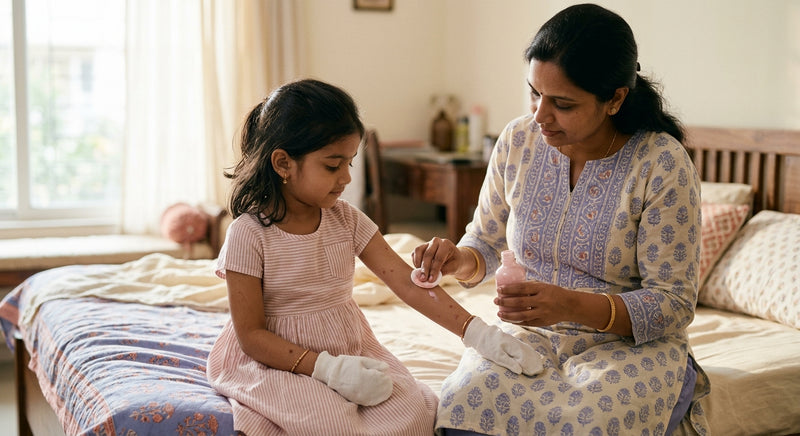
- Within 3 minutes, smooth a kid-friendly lotion all over. Damp skin locks the moisture in.
- Give elbows, knees and shins a second pass — these go dry and “ashy” first.
- Fresh, dry cotton clothes for sleep. Sweaty daytime clothes left on overnight are a common cause of itchy backs and prickly heat.
Morning, before school
- A quick splash of water on the face — a full bath isn't always needed if they bathed the night before.
- A light layer of moisturiser on face, arms and legs.
- For outdoor play, games period or a long bus wait: a kid-safe sunscreen on exposed skin, for children 3 and up.
- Trimmed nails. Boring, yes — but it's the single best way to stop a scratch turning into a scab or infection.
What should I look for in a kids' cleanser and lotion?
Here the ingredient label tells you more than the marketing on the front. As a cosmetologist, this is how I read a kids' product:
- Soap-free, mild surfactants. Look for gentle cleansing agents instead of “sodium tallowate” (traditional soap) or a long list of harsh sulphates. The cleanser should leave skin clean, not squeaky — squeaky means stripped.
- Skin-friendly pH. A wash that stays close to the skin's natural acidity protects the barrier rather than disrupting it.
- Humectants + emollients in the lotion. Ingredients that pull in water (like glycerin) paired with softening oils (almond oil, oat-based actives) give you both immediate comfort and a lotion that actually holds through a school day.
- Fragrance-light, dye-free. Heavy perfume is one of the more common triggers for sensitive young skin. Less is genuinely more here.
If you want a daily wash built for this age group, a gentle, soap-free body cleanser made for kids 3+ is the easiest swap to make — it cleans without the strip.
How do I adjust the routine for the Indian seasons?
Same three steps, dialled up or down. India isn't one climate, and your child's skin knows it.
| Season | Skin tends to | Tweak the routine |
|---|---|---|
| Summer | Sweat, prickly heat, oilier feel | Lighter lotion, a quick second rinse after evening play, loose cotton uniforms, change out of sweaty clothes fast |
| Monsoon | Damp skin folds, fungal patches between toes | Dry skin folds and between toes thoroughly, swap wet socks/shoes immediately, don't skip moisturiser despite the humidity |
| Winter | Dry, flaky, tight, “ashy” patches | Shorter, less frequent baths, lukewarm water, a richer balm on knees/elbows/cheeks, moisturise morning and night |
Why does my child's skin feel dry even though we bathe daily?
Usually one of two reasons, and often both. First, hard water. Most Indian municipal and borewell supplies run high in calcium and magnesium. That leaves a fine mineral residue on skin, and it reacts with soap to form a film that's mildly irritating and drying. You can't easily change your water — but you can counter it: use less soap, rinse well, and always moisturise after.
Second, frequent hot baths. In winter especially, a long hot soak strips the skin's natural oils far faster than a quick lukewarm one. Bathing daily is fine. Just keep it short and warm, not hot and long.
The fix for both is the same dull, dependable step: moisturise on damp skin, every day, even when the skin doesn't look dry. A lotion that helps support the skin's natural barrier means you're not only adding surface moisture — you're helping the skin hold its own.
Do school-going kids really need sunscreen in India?
For children 3 and up who spend time outdoors — yes. India gets intense UV through most of the year, and games period, the school bus stop and weekend play add up to real daily exposure. Nothing elaborate is needed: a kid-safe broad-spectrum sunscreen on the face, ears, neck and arms before they head out, topped up if they're outdoors past midday. A wide-brimmed hat and shade during peak hours, roughly 11 am–3 pm, do a lot of the work for free.
When to see a doctor
A daily routine handles ordinary dryness, sweat and dust. It does not replace medical advice. See your paediatrician or a dermatologist if a rash spreads, weeps or crusts; if there are scaly rings or intense itching that interrupts school and sleep; if dry patches keep coming back in the same spot despite consistent moisturising; or if anything looks infected. Early review almost always means a simpler fix.
The honest summary
Most school-going kids' skin troubles in India trace back to two fixable things — a too-harsh cleanser and a skipped moisturiser — sitting on top of hard water and sun. Keep the cleanse gentle. Moisturise on damp skin within three minutes. Protect outdoor skin from the sun. Adjust lightly by season. It's a routine a tired parent can actually keep up with, which is the only kind that ever works.
For the daily moisturising step, a soothing kids' lotion with almond oil and oats applied right after the evening bath is the simplest way to make the whole routine stick.
In summary
- Build the routine around three steps: gentle cleanse, moisturise within three minutes on damp skin, and sun protection for outdoor play.
- Swap harsh bar soaps for a mild, soap-free, low-pH cleanser made for kids 3+ — over-cleansing causes most dryness, not under-cleansing.
- Counter India's hard water and hot baths by keeping baths short and lukewarm, then moisturising every day even when skin looks fine.
- Adjust by season — lighter lotion and quick rinses in summer, dry skin folds in monsoon, richer balm and fewer hot baths in winter.
- See a paediatrician for spreading, weepy, crusted or ring-shaped rashes, or dryness that keeps returning despite a consistent routine.
Frequently asked questions
What is a good daily skincare routine for school-going kids in India?
Keep it to three steps. After school: rinse off dust and sweat with lukewarm water, use a mild soap-free cleanser only on dirty areas, pat dry, and moisturise within three minutes on damp skin. In the morning: a light moisturiser and, for outdoor play, a kid-safe sunscreen for children 3 and up. Adjust the richness of the lotion by season.
Do school-going kids need sunscreen every day?
If your child spends time outdoors — games period, the bus stop, weekend play — then yes, children 3 and up benefit from daily broad-spectrum sunscreen on exposed skin. India gets strong UV most of the year. Pair it with a hat and shade during peak hours, roughly 11am to 3pm, and reapply if they stay out past midday.
Why does my child's skin feel dry even though we bathe every day?
Two usual culprits: hard water and hot baths. Most Indian water is mineral-heavy, leaving a drying film on skin, while long hot baths strip natural oils. Bathing daily is fine — keep it short and lukewarm, use less soap, rinse well, and always moisturise on damp skin afterward, even when the skin doesn't look dry.
Can school-going kids use adult soap or body wash?
It's better not to. Most bar soaps are alkaline (pH 9–10), while young skin prefers a slightly acidic surface around pH 5.5. Harsh adult washes strip the skin's protective acid mantle, leaving it tight, itchy and ashy. A mild, soap-free cleanser made for kids cleans effectively without that stripping effect.
How do I manage prickly heat in school-going kids?
Keep skin cool and dry. Use lukewarm baths, dress them in loose cotton uniforms, and get them out of sweaty clothes quickly after play. A second quick rinse in the evening helps in peak summer. Avoid heavy, greasy products on affected areas. If the rash spreads, blisters or doesn't settle in a few days, see your paediatrician.
Is daily moisturiser necessary for kids with oily skin?
Yes — oily-feeling skin can still be dehydrated, especially with hard water and daily washing. The trick is choosing a lighter lotion rather than skipping it. Moisturising on damp skin helps support the skin's natural barrier, which actually keeps oiliness more balanced over time than leaving the skin stripped and reactive.