It's usually somewhere around the seventh month, in front of the bathroom mirror, that you first notice them — those pinkish-red lines fanning across your belly or hips. And then the late-night Googling starts: can I get rid of stretch marks, which oil removes them, is it too late. I've had this exact conversation with so many mums, including in my own family.
So let me give you the honest answer first, the way I'd tell a friend. No cream, oil or serum erases stretch marks completely — anyone promising that is selling you a story. But you absolutely can make them itch less, look less angry, and fade fresh ones faster by keeping the skin well-moisturised and massaging it daily. The trick is knowing where to put your effort (and your money) and where not to.
At a glance
- Stretch marks can't be fully erased — but fresh (red/purple) ones respond far better than old (silvery-white) ones.
- The single most useful thing you can do is massage a rich moisturiser in daily — the massage matters as much as the product.
- Cocoa butter and plain olive oil, on their own, perform no better than placebo in trials. Save your money.
- Centella asiatica (gotu kola) and hyaluronic acid have the most consistent evidence for prevention.
- For old, settled marks, a dermatologist's tools (microneedling, laser) work better than any cream.
Why do stretch marks happen in the first place?
Your skin is remarkably stretchy, but it has a speed limit. When it's pulled faster than the collagen and elastin underneath can keep up — a growing belly, a growth spurt, fast weight change — the middle layer (the dermis) tears a little. Pregnancy stacks two things on top of each other: rapid stretching and hormones that soften collagen so your body can expand. That's why so many of us get them, and why it's genuinely not about "not moisturising enough." Some of it is simply your skin type and family history.
One detail decides what you can actually do about them: stretch marks have two stages.
- Fresh — striae rubra. Red, pink, purple, sometimes itchy and slightly raised. This is the window where you can actually influence them.
- Settled — striae alba. Silvery-white, flat, sometimes a little sunken. The skin has finished remodelling. These fade slowly with time but no cream meaningfully reverses them.
If yours are still pink or red, that's good news — you're in the stage that responds.
What actually works?
First, what I mean by "works": there's reasonable evidence it reduces how visible or how severe stretch marks are — not that it makes them vanish.
1. Daily massage with a rich moisturiser
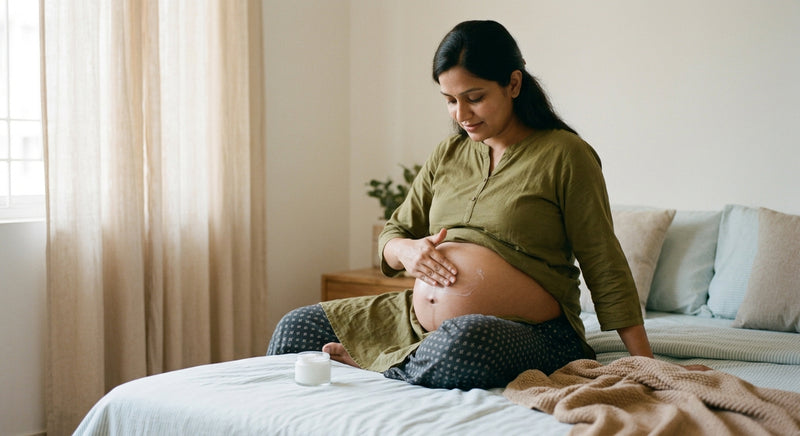
This is the one I'd never skip. Studies that show a benefit almost always involve massaging a product in, not just dabbing it on — and researchers think the massage itself (better blood flow, keeping the skin supple and hydrated) is doing a lot of the work. Two to five minutes per area, twice a day, on slightly damp skin. Consistency over months beats any single "hero" ingredient.
2. Centella asiatica (gotu kola) and hyaluronic acid
If you want to look for active ingredients with the best track record for prevention, these two come up most. Centella (you'll see it as gotu kola or mandukaparni — a familiar Ayurvedic herb) and hyaluronic acid have the most consistent trial support for reducing how many stretch marks form when used early and regularly. They're not magic, but they're a sensible bet.
3. Starting early and staying consistent
The earlier you begin — ideally as soon as the belly is growing, while marks are red or before they appear — the better your odds. Gradual, steady weight gain (in pregnancy and after) and staying well-hydrated also genuinely help your skin cope with the stretch.
4. For old marks: a dermatologist's tools
Once marks are white and settled, in-clinic treatments — microneedling, fractional laser, radiofrequency — have far stronger evidence than anything in a tube. They're not cheap and they take sessions, but if old stretch marks really bother you, that's where the real results live. A good dermatologist will tell you honestly what's realistic.
What doesn't work (honestly)?
Here's where I can save you the most money and disappointment. None of the below are dangerous — but they don't do what the packaging implies.
| The claim | The honest verdict |
|---|---|
| Cocoa butter "removes" stretch marks | Trials show it performs no better than a plain placebo cream. The moisturising helps a little; the cocoa butter isn't the hero. |
| Olive oil / plain almond oil alone | Weak, inconsistent evidence. Fine as a massage medium, but it's the massage and hydration helping — not a special oil power. |
| Vitamin E creams | Inconsistent results; no reliable benefit on its own. |
| "Miracle" removal creams | If a product promises to erase stretch marks, that's a red flag, not a feature. |
| Retinol / tretinoin during pregnancy | Can help fresh marks — but it's not safe in pregnancy or breastfeeding. Skip it for now. |
That last one matters. Retinoids are one of the few topicals with real data on fresh stretch marks, but they're on the no-list while you're pregnant or nursing. If you're sorting through what's safe to use right now, our guide to pregnancy-safe skincare ingredients walks through the full list so you're not second-guessing every label.
What to do tonight
You don't need a ten-step regime. You need one you'll actually repeat. Here's the routine I'd start with:
- After your shower, pat skin damp, not bone-dry — moisturiser locks in better.
- Take a coin-sized amount of a rich, fragrance-light moisturiser or balm.
- Massage it into the belly, hips, thighs and breasts in slow circles for 2-3 minutes each — until it's absorbed and the skin feels warm.
- Repeat in the morning. Twice a day, every day, is the whole secret.
- Drink water through the day and aim for steady, gradual weight changes rather than sudden swings.
For the moisturiser itself, you want something rich enough to actually sit on the skin and support its barrier through months of stretching — not a thin lotion that disappears in seconds. Our Hydra Healing Moisturizing Balm is a fragrance-light, barrier-supporting balm made for exactly this kind of daily massage on dry, stretched, sensitive skin — and because it's gentle enough for newborns, the same jar works for your baby afterward.
When to see a doctor
Stretch marks themselves are harmless — your body kept up with a big, fast job. But check in with your doctor if:
- Stretch marks appear suddenly and you're not pregnant or going through an obvious growth phase — rapid, unexplained striae can occasionally signal a hormonal issue worth checking.
- The skin becomes intensely itchy in late pregnancy, especially on the belly, palms or soles — this needs a same-week obstetrician check, as severe itching can point to a pregnancy condition unrelated to stretch marks.
- A mark looks infected, broken, weepy or painful rather than just stretched.
- Old marks bother you enough that you're considering laser or microneedling — see a dermatologist for a realistic, personalised plan rather than buying yet another cream.
And honestly? Most stretch marks fade quietly on their own over the year or two after pregnancy, settling from red to a pale silver you'll barely notice. Be kind to yourself in the meantime. You're not doing anything wrong — your skin is just keeping up with a big job.
In summary
- No cream erases stretch marks fully — fresh red marks respond, settled white ones barely change.
- Massage a rich moisturiser into stretched skin twice a day; the massage matters as much as the product.
- Skip cocoa butter and miracle 'removal' creams — trials show no real benefit over plain moisturiser.
- Avoid retinol and tretinoin while pregnant or breastfeeding, even though they help fresh marks.
- See a dermatologist for old marks you want treated, or a doctor for sudden marks or severe belly itching.
Frequently asked questions
Can stretch marks be removed completely?
No topical cream or oil removes stretch marks completely — be wary of any product that promises it. Fresh red or purple marks can be made less visible with daily massage and good moisturising, and they fade naturally over time to a pale silver. For old, settled marks, dermatologist treatments like microneedling or laser give the best (though still partial) results.
Does cocoa butter really work on stretch marks?
Not as well as the marketing suggests. In controlled trials, cocoa butter performed no better than a plain placebo cream at preventing or reducing stretch marks. The light moisturising it provides helps a little, but the cocoa butter itself isn't doing anything special. Your money is better spent on consistent daily massage with any rich, skin-friendly moisturiser.
Which oil is best for stretch marks during pregnancy?
There's no single magic oil — the evidence points to the massage and hydration helping more than any specific oil. A rich, fragrance-light moisturiser or balm massaged in twice daily is more reliable than a fancy oil. Avoid retinol or tretinoin products during pregnancy and breastfeeding, and check any active ingredients against a pregnancy-safe list before using.
When is the best time to start preventing stretch marks?
As early as possible — ideally as soon as your belly starts growing, and while any marks are still pink or red. That fresh stage responds far better than the later silvery-white stage. Massage a rich moisturiser in twice a day, stay hydrated, and aim for gradual rather than sudden weight changes to give your skin the best chance to keep up.
Do stretch marks go away after pregnancy?
They rarely disappear entirely, but most fade significantly on their own. Over the year or two after delivery, the red and purple tones settle into pale, silvery lines that are far less noticeable. Daily moisturising and massage can help fresh marks fade faster. If old marks really bother you, a dermatologist can discuss in-clinic options like microneedling or laser.