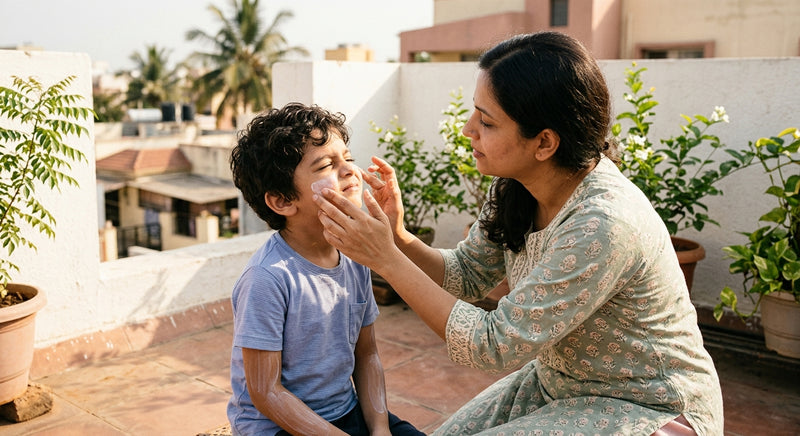
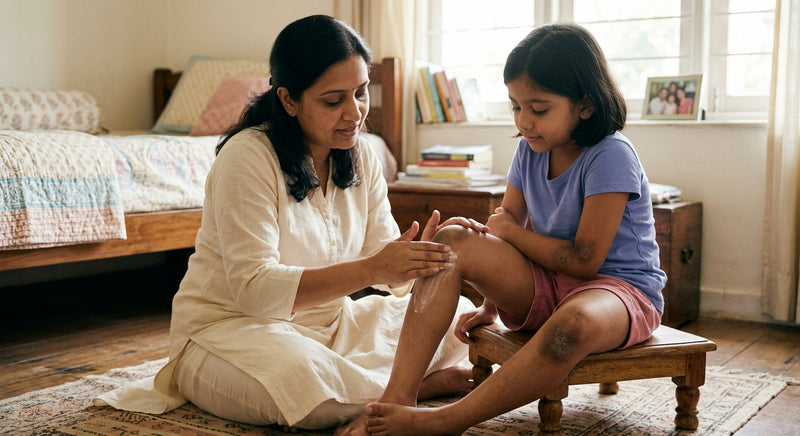
Walk into any chemist in India and pick up six baby lotions. Five will say the same three words on the front — gentle, mild, soft — in the same soft pastel type, beside the same sleeping baby. Here's what I tell the parents who corner me at family weddings, and I'll tell you the same as a cosmetologist: not one of those three words is regulated. A brand can print "gentle" on a bottle that holds the exact thing flaring up your baby's cheeks.
So flip it over. "Gentle" isn't a feeling or a font. It's a handful of formulation choices, and all of them are sitting on the back label — if you know what you're reading. These are the questions parents actually ask me, answered the way I'd answer a friend.
At a glance
- "Gentle" and "mild" are marketing words, not legal standards. The proof is in the ingredient list, never the front label.
- A baby's skin is 20-30% thinner than an adult's, so it absorbs more and reacts faster.
- Gentle = a short list, a skin-friendly pH, no added fragrance or harsh sulphates, and a barrier-supporting base.
- "Fragrance-free" and "unscented" are not the same thing — one can still hide a masking fragrance.
- Flip the bottle. The first five ingredients tell you most of what you need to know.
What does "gentle" actually mean on a baby lotion?
Legally? Almost nothing. No lotion has to pass a test to earn the word. So I ignore the front and check four things instead. A truly gentle lotion gets all four right.
A short, readable list. Fewer ingredients, fewer things that can react with thin, still-developing skin. When the list runs to forty lines and I can't pronounce the first ten, I get nervous.
A skin-friendly pH. Healthy skin sits slightly acidic, around 4.5 to 5.5, and that acidity is part of how the barrier defends itself. Push it too alkaline and you can nudge the barrier open. Good baby formulations are pH-balanced to sit close to the skin's own.
No passengers. Added fragrance, harsh sulphates, drying alcohols, strong dyes — none of these moisturise. They're in there for smell, foam or colour, and on baby skin they're the usual suspects behind a flare.
A base that actually does something. This is the part the marketing forgets. A good lotion isn't just "not harmful" — it helps. Humectants pull water in; emollients smooth and seal. That's what leaves skin softer the next morning, not just slippery tonight.
Which ingredients make a lotion gentle — and which don't?
I wish more parents asked me this at the shelf. Ingredients are listed in order of how much is in the bottle, so the top of the list is where the real work happens. Here's how I sort the common ones.
| Gentle, do the work | Skip or be cautious |
|---|---|
| Humectants — glycerin, which draws water into skin | Added "fragrance" / "parfum" — the top trigger for baby reactions |
| Emollients — light plant oils, that smooth and soften | Sulphates like SLS in a lotion — drying, mostly there to feel rich |
| Colloidal oatmeal — comforts dry, itchy skin | Denatured / SD alcohol high on the list — strips moisture |
| Barrier lipids — ceramide-style ingredients, that seal water in | Strong dyes and colourants — purely cosmetic, no skin benefit |
A word on oils, because Indian parents ask me this constantly. A little well-formulated plant oil in a lotion is lovely — it's an emollient, it softens. That's a different thing from slathering neat mustard or coconut oil on a baby in a Nagpur summer, which can just sit on the surface and, in some babies, clog or irritate. Formulation is everything: the same ingredient behaves differently depending on how much, alongside what, and at what pH.
Is "fragrance-free" the same as "no fragrance"?
No — and this one trips up even careful parents. The difference, plainly:
- Fragrance-free usually means nothing has been added for smell. This is what you want for reactive baby skin.
- Unscented can mean a masking fragrance was added to cover the raw smell of the other ingredients. There's still fragrance in there — it just doesn't smell of anything.
Added fragrance is the single most common reason I see a baby lotion not agree with a baby. It does nothing for the barrier. It's there so the product smells nice on the shelf. For newborn skin, that's a trade I'd never make. If your baby has had a flare you couldn't explain, fragrance is the first thing I'd rule out.
Same goes for "natural" and "herbal" and "ayurvedic" splashed across the front. I love a well-made Ayurvedic formulation. But "natural" is not a synonym for "gentle." Some of the most reactive substances on earth are perfectly natural — essential oils, for one, can still irritate thin baby skin. Read past the front claim to the actual list, every time.
How do I check a baby lotion in 30 seconds at the shop?
You don't need a chemistry degree. You need the back of the bottle and this quick routine.
- Turn it over and read the first five ingredients. Do you recognise most of them? Is there a real moisturiser — glycerin, an oil, oats — near the top?
- Scan for the word "fragrance" or "parfum." If your baby is reactive, put it back.
- Check for "fragrance-free" specifically, not just "unscented."
- Look for a line about being dermatologically tested or pH-balanced. Tested means a human checked it on skin, not just on paper.
- Do a patch test at home first — a coin-sized amount on the inner forearm, wait 24 hours, watch for redness before you go head-to-toe.
That patch test is the step everyone skips, and the one I wish nobody would. On a brand-new product on a newborn, it costs you one day and saves you a week of guessing.
Why does thin baby skin change the rules?
Because the margin for error is smaller. A baby's barrier is still maturing in the first months. It's thinner — by roughly 20 to 30% against adult skin — so it loses water faster and lets more of what you apply pass through. Whatever's in the lotion has an easier route in.
That's exactly why "gentle" can't be a vague promise. On adult skin a slightly harsh formula gets forgiven. On a newborn's cheek it shows up as dryness, redness or a flare within a day. So the bar for a baby lotion isn't "does no harm" — it's "keeps that thin barrier comfortable and sealed." Up to around 48.6% of babies hit some atopic-type skin issue at some point, which is precisely why the base of the lotion — the part that supports the barrier — matters more than anything printed on the front.
When I'm assessing a formulation at Janma, that's the lens: a short list, a skin-close pH, no added fragrance, a base built to support the barrier rather than just coat it. In our own lab work, that barrier-support approach showed increased Keratin-10 and Filaggrin expression — the proteins that help skin hold itself together and hold water in. That's the gap between a lotion that sits on top and one that helps the skin do its own job.
When to see a doctor
Most dryness settles with one good, gentle moisturiser. But book a paediatrician if the skin is cracked, weeping or bleeding; if redness spreads or comes with fever; if your baby is scratching enough to disturb sleep or feeds; or if patches keep coming back despite a simple, fragrance-free routine. Eczema and other conditions are very manageable — but they need a real diagnosis, not a new bottle every week.
If you'd rather keep things simple with one moisturiser, look for a fragrance-free, barrier-supporting balm that's safe across ages. Our Hydra Healing Moisturizing Balm was built around the four things above: a short list, a skin-friendly base, no added fragrance, and barrier support.
In summary
- "Gentle" and "mild" are unregulated marketing words — judge a lotion by its ingredient list, not the front label.
- Look for a short list, a skin-friendly pH (4.5-5.5), no added fragrance, and a barrier-supporting base.
- Choose "fragrance-free" over "unscented," and don't assume "natural" or "herbal" means gentle.
- Read the first five ingredients and always patch-test a new lotion on the forearm for 24 hours.
- See a paediatrician if skin stays cracked, weepy, spreading or itchy despite a simple, fragrance-free routine.
Frequently asked questions
Does "gentle" on a baby lotion label mean anything official?
No. "Gentle," "mild" and "soft" are marketing words with no legal standard behind them — a brand can print them on almost any lotion. What actually matters is on the back: a short ingredient list, a skin-friendly pH, no added fragrance or harsh sulphates, and a barrier-supporting base. Read the ingredients, not the front claim.
Is fragrance-free the same as unscented in baby lotion?
Not quite. Fragrance-free means no fragrance was added for smell — what you want for reactive baby skin. Unscented can mean a masking fragrance was added to cover the smell of other ingredients, so there's still fragrance in the bottle. For newborn and baby skin, look specifically for the words "fragrance-free."
Which ingredients make a baby lotion gentle?
Look for humectants like glycerin that pull water into skin, light emollient oils that soften, colloidal oatmeal that comforts itchy skin, and barrier lipids that seal moisture in. Just as important is what's absent: added fragrance, harsh sulphates, drying alcohols high on the list, and strong dyes. A gentle lotion both avoids irritants and actively supports the skin barrier.
Is a natural or ayurvedic baby lotion automatically gentle?
No — "natural" isn't a synonym for gentle. Some natural ingredients, like certain essential oils, can irritate thin baby skin. A well-made Ayurvedic formulation can be excellent, but you still have to read the actual ingredient list and check it's fragrance-free and dermatologically tested, rather than trusting the word on the front of the bottle.
How do I quickly check if a baby lotion is safe?
Flip the bottle and read the first five ingredients — recognisable moisturisers near the top are a good sign. Scan for "fragrance" or "parfum" and put it back if your baby is reactive. Prefer "fragrance-free" over "unscented," look for "dermatologically tested" or "pH-balanced," and always patch-test a coin-sized amount on the forearm for 24 hours first.
Why does a baby need a gentler lotion than an adult?
A baby's skin is roughly 20-30% thinner than an adult's and its barrier is still maturing, so it loses water faster and absorbs more of whatever you apply. A formula an adult would forgive can show up as dryness or redness on a baby's cheek within a day. That smaller margin is why the lotion's base and absence of irritants matter so much.