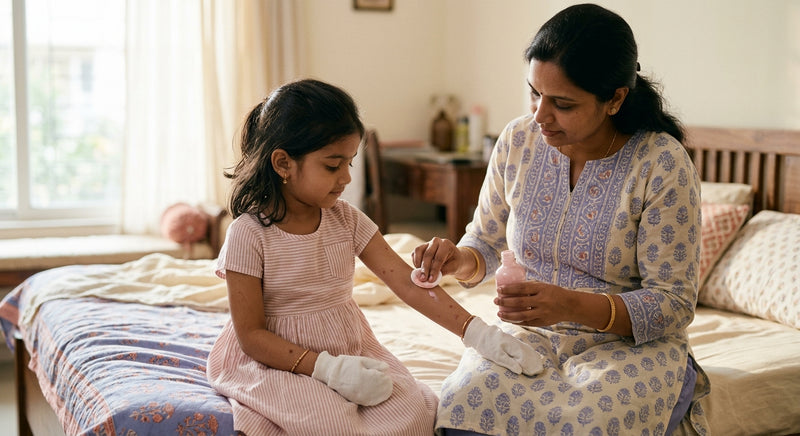
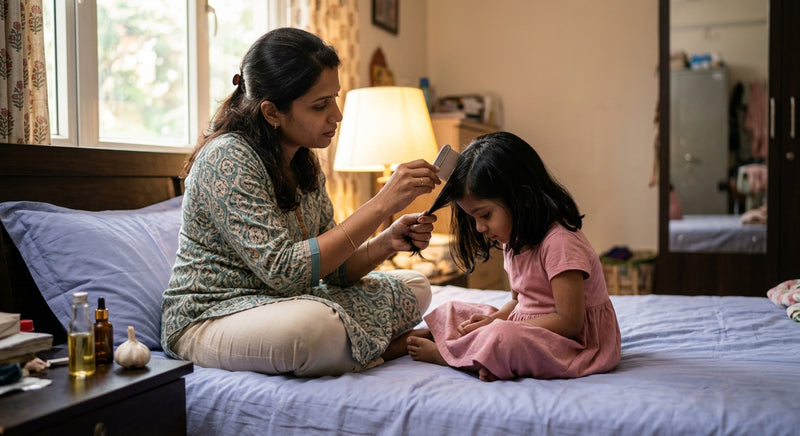
In most Indian families, a baby's skin routine arrives before the baby does. Haldi and malai whipped into a paste for "glow." A drop of ghee on a dry cheek. Neem leaves tossed in the bathwater "to keep infection away." My dadi did all three on every cousin who passed through the house, and she'd have argued with anyone who said otherwise.
So here's the question I get asked most, and I get it as a formulator, not as a granddaughter: which of these actually hold up to the evidence, and which survive on habit alone? A few are genuinely good. A couple are fine in the right form. One or two I'd be careful with on a newborn. Let me go through them one at a time.
At a glance
- Coconut oil has the most supportive evidence — it helps soften and moisturise, and small studies suggest it supports the skin barrier.
- Ghee works as a simple occlusive for tiny dry patches, but it's heavy and can trap heat in our climate.
- Haldi (turmeric) has interesting lab data, but as a raw kitchen paste it stains, can irritate, and isn't reliable on a baby.
- Neem and mustard oil need real caution on newborns — strength and quality vary wildly.
- "Ayurvedic" is a tradition, not a safety certificate — the form, purity and dose decide whether something helps or harms.
If you want the bigger picture on how to read any baby-skincare ingredient, this fits inside our complete guide to baby skincare ingredients — this article zooms in on the ayurvedic ones specifically.
Why "ancient" doesn't automatically mean "gentle"
A baby's skin is not a smaller version of yours. It's built differently. Newborn skin is thinner, the barrier is still maturing, and it soaks up what you put on it far more readily than adult skin does.
Which is why "my mother used it on me" and "it's been tested and standardised" are two different sentences. The same ingredient can be lovely in a purified, correctly-dosed form and risky as a raw, kitchen-grade paste. Respect the tradition. Question the form.
The myth vs the evidence, ingredient by ingredient
This is where I try to give the tradition its due and the data its due, even when they disagree.
| Ingredient | What tradition says | What the evidence actually shows |
|---|---|---|
| Coconut oil | The everyday malish oil; "makes skin soft and strong" | The strongest case of the lot. Small studies show it helps moisturise and may support the barrier in mild dryness. Use cold-pressed/virgin, warm slightly, massage gently. |
| Ghee | A dab on dry lips, cheeks, cracked patches | A reasonable simple occlusive — it seals in moisture. But it's heavy and can feel sticky in humid weather. Fine on a tiny patch, not as an all-over body coat. |
| Haldi (turmeric) | Ubtan paste for "glow" and to "clean" skin | Curcumin has genuinely interesting lab properties, but raw kitchen haldi stains, varies in strength, and can irritate delicate skin. Not a reliable baby treatment. |
| Besan + malai ubtan | Removes vernix, body hair, "cleans" the baby | Scrubbing a newborn is unnecessary and can disrupt the barrier. Vernix protects skin and absorbs on its own. Skip the scrub. |
| Neem | In bathwater "to prevent infection" | Has studied antimicrobial compounds, but strength is unpredictable and concentrated neem can irritate. Not for routine newborn use without guidance. |
| Mustard oil (sarson) | Warming winter malish, especially in the north | Can irritate and damage the barrier in infants in some studies; pungent and harsh for newborn skin. I'd choose coconut or a tested blend instead. |
Two of these come up so often that I gave each its own piece: a careful look at ghee for baby skin, tradition vs what the evidence says, and an honest read on a modern "ayurveda-adjacent" hero, colloidal oatmeal and the science behind it. Worth a read if you use either.
So which ones genuinely earn a place?
Formulator's hat on, marketer's hat off. Here's how I'd sort them.
Keep (with care)
- Cold-pressed coconut oil for a gentle warm malish — the best-supported traditional choice.
- A small dab of pure ghee on specific dry, cracked patches in winter — not as a full-body layer.
- Sesame oil, classically Ayurvedic and lighter than mustard, for massage if your baby tolerates it.
Be cautious with
- Raw haldi paste — staining and irritation aren't worth it on a baby. If you love it culturally, keep it symbolic and off the skin, or wipe quickly.
- Neem and concentrated herbal washes — only with a paediatrician's nod, never as a daily default.
- Mustard oil on infants — the irritation data makes me uneasy for newborn skin.
Skip on a newborn
- Ubtan scrubbing to remove vernix or hair — it does more harm than good.
- Anything fragranced "for nice smell" — added perfume is a common irritant; here's why fragrance in baby products deserves a second look.
The real lesson: it's the form, not the folklore
Tradition gets the instinct right. Keep baby skin moisturised. Massage with care. Reach for something natural. What it can't give you is consistency. Kitchen-grade haldi changes batch to batch. Loose-sold "neem oil" can be almost anything. Even good coconut oil turns rancid if the bottle sits open through a Nagpur summer.
A properly made formulation is built to close that exact gap. The active is purified, the concentration is fixed, the pH is set close to baby skin's own slightly-acidic range, and the whole thing is dermatologically and in-vivo tested before it ever meets a real baby. We make ours in our own GMP-certified facility for one reason — so I can tell you exactly what's inside and at what strength. A handful of haldi from the kitchen can't make that promise.
None of this is me dismissing ayurveda. Take the ingredient the tradition loves, then make it safe, stable and provable. Ingredient knowledge cuts both ways, so if you want to go deeper on the synthetic side of the same question, we also wrote plainly about parabens, sulfates and phthalates in baby products.
What to actually do tonight
- Pick one well-tolerated oil (cold-pressed coconut or sesame). Warm a little between your palms.
- Massage gently for a few minutes — pressure light enough that the skin barely moves.
- Bathe in lukewarm water, keep it short, use a mild tear-free wash, pat dry.
- Within three minutes, while skin is still slightly damp, seal with a gentle barrier moisturiser.
- For one specific dry, cracked patch only, a tiny dab of pure ghee is fine. For widespread dryness or any redness, reach for a tested barrier balm instead.
When to see a doctor
Please see your paediatrician — and skip the home experiments — if your baby has: skin that's cracked, weeping, bleeding or crusting; a rash that's spreading or worsening over a day or two; signs of infection (warmth, pus, fever); or eczema-type patches that aren't settling with gentle care. Also check in before using neem, strong herbal washes, or any new ingredient on a baby under three months. A quick visit beats a week of guessing.
For everyday dryness and barrier support across babies, juniors and mums, a tested, fragrance-free balm does what a kitchen paste can't reliably do — our Hydra Healing Moisturizing Balm is formulated exactly for that gentle, barrier-supporting job.
In summary
- Cold-pressed coconut oil is the best-evidenced traditional choice for gentle baby massage and mild dryness.
- Pure ghee works only as a small occlusive dab on specific cracked patches, not as an all-over layer.
- Skip raw haldi paste, neem washes and mustard oil on newborns unless a paediatrician advises otherwise.
- Don't scrub off vernix with ubtan — it protects the skin and absorbs on its own.
- Judge an ayurvedic ingredient by its form, purity and strength, not by how old the tradition is.
Frequently asked questions
Are ayurvedic ingredients safe for newborn skin?
Some are, in the right form. Cold-pressed coconut and sesame oil are generally well tolerated for gentle massage. But raw haldi paste, concentrated neem and mustard oil can irritate a newborn's thinner skin, which absorbs more than adult skin. "Ayurvedic" describes a tradition, not a safety standard — the purity, strength and form decide whether an ingredient helps or harms. Patch-test first, and check with your paediatrician under three months.
Is coconut oil really good for baby skin, or is that just tradition?
It's the traditional choice with the most evidence behind it. Small studies suggest coconut oil helps moisturise and may support the skin barrier in mild dryness, and it's gentle enough for everyday massage. Use cold-pressed or virgin coconut oil, warm a little between your palms, and massage lightly. Store it sealed and away from heat so it doesn't turn rancid in Indian summers.
Can I use haldi (turmeric) on my baby's skin?
I'd be cautious. Curcumin in turmeric has interesting lab properties, but raw kitchen haldi varies in strength, stains skin yellow, and can irritate delicate baby skin. It isn't a reliable or standardised treatment for a baby. If turmeric matters to you culturally, keep it symbolic rather than rubbed onto the skin, and never apply it to broken or inflamed areas.
Is neem in bathwater good for preventing infection in babies?
Neem does contain studied antimicrobial compounds, but the strength of homemade neem water or oil is unpredictable, and concentrated neem can irritate a baby's skin. It isn't something I'd recommend as a routine daily default. If you want to use it for a specific reason, talk to your paediatrician first rather than adding it to every bath.
Why is mustard oil discouraged for baby massage?
Mustard oil is a popular warming winter malish, especially in north India, but some studies suggest it can irritate and weaken the skin barrier in infants. It's also pungent and fairly harsh for newborn skin. For massage, a cold-pressed coconut or sesame oil, or a tested baby oil blend, is a gentler choice that's better suited to a baby's developing barrier.
Should I scrub off vernix with an ubtan paste after birth?
No. Vernix is the natural protective coating on a newborn and absorbs into the skin on its own — it doesn't need scrubbing off. Besan-and-malai ubtan to remove vernix or fine body hair can disrupt the still-maturing skin barrier. Let vernix do its job, keep early baths short and gentle, and moisturise afterwards instead of exfoliating.