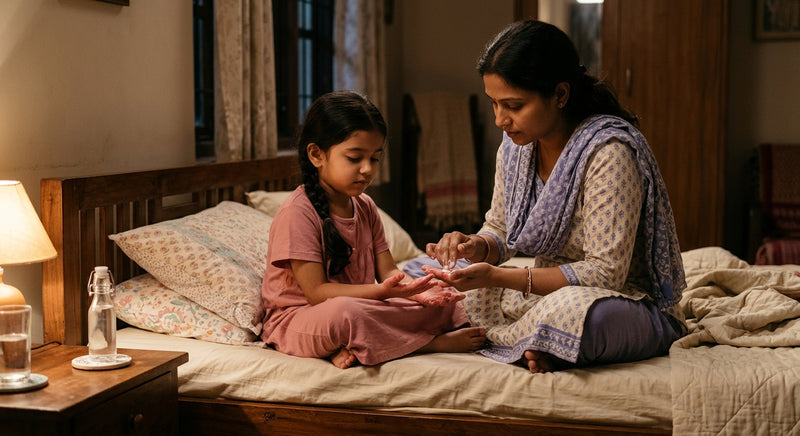
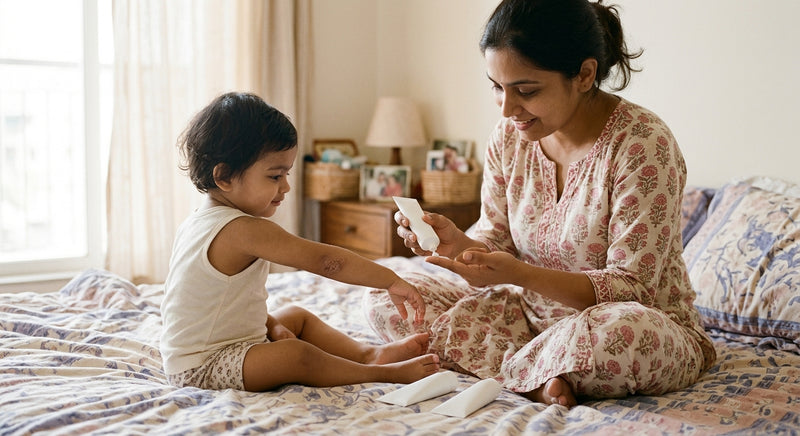
Your mother-in-law warms a little ghee between her palms and smooths it over the baby's dry cheeks — "desi ghee, isse pure kuch nahi." She's half right. Ghee really is an occlusive: on intact, dry skin it lays down a thin film that slows water from escaping, so a flaky patch can look softer for a few hours. That's the half that's true. The other half is everything around it. Homemade ghee isn't standardised or preserved. It can turn rancid. And a baby's skin is far thinner and more reactive than yours.
I work on baby formulations for a living. So let me split this down the middle — what ghee actually does, where it genuinely helps, and the one place it can be dangerous.
At a glance
- Ghee is a true occlusive — it sits on the surface and slows water loss, which is why dry patches can look smoother after applying it.
- But it doesn't "feed" or deeply hydrate skin, and homemade ghee isn't standardised, preserved or tested — so it behaves unpredictably on a baby.
- Never put ghee (or anything) on a healing umbilical cord stump — keep it clean and dry.
- For everyday care, a stable, tested moisturiser gives you the same barrier comfort without the spoilage and contamination worries.
Why does ghee seem to work on dry skin?
Because it does one thing, and does it well: it occludes. Ghee is almost pure milk fat — saturated fatty acids, a little vitamin A and E, no water. Spread it over dry skin and it makes a temporary barrier that traps the moisture already there. Less water leaves. The surface feels softer, looks softer. That's real, and it's the same physics behind petrolatum or a good butter-based balm.
There's a quieter reason parents swear by ghee malish, though, and it has nothing to do with the ghee. It's the massage. Warm, slow strokes settle a fussy baby. The warmth feels lovely. The ritual bonds you both. You'd get every bit of that from a gentle, tested massage oil or balm — but the ghee gets the credit for what the malish is doing.
What ghee actually is, ingredient by ingredient
Clarified butter is roughly 99% fat, with the milk solids and water cooked off. To a formulator, that one line raises three flags. There's no water phase — so it can't add hydration, only seal in what's there. There's no preservative — so the moment warm fingers and air get to it, it's a food source for microbes. And it's an animal fat that oxidises — in a Nagpur or Chennai summer, an open jar can turn rancid faster than you'd guess, and oxidised fat irritates more, not less.
Tradition vs evidence, side by side
| The belief | What's actually true |
|---|---|
| "Ghee is natural, so it's safe for a newborn." | Natural doesn't mean inert. Trace milk proteins can trigger reactions in dairy-allergic or eczema-prone babies, and unpreserved fat can spoil. |
| "Ghee moisturises deeply." | It occludes the surface and slows water loss. It doesn't add water or nourish skin from the outside in. |
| "Put ghee on the cord stump to heal it." | Don't. Keep the stump clean and dry — anything applied raises the risk of infection. |
| "Warm ghee malish makes skin stronger." | The massage and warmth soothe; the ghee itself isn't building the skin barrier in any tested way. |
| "Homemade is purer than a cream." | A well-made cream is pH-balanced, preserved and tested batch to batch. Homemade ghee varies every time and oxidises with heat. |
Where ghee genuinely falls short for babies
A baby's skin is 20-30% thinner than an adult's. Whatever you put on it penetrates and reacts more readily — which is exactly why I'm cautious here. A few honest concerns:
- It can clog and cause bumps. Heavy fats settle into pores and around hair follicles. On a newborn's face — the cheeks and forehead especially — that can show up as milia or worsen baby acne.
- It oxidises and spoils. No preservative plus Indian heat equals a jar that can go rancid. Rancid fat irritates, and the same finger dipping in and out carries bacteria back into the jar.
- Milk proteins are an allergen. Up to ~48.6% of babies experience atopic-type skin issues, and an eczema-prone or dairy-sensitive baby can react to the residual proteins in ghee.
- It traps heat. A thick occlusive in a humid summer can make prickly heat and sweat rash worse, not better.
- It isn't standardised. No two jars of homemade ghee are alike — different fat profiles, different freshness. You can't predict how a given batch will sit on sensitive skin.
If you're weighing ghee as a moisturiser, it helps to see how an evidence-tested ingredient is meant to behave. Our piece on colloidal oatmeal for baby skin, honestly walks through what "actually studied" looks like, next to "grandmother-approved."
The one place ghee is genuinely dangerous
So what should you do tonight?
Don't throw out the ritual. Keep the warm malish — just be smart about what's on your hands.
- Patch-test anything new on the inner forearm and wait 24 hours before using it on the face or body.
- Moisturise within about 3 minutes of a bath, on skin that's still slightly damp — that's when occlusion does the most good.
- Use a small amount of a stable, low-fragrance moisturiser twice a day for dry patches.
- In summer, go lighter. Heavy fats trap heat and can worsen prickly heat — save the richer balm for dry winters.
- If you've used ghee, wash off the greasy residue at bath time with a gentle, tear-free cleanser so it doesn't sit and oxidise on the skin overnight.
- Keep the cord stump completely bare, clean and dry.
When to see a doctor
Home care handles ordinary dryness. Check in with your paediatrician if your baby has dry skin that cracks, weeps or bleeds; widespread or fast-spreading redness; itching that disrupts sleep; any redness, swelling, smell or discharge around the cord stump; or skin that flares within hours of applying ghee or any product. A doctor can tell ordinary dryness from eczema or an allergy, and that distinction changes what you should use.
Tradition is worth honouring. But on a newborn's skin, the safest version of "natural" is something tested, stable and predictable — and if dry patches are the worry, a barrier-supporting balm like our Hydra Healing Moisturizing Balm is the gentle place to start.
In summary
- Ghee is a real occlusive that can soften dry patches, but it doesn't deeply hydrate or strengthen the skin.
- Homemade ghee isn't standardised, preserved or tested, and it can go rancid in Indian heat — unpredictable on thin baby skin.
- Never apply ghee to a healing umbilical cord stump, inside the nose or near the eyes.
- Keep the calming malish ritual but swap to a stable, tested balm or oil for predictable barrier care.
- See a paediatrician for cracked, weeping or fast-spreading skin, or any redness or discharge around the cord.
Frequently asked questions
Is ghee safe to apply on a baby's skin?
On intact, dry skin a tiny amount of fresh ghee can act as a temporary occlusive and soften flaky patches. But it isn't standardised or preserved, it can oxidise in Indian heat, and the milk proteins may trigger eczema-prone or dairy-allergic babies. Patch-test first, never use it on broken skin, and skip it entirely on the umbilical cord stump.
Does ghee massage make a baby's skin stronger or fairer?
No. The benefit of a ghee malish comes from the warm, slow massage itself — which soothes and bonds — not from the ghee. There's no good evidence that ghee builds the skin barrier or changes skin tone. A gentle, tested massage oil or balm gives you the same calming ritual more reliably.
Can I put ghee on my baby's umbilical cord stump?
No, this is genuinely unsafe. The cord stump must stay bare, clean and dry until it drops off naturally. Applying ghee, oil, turmeric or ash raises the risk of infection in newborns. If you notice redness, swelling, smell or discharge around the stump, see your paediatrician promptly.
Why can ghee cause pimples or bumps on a baby's face?
Ghee is a heavy fat with no water phase, so it can sit in pores and around hair follicles. On a newborn's cheeks and forehead this can show up as milia or worsen baby acne. If you see clogged-looking bumps after using ghee, stop, cleanse gently, and switch to a lighter, tested moisturiser.
What's a safer alternative to ghee for dry baby skin?
A stable, low-fragrance moisturiser applied within three minutes of a bath does the same barrier-sealing job ghee is reaching for — but it's pH-balanced, preserved and tested batch to batch. In dry winters a richer balm works well; in humid summers go lighter so you don't trap heat and worsen prickly heat.