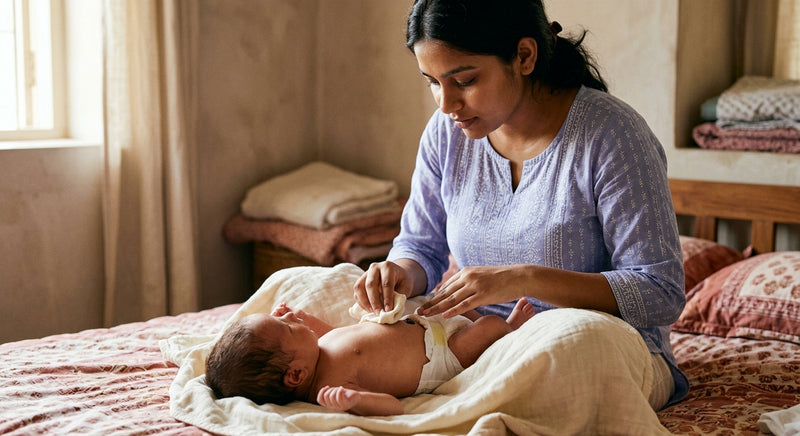
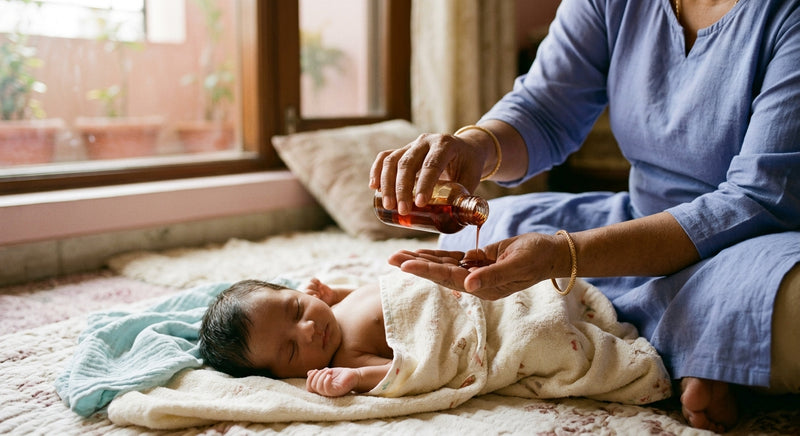
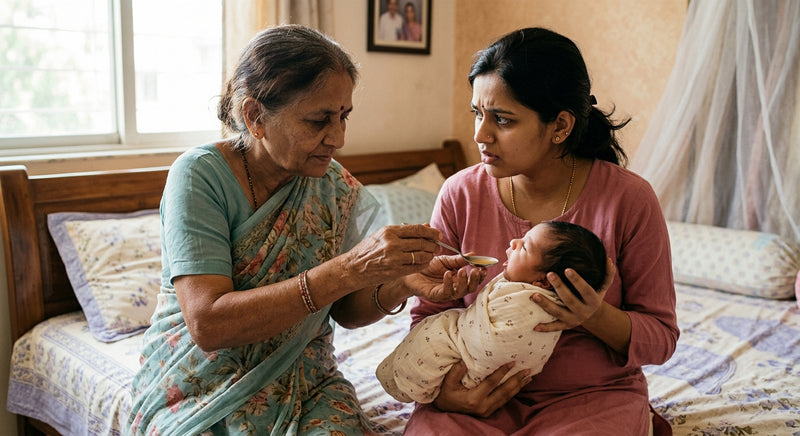
"It smells so good — that's how you know it's a proper baby product." I've heard some version of that in pharmacy queues, at baby showers, and from my own relatives leaning over a freshly bathed newborn. In India, a soft powdery scent has quietly become shorthand for clean, premium, well cared-for. So when I tell parents the smell is often the first thing I'd question, they sometimes look at me like I've insulted their grandmother.
Here's the honest version, up front. Fragrance in a baby product isn't automatically dangerous. "Fragrance-free" isn't automatically better at everything, either. But that lovely smell is doing far less for your baby's skin than you think — and on sensitive or eczema-prone skin, added fragrance is one of the more common avoidable triggers. So let's sort the true from the marketing.
At a glance
- Fragrance is for you, not the baby. It makes a product pleasant to use; it adds nothing to skin health.
- "Unscented" and "fragrance-free" are not the same thing — one can still contain masking fragrance.
- Natural fragrance and essential oils can trigger skin too — "plant-based" doesn't mean "won't react."
- For everyday newborn use, less fragrance is the safer default, especially on broken or eczema-prone skin.
- A baby's skin is thinner and more reactive than yours — read the label, don't follow the smell.
If you want the bigger picture on how to judge any ingredient — not just fragrance — read our complete guide to baby skincare ingredients alongside this. Fragrance is one piece of a larger label-reading habit.
Myth: "A good baby product should smell strongly nice"
This is the belief I meet most often, and I understand where it comes from. A strong, comforting scent feels like quality. It tells you the product is fresh, that bath time worked, that you've done something good for your baby. None of that is true, but it's a powerful feeling.
Because fragrance is a performance ingredient — and the only thing it performs for is the adult nose. It doesn't moisturise. It doesn't protect the barrier. It doesn't soothe. When we formulate at Janma in our own GMP facility, fragrance sits in a completely different bucket from the actives that actually do something on skin. The smell is the wrapping paper, not the gift.
And there's a real trade-off hiding in that wrapping. A baby's skin is 20–30% thinner than an adult's, with a barrier still maturing through the first year. Whatever you apply — fragrance molecules included — sits closer to living skin and crosses it more easily. A scent you'd find pleasant and completely harmless can be a genuine irritant on a newborn.
Fact: fragrance is one of the most common skin triggers
This part isn't a Janma opinion — it's well established in dermatology. Fragrance is among the leading causes of contact allergy and irritation in skincare, across every age group. For a baby, with thinner skin, an immature barrier, and a real chance of atopic (eczema-type) tendencies, the odds only go up.
It rarely looks dramatic. Usually it's a faint roughness, a little redness in the neck or knee folds, a patch that flares after one particular wash or lotion and calms once you stop. Parents tend to blame the weather, or the heat, or "teething." Sometimes it really is the fragrance.
Myth: "Natural fragrance and essential oils are safe because they're natural"
This one trips up the most careful parents — the ones reading labels, trying hard to do right. "Parfum" sounds chemical and scary. "Natural fragrance" or "essential oil blend" sounds gentle, wholesome, almost like food. So they reach for the second one.
Your baby's skin doesn't read marketing, though. It reads molecules. Several common essential oils — lavender, citrus oils, certain florals — contain known fragrance allergens like linalool and limonene, the very same compounds that show up on synthetic-fragrance warning lists. Natural doesn't mean inert. We saw the same tension with a kitchen staple: in our piece on ghee for baby skin, "natural and ancestral" still has to be weighed against what the evidence and the skin actually show.
None of this means you should fear every plant extract. It means you judge an ingredient by how it behaves, not by where it came from. A fragrance-free formula built around a genuinely soothing active — like the colloidal oatmeal in our honest look at colloidal oatmeal — is doing real work on the skin, with nothing added just to make it smell like a perfume counter.
What do the words on the label actually mean?
Here's where most of the confusion lives, because shops use these terms as if they're interchangeable. They aren't.
| What the label says | What it usually means |
|---|---|
| Fragrance / Parfum | Added scent. Can be one ingredient or dozens, often undisclosed individually. The thing to watch on sensitive skin. |
| Fragrance-free | No fragrance added to create a scent. Usually the safest bet for newborns and reactive skin. |
| Unscented | Smells like "nothing" — but a masking fragrance may have been added to hide raw-ingredient odour. Not the same as fragrance-free. |
| Natural fragrance / essential oils | Still fragrance. Can contain allergens (linalool, limonene). Not automatically gentler. |
| Hypoallergenic | A marketing claim with no fixed legal definition in many markets. Read the actual ingredient list, not the front of the bottle. |
One habit beats all the others: turn the bottle around. The front of the pack is advertising. The ingredient list is the truth. We've written a fuller walkthrough on reading a baby skincare label, but for fragrance alone, the checklist below does most of the job.
How to choose: a fragrance checklist you can use tonight
- Read the full ingredient list, not the marketing words on the front.
- For a newborn or eczema-prone baby, prefer "fragrance-free" over "unscented."
- Scan for "fragrance / parfum," "linalool," "limonene," "citronellol," "geraniol" if your baby reacts easily.
- Patch test anything new: a little on the inner forearm, wait 24 hours, check for redness before regular use.
- Introduce one new product at a time — so if something flares, you know the culprit.
- Trust calm skin over a nice smell. If it smells like a bakery, ask what's making it smell that way.
So should every baby product be completely fragrance-free?
Honestly, no — not always. For a healthy toddler with no skin sensitivity, a lightly, thoughtfully fragranced wash is usually fine, and a bath the child actually enjoys counts for something too. Think about contact time. A wash spends seconds on skin and rinses off; a lotion or balm stays put for hours. That's exactly where I get strict about keeping fragrance minimal or absent.
My rule of thumb for Indian families is simple: the younger the baby and the more reactive the skin, the lower the fragrance. Newborn, eczema-prone, broken or weepy skin, the nappy area — keep it as fragrance-light as you can. A sturdy three-year-old after a dusty Nagpur summer afternoon? You've got a little more room.
For a daily wash, a gentle, tear-free head-to-toe baby foam wash made for sensitive skin keeps bath time pleasant without loading the skin with strong scent. For leave-on care on dry or eczema-prone patches, a barrier-supporting moisturizing balm that helps comfort sensitive skin does the actual work — fragrance optional, soothing essential.
When to see a doctor
Most fragrance-related irritation settles quickly once you remove the trigger. See your paediatrician or a dermatologist if:
- A rash is spreading, weeping, blistering, or crusting, or the skin is broken.
- There's swelling of the face, lips or eyes, or any breathing difficulty after a product — treat this as urgent.
- Redness or itching doesn't improve within a week of removing scented products.
- Your baby seems distressed, isn't feeding or sleeping, or develops a fever alongside the skin issue.
- You're unsure whether it's irritation or eczema — a clinician can confirm and guide ongoing care.
A doctor can tell genuine contact allergy apart from ordinary dryness or heat rash, and that one distinction changes what you do next.
In summary
- Fragrance makes a product pleasant for you but adds nothing to your baby's skin health.
- "Fragrance-free" is usually safer than "unscented," which can still hide a masking scent.
- Natural fragrance and essential oils can also trigger skin — judge by reaction, not origin.
- Read the full ingredient list, patch test new products for 24 hours, and add one at a time.
- Keep fragrance lowest for newborns, eczema-prone skin and leave-on products; see a doctor if skin is broken, swelling or not improving.
Frequently asked questions
Is fragrance in baby products bad?
Not automatically, but it carries risk with little benefit. Fragrance makes a product smell pleasant; it doesn't moisturise or protect skin. Because a baby's skin is thinner and more reactive, added fragrance is one of the more common avoidable triggers for irritation and allergy. For newborns and eczema-prone skin, choosing low- or no-fragrance products is the safer everyday default.
What's the difference between "fragrance-free" and "unscented"?
They sound identical but aren't. "Fragrance-free" means no fragrance was added to create a scent — usually the safest choice for sensitive baby skin. "Unscented" means the product smells like nothing, but a masking fragrance may have been added to cover raw-ingredient odour. So an "unscented" product can still contain fragrance. Always read the full ingredient list to be sure.
Are essential oils safer than synthetic fragrance for babies?
Not necessarily. "Natural" doesn't mean non-irritating. Several common essential oils — lavender, citrus, certain florals — contain known fragrance allergens like linalool and limonene, the same compounds flagged on synthetic-fragrance lists. Baby skin responds to molecules, not to where they came from. Judge an ingredient by how the skin reacts, and patch test anything new for 24 hours.
Why do baby products have fragrance at all?
Mostly for the experience of using them — a pleasant scent makes bath and massage time feel nicer for parents and can mask the natural smell of oils and butters in the formula. It's a sensory ingredient, not a skin-care one. That's fine for many children, but on newborns or reactive skin the smell isn't worth the added risk, so minimal or no fragrance is wiser.
Can fragrance cause eczema or allergy in a baby?
Fragrance is a leading cause of contact allergy and irritation in skincare, and a baby's thinner, still-maturing barrier raises the risk. It rarely looks dramatic — often just faint redness or roughness that flares with one product and calms when you stop it. Fragrance doesn't cause eczema itself, but it can trigger flares in eczema-prone skin, so a clinician's input helps if it keeps recurring.