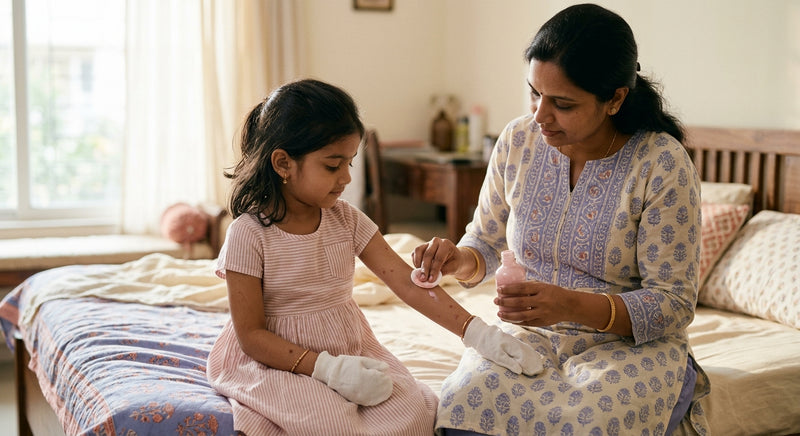
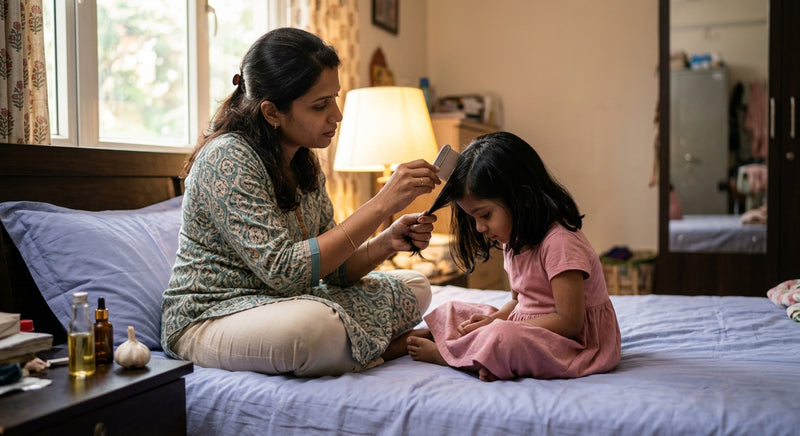
You massage in the malish oil every morning, dress her in soft cotton, and still — those rough, dry patches on her shins and the backs of her upper arms won't smooth out. One grandmother says it's just the weather. A neighbour says you're not oiling enough. Both are half-right and half-wrong, and that's exactly why this is so confusing.
Here's the short answer first: dry patches on a baby's legs and arms are almost always about a skin barrier that's still learning to hold water in. Sometimes it's plain dry skin, sometimes it's early eczema, and quite often on the outer arms it's a harmless bumpy texture called keratosis pilaris. Weather, hard water and harsh washing make all three worse — and oil alone rarely fixes any of them.
At a glance
- A baby's barrier is genuinely leakier than yours — it loses water fast, so legs and arms (thin skin, lots of friction) dry out first.
- Rough bumps on the outer upper arms are usually keratosis pilaris — common, harmless, and not a hygiene problem.
- Oil sits on top; it doesn't replace the water the skin has already lost. You need water plus a seal.
- Hot water, hard water and daily soap strip the barrier — the fix is gentler washing, not more scrubbing.
- See a paediatrician if patches are cracked, weeping, spreading fast or clearly itchy enough to disturb sleep.
If you want the bigger picture behind all of this, we've put together our complete guide to baby eczema and dry skin — this article zooms in on the legs-and-arms question specifically.
Why legs and arms dry out before the rest
Let me put my cosmetic-science hat on for a moment, because the “why” genuinely helps you choose what to do. A baby's skin is thinner and less mature than an adult's — around 20–30% thinner. The outermost layer, the stratum corneum, is the part that holds water in and keeps irritants out. In a baby it's still building up its stores of natural moisturising factors and the lipids (including ceramides) that act as mortar between skin cells.
So water escapes faster than it does from your skin — what the textbooks call higher trans-epidermal water loss. Legs and arms take the worst of it. They're thin-skinned, they rub against clothes and cot sheets all day, and they're usually the last place a rushed parent gets to. Shins are the giveaway: barely any oil-producing activity there, so they go rough almost the moment the air turns dry.
Myth vs fact: what parents believe about dry patches
Most of the advice floating around isn't wrong so much as incomplete. Here's how the common beliefs hold up against what we actually know about skin.
| What many parents believe | What's actually true |
|---|---|
| “It's just the weather — it'll pass.” | Weather is a trigger, not the whole cause. Dry winters and AC pull water out, but the underlying reason is a barrier that can't hold it in. Fix the barrier and weather matters less. |
| “More malish oil will fix it.” | Oil is an occlusive — it seals. But if you seal dry skin with no water underneath, you're locking in dryness. Water first, then oil or balm. |
| “Rough bumps on the arms mean she's dirty or not bathed enough.” | Those are usually keratosis pilaris — tiny plugs of keratin in the follicles. It's harmless, often runs in families, and scrubbing makes it redder, not smoother. |
| “Dry patches mean a serious allergy.” | Usually not. Most dry patches are simple barrier dryness or mild eczema. True food-allergy links are far rarer than the internet suggests. |
| “A hot bath soothes dry skin.” | Hot water feels lovely but strips the very lipids that keep skin soft. Lukewarm and short is kinder. |
The three usual suspects
1. Plain barrier dryness
The most common by far. The skin looks a little dull, feels rough or faintly scaly, maybe flakes. It doesn't itch much, and it turns around within a few days once you moisturise consistently. If you had to pick a diagnosis to get, this is the one.
2. Early or mild eczema (atopic dermatitis)
Now, if the patches are pink, warm, clearly itchy, and keep coming back in the same spots — the fronts of the shins, the creases of the elbows, sometimes the cheeks — you may be looking at eczema rather than simple dryness. It's genuinely common; up to around 48.6% of babies experience atopic-type skin issues at some point. The care overlaps heavily with dry-skin care, just more diligent and more frequent. Our note on how often to moisturise eczema-prone baby skin walks through the rhythm, and if her cheeks are involved too, a gentle face routine is worth a read.
3. Keratosis pilaris
Those tiny, rough, sandpaper-like bumps on the outer upper arms — and sometimes the thighs and cheeks? That's keratosis pilaris. Parents often assume something that looks this specific must be scrubbed off. It's the opposite. Regular moisturising softens the texture over months; scrubs and harsh exfoliants only inflame it. More often than not it fades on its own as the child grows.
What actually makes it worse in Indian homes
Some of the biggest culprits are hyper-local — the sort of thing you notice once you've spent years reading ingredient labels and living with the water that comes out of an Indian tap:
- Hard water. Much of India runs on hard, mineral-heavy water — ask anyone in Delhi or Bengaluru about the scale on their taps. It leaves a fine mineral film and makes cleansers harder to rinse, both of which nag at a delicate barrier.
- Adult or antibacterial soap. High-pH bar soaps disrupt the skin's naturally slightly acidic surface. A baby's barrier does far better with a low-lather, pH-considerate wash.
- Over-bathing in summer, hot baths in winter. Both extremes strip lipids. Short and lukewarm wins in every season.
- Air conditioning. AC is a quiet dehumidifier. Skin that's fine at breakfast can feel rough by dinner in a cooled room.
- Rough or synthetic fabric. Friction and trapped sweat both irritate. Soft cotton helps — here's the honest comparison of cotton versus synthetic clothing for eczema-prone babies.
The routine to start tonight
Here's the one habit that changes the most. If you remember nothing else from this article: put the moisturiser on while the skin is still damp, within about three minutes of the bath. You're trapping the bath water against the skin instead of chasing it once it's gone.
- Keep the bath short (about 5–10 minutes) and lukewarm — test it against your inner wrist, not your hand.
- Use a gentle, low-lather, tear-free wash rather than soap. Janma's Head to Toe Baby Foam Wash is built for exactly this — a soft cleanse that doesn't strip the barrier.
- Pat — don't rub — with a soft towel, leaving the skin slightly damp.
- Within three minutes, seal in the water with a rich moisturiser or balm over legs, arms and any rough spots.
- Re-apply once more during the day on the shins and outer arms if the air is dry or the AC is on.
- Dress in soft, breathable cotton; wash new clothes before first wear.
Why “water first, then seal” matters — the ingredient logic
Moisturisers work in three ways, and good baby care uses all three. Humectants (like glycerin) draw water into the skin. Emollients (soft oils and butters) fill the gaps between skin cells so the surface feels smooth. Occlusives form a light seal on top that slows evaporation. Plain malish oil is mostly that last one. It seals — but it brings no water and rebuilds nothing. That's the whole reason oil alone disappoints on the stubborn patches. A formulated balm that pairs humectants and emollients with a seal does the full job. Look for one that also helps support the barrier itself, not just coats it.
When to see a doctor
Most dry patches are a home-care matter. But check in with your paediatrician if you notice any of these:
- Skin that is cracked, weeping, crusted yellow, or looks infected.
- Patches spreading quickly, or a rash that's clearly itchy enough to disturb sleep or feeding.
- Dryness that doesn't budge at all after two weeks of consistent, gentle moisturising.
- Any fever, unusual fussiness, or the skin feeling hot to the touch alongside the rash.
A doctor can tell eczema from other conditions with confidence and, where needed, prescribe something short-term — which sits perfectly alongside a good daily barrier routine.
The honest takeaway: dry patches on the legs and arms are rarely a sign you're doing something wrong. They're a sign of young skin doing a young-skin thing — and they respond beautifully to gentle, consistent care. For the barrier-support step, a rich balm like the Janma Hydra Healing Moisturizing Balm is a simple place to start.
In summary
- Dry patches on legs and arms come from a young, leaky skin barrier — not bad parenting.
- Rough bumps on the outer arms are usually harmless keratosis pilaris; don't scrub them.
- Moisturise onto damp skin within three minutes of a short, lukewarm bath.
- Choose a balm that adds water and seals it in — oil alone rarely smooths stubborn patches.
- See a paediatrician if skin cracks, weeps, spreads fast, or stays rough after two weeks.
Frequently asked questions
Why does my baby have dry patches only on the legs and arms?
Legs and arms have thin skin, lots of friction against clothes and bedding, and very little natural oil — especially the shins. A baby's barrier already loses water faster than an adult's, so these spots dry out first. They're also the areas parents often moisturise last, which lets roughness build up before you notice it.
Are rough bumps on my baby's arms serious?
Usually not. Rough, sandpaper-like bumps on the outer upper arms are typically keratosis pilaris — tiny keratin plugs in the hair follicles. It's harmless, often runs in families, and isn't caused by poor hygiene. Regular gentle moisturising softens the texture over time; scrubbing tends to make it redder rather than smoother, and it often fades as a child grows.
Is oil enough to fix dry patches on my baby's skin?
On its own, usually not. Oil is an occlusive — it seals the surface but doesn't add water or rebuild the skin's texture. If you apply it over already-dry skin, you can lock the dryness in. The reliable approach is water first: moisturise damp skin within a few minutes of the bath, using a balm that combines humectants and emollients with a seal.
How can I tell dry skin from baby eczema?
Plain dry skin looks dull and feels rough or flaky, isn't very itchy, and improves within days of moisturising. Eczema tends to be pink, warm, clearly itchy, and keeps returning to the same spots like the shins, elbow creases or cheeks. If the patches are itchy enough to disturb sleep or keep coming back, ask your paediatrician.
Does hard water make baby dry patches worse?
It can. Hard, mineral-heavy water — common across much of India — leaves a fine film on skin and makes cleansers harder to rinse fully, both of which nag at a delicate barrier. You don't necessarily need a softener; shorter lukewarm baths, a gentle low-lather wash, and moisturising damp skin straight after go a long way to offset it.