The question I get asked most lands as a slightly frantic WhatsApp voice note: "Ridhee, how many times a day am I actually supposed to moisturise? I feel like I'm doing it wrong."
Short answer: for eczema-prone baby skin, moisturise at least twice a day, morning and night, and always within three minutes of a bath, while the skin is still damp. On dry-winter days, red-flag days, or when your baby's skin drinks the cream up inside an hour, go to three or four. More really is better here. You almost cannot over-moisturise eczema-prone skin.
That's the headline. The rest is the actual routine, because "twice a day" only helps once you know when, how much, and in what order. This sits inside our complete guide to baby eczema and dry skin. Want the full picture? Start there. For the everyday rhythm, stay with me.
At a glance
- Minimum: twice a day — after the morning change and before bed.
- Non-negotiable: within 3 minutes of every bath, on damp skin.
- During a flare: bump up to 3–4 times a day, or whenever skin feels dry to your touch.
- Use a lot — a thick, generous layer, not a thin smear.
- Consistency beats any single "miracle" product. Same times, every day.
Why does eczema-prone skin need moisturiser so often?
Eczema isn't really a surface moisture problem. It's a barrier problem underneath. A baby's skin is already 20–30% thinner than an adult's, and in eczema-prone skin the outer barrier behaves like a brick wall with gaps in the mortar. Water escapes through those gaps all day (dermatologists call it trans-epidermal water loss). The skin dries out, tightens, turns itchy. Then the scratching starts, and round the cycle goes again.
Moisturiser is the mortar. Every application patches the wall and slows that water loss. It also wears off; it won't hold for 24 hours. So here's the honest reason you reapply: not because the last layer failed, but because skin keeps leaking water and needs topping up. Think of it less like sunscreen, which you protect with once, and more like watering a plant through a Nagpur summer. Steady, repeated, unglamorous.
The daily moisturising routine, step by step
Here's the rhythm I'd hand a parent starting today. Print it, stick it on the fridge, don't overthink it.
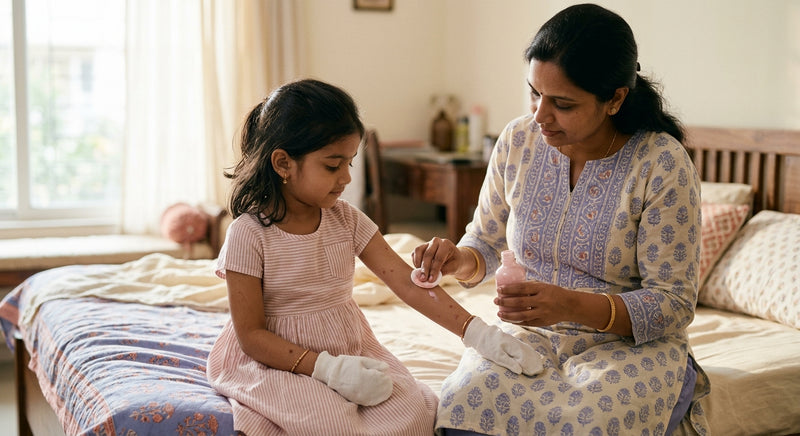
- Morning (after nappy change / before dressing): Full-body layer. Warm a coin-sized amount between your palms and smooth it on in the direction the hair grows — arms, legs, chest, back, behind the knees and inside the elbows (the classic eczema spots).
- After every bath (within 3 minutes): Pat, don't rub, until the skin is just damp, then seal the water in with a generous layer. This is the one that matters most. A bath with no moisturiser lock-in afterwards actually leaves skin drier than before.
- Midday top-up (spot check): Run the back of your fingers over cheeks, hands and shins. Rough or tight? Add a thin layer to just those spots. On humid monsoon days you may skip this. In AC or winter you won't.
- Before bed (the big one): The thickest layer of the day. Warm skin loses more water overnight and the itch peaks at night, so a proper occlusive layer before sleep buys everyone calmer nights.
- During a visible flare: Every 3–4 hours, or any time the skin feels dry when you touch it. You're not overdoing it. Flaring skin genuinely needs it.
How much moisturiser is enough?
Parents almost always use too little. Eczema-prone skin wants a generous, visible layer. You should still see a slight sheen after you've smoothed it in, not watch it vanish on contact. Rough guide for a whole baby body: a coin-sized (₹10 coin) blob per limb, more for the trunk. Over a week, the jar should visibly go down. If it's lasting a month, you're being far too polite with it.
Does the season change how often you moisturise?
Yes, quite a bit. India isn't one climate, and eczema-prone skin feels every shift.
| Season / setting | How often | What to watch |
|---|---|---|
| Dry winter (North India, hill stations) | 3–4x a day | Cheeks and hands crack first; layer thickest at night |
| Hot, humid summer / monsoon | 2x a day, lighter | Sweat can irritate — moisturise on clean, cool skin, not sweaty skin |
| Air-conditioned rooms | Add a midday top-up | AC pulls moisture out; skin dries even in summer |
| Hard-water areas | Always seal after bath | Hard water leaves skin tighter; the after-bath layer matters more |
If your tap water leaves a chalky film on the steel tumbler, treat every bath as drying and never skip the seal-in step. And on hot days, wait until your baby has cooled down before you moisturise. Smearing cream over sweat just traps it, and it can sting.
What kind of moisturiser holds up to this many applications?
Apply something three or four times a day and it has to be boringly safe: fragrance-free, no essential oils, no elaborate botanical cocktail that might sensitise thin skin. You want humectants to pull water in, emollients to soften, and an occlusive layer to lock it all down. A proper barrier balm, not a light splash-on lotion. I've written a full breakdown of what to actually look for in a moisturiser for baby eczema if you want to read labels like a pro before you buy.
The face needs a lighter hand. Cheeks are usually where baby eczema shows up first, so go thinner there and mind the eyes and mouth. My gentle face routine for eczema on the cheeks covers that on its own, because the face isn't just "the body, smaller."
One honest aside. Food doesn't cause most baby eczema, and cutting things from a breastfeeding mum's diet rarely helps and can do harm. I've laid out what the evidence actually says about food and baby eczema so you don't go down that anxious rabbit hole. Moisturising well beats elimination diets almost every time.
A gentle bath, then a firm seal
Bathing and moisturising work as a pair. A short, lukewarm bath (5–10 minutes, not hot) with a soap-free, tear-free wash actually helps eczema by hydrating the skin, as long as you seal it in the moment you're done. Long, hot, daily soapy baths do the opposite. So the order is simple: gentle wash, quick pat-dry, moisturiser on before your baby is even fully dressed.
When to see a doctor
Moisturising is the foundation, but it isn't the whole treatment. See your paediatrician or a dermatologist if the eczema is weeping, crusting yellow, or looks infected; if your baby is losing sleep or feeding poorly from the itch; if it's spreading fast or not improving after two weeks of a consistent routine; or any time you're simply worried. Babies under three months with a widespread rash should always be checked. A doctor may add a short course of a medicated cream — and that's not a failure of your routine, it works alongside the daily moisturising, never instead of it.
The honest bottom line
Most parents don't need a cupboard of products. They need one gentle wash, one good barrier moisturiser, and the discipline to apply it more often than feels necessary. Twice a day is the floor. After every bath, the rule. During a flare, whenever the skin feels dry. Do that consistently and you'll head off far more flares than any single "miracle" ingredient ever will.
If you want one fragrance-free barrier layer gentle enough to reapply this often and built to support the skin barrier, our Hydra Healing Moisturizing Balm was formulated for exactly this kind of dry, eczema-prone skin.
In summary
- Moisturise eczema-prone baby skin at least twice a day, morning and night.
- Always apply within three minutes of a bath, on damp skin, to seal in water.
- During flares, dry winters or AC, go up to three or four times a day.
- Use a generous, visible layer — most parents apply far too little.
- See a doctor for weeping, crusting, infected-looking or fast-spreading eczema.
Frequently asked questions
How many times a day should I moisturise my baby's eczema?
At least twice a day for eczema-prone skin — once in the morning and once before bed — plus always within three minutes of every bath while the skin is still damp. During an active flare, or in dry winter and air-conditioned rooms, increase to three or four times a day, or any time the skin feels dry when you touch it. You can't really over-moisturise eczema-prone skin.
Should I moisturise my baby before or after a bath?
After. Pat the skin until just damp — not fully dry — and apply a generous layer within three minutes to seal in the water the bath added. This is the single most important application of the day. A bath without a moisturiser lock-in afterwards actually leaves eczema-prone skin drier than before, so keep the jar right next to the bath.
How much moisturiser should I use on a baby with eczema?
More than you think. Eczema-prone skin needs a generous, visible layer — you should still see a slight sheen after smoothing it in, not have it disappear instantly. A rough guide is about a ₹10-coin-sized blob per limb, more for the trunk. If a jar lasts you a whole month for a baby with eczema, you're almost certainly using too little.
Can I moisturise my baby too much?
With a gentle, fragrance-free barrier moisturiser, over-application is very hard to do — reapplying often is exactly what eczema-prone skin needs. The thing to avoid isn't frequency; it's the wrong product. Heavily fragranced creams, essential oils or harsh actives applied many times a day can irritate thin baby skin, so choose a boring, safe formula and then use it liberally.
Does the weather change how often I should moisturise?
Yes. Dry North Indian winters, hill stations and air-conditioned rooms pull water out of the skin, so you'll often need three to four applications a day. In hot, humid or monsoon weather you can go lighter and stick to twice a day, but always moisturise on cool, clean skin rather than over sweat. In hard-water areas, never skip the after-bath seal.