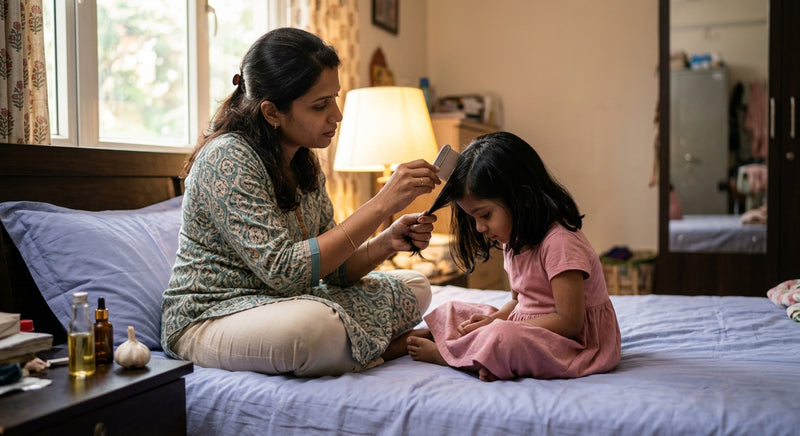
You finish the evening malish, the baby smells like heaven, everyone sleeps. By morning the cheeks are rough again. Here's why: a baby's skin barrier is thin and still half-built, and it leaks water far faster than yours does. Ceramides are the mortar holding that barrier together. The right herbal oils feed it. A few popular ones quietly wreck it. Most of good baby skincare is just sorting which oil is doing what — and shifting the routine as the seasons turn.
At a glance
- The skin barrier is a "brick-and-mortar" wall; ceramides, cholesterol and fatty acids are the mortar.
- A baby's barrier is 20-30% thinner than an adult's, so it loses water and reacts faster.
- Oils high in linoleic acid (sunflower, safflower) tend to support the barrier; oils high in oleic acid (mustard, olive) can disrupt it on fragile baby skin.
- Hard water, AC-dry winters and monsoon humidity each stress the barrier differently — your routine should shift with them.
- Ceramide-rich moisturisers and barrier-friendly oils work best together, not as rivals.
This sits inside our complete guide to bridging Ayurvedic tradition and skin science, where we put old practices under a microscope. Start with the biology. Once you can see how the wall is built, the product aisle stops being confusing.
What is the skin barrier, really?
The top layer of skin — the stratum corneum — is a brick wall. The bricks are flattened, dead skin cells called corneocytes. The mortar between them is a blend of lipids: ceramides, cholesterol and free fatty acids, in a ratio that has to be right for the wall to seal.
Get the mortar right and two things follow. Water stays in. Irritants, allergens and microbes stay out. Let it run low and water escapes — dermatologists call it trans-epidermal water loss, or TEWL — and the skin turns dry, tight, touchy. Those are the rough morning cheeks.
A baby's wall is genuinely more fragile, and not by a little. The skin is thinner. The lipid mortar keeps building through the whole first year. And the natural moisturising factors (NMF) — tiny humectant molecules released when a protein called filaggrin breaks down — aren't fully switched on yet. That's the real reason newborn skin chaps, flakes and reddens at the slightest provocation.
What do ceramides actually do?
Ceramides are the biggest single part of that lipid mortar — by some measures around half of it. They're why the wall holds water at all. Picture the cement that the cholesterol and fatty acids set into. Short on ceramides, the gaps open and the water pours straight out.
And babies with very dry or eczema-prone skin often start with lower ceramide levels and weaker filaggrin function to begin with. So a good ceramide moisturiser isn't a luxury you're talking yourself into — it's topping up mortar that's genuinely running short. In our own lab work, supporting the barrier showed up as increased expression of Keratin-10 and Filaggrin, two markers of healthier, better-sealed skin.
What I actually scan a label for is one moisturiser pulling three shifts at once: a humectant (glycerin) to draw water in, an emollient (oils, butters) to smooth and soften, and an occlusive layer to slow the escape — ideally with barrier-identical lipids like ceramides in the mix. Any one of the three is fine. All three together is what holds overnight.
Where do herbal oils fit — and where don't they?
Indian tradition and skin science mostly agree here, which surprises people. Malish with oil is one of the loveliest, most bonding things you'll do as a parent, and the right oil really does feed the barrier. The whole question turns on one thing: fatty acid composition. Oils high in linoleic acid behave like barrier-builders. Oils high in oleic acid do the reverse on thin baby skin — they loosen the mortar and let more water out.
| Oil | Dominant fatty acid | For a baby's barrier |
|---|---|---|
| Sunflower | Linoleic (high) | Supportive — among the gentler choices |
| Safflower | Linoleic (high) | Supportive |
| Coconut | Lauric + some linoleic | Generally well-tolerated; soothing, mild antimicrobial feel |
| Mustard (sarson) | Oleic + erucic (high) | Caution — can irritate and disrupt thin skin |
| Olive | Oleic (high) | Caution — oleic-heavy; not ideal as a baby barrier oil |
I know how deep mustard-oil malish runs across North and Central India — my own grandmother warmed sarson ka tel with a clove of garlic for every winter massage, and I understand exactly why a family wouldn't want to give that up. But on infant skin the evidence sits somewhere between mixed and unfavourable: the high oleic acid and the pungent compounds can push up TEWL and irritate. If you love the ritual, keep it — go gentle, patch-test first, and reach for a linoleic-rich oil or coconut for the baby's actual skin. We dig further into matching oils to a baby's constitution in our piece on Ayurvedic remedies vs creams for baby eczema.
Can a herbal oil be held to a clinical standard? Yes — and we've written about that exact question: can Ayurvedic baby skincare be dermatologist tested? Tradition and a lab test were never on opposite sides. The formulations worth buying pass both.
How India's seasons test the barrier
No single routine survives a Nagpur summer, a Mumbai monsoon and a Delhi December. Each one comes at the barrier from a different angle.
- Summer heat: sweat and prickly heat. Keep baths simple, dress the baby in cotton, switch to a lighter moisturiser so pores aren't smothered. Barrier care still counts — just in thinner layers.
- Monsoon humidity: damp skin folds turn into fungal trouble. Pat the neck, groin and backs of the knees properly dry, and don't seal trapped moisture under a heavy occlusive.
- Dry winter & AC: this is when the barrier loses water fastest. Richer ceramide-and-oil moisturising, twice a day, sealed in within three minutes of a bath.
- Hard water (year-round across much of India): the calcium and magnesium in it, plus alkaline soap, push skin pH up and strip lipids. A soap-free, pH-balanced wash, then moisturiser straight after.
A barrier-friendly routine you can start tonight
It isn't complicated. Lose less water, put back what's lost, do it every day. That's the whole job.
- Keep baths short (5-10 min) and lukewarm — hot water strips lipids fast, worst of all in winter.
- Use a soap-free, pH-balanced cleanser instead of regular soap, especially if your water is hard.
- Pat dry — never rub — and leave the skin a little damp.
- Within three minutes, while the skin is still damp, apply a ceramide-supporting moisturiser or balm to lock the water in.
- For malish, pick a linoleic-rich oil (sunflower, safflower) or coconut over mustard or olive on baby skin; patch-test anything new.
- Go back over cheeks, shins and any rough patches before bed — those dry out first.
One more thing about layering oils and creams. Oil on its own is an emollient, but a weak occlusive, with no humectant at all. That's why a malish-only routine often falls short for a truly dry baby. A moisturiser that brings glycerin, barrier lipids and a soft occlusive together does the heavy lifting — and the oil massage stays what it should be, the lovely ritual on top, not the entire plan.
When to see a doctor
Most dry, rough baby skin settles with gentle cleansing and steady moisturising. But see your paediatrician if you notice: skin that's cracked, weeping, crusting or bleeding; redness that spreads or feels warm (possible infection); intensely itchy patches that disturb sleep or feeding; or dryness that simply won't improve after two weeks of a steady barrier routine. These can point to eczema or infection that needs proper assessment — and early help makes a real difference. Never start a steroid or prescription cream on a baby without medical advice.
If you do one thing tonight, make it this: add a ceramide-supporting, barrier-friendly moisturiser. It's the highest-value step there is. Our Hydra Healing Moisturizing Balm was formulated for exactly this — comforting dry, sensitive skin and supporting the barrier through India's hardest seasons.
In summary
- Ceramides are the "mortar" that seals a baby's barrier — supporting them keeps water in and irritants out.
- Choose linoleic-rich oils (sunflower, safflower) or coconut over oleic-heavy mustard and olive for baby skin.
- Moisturise within three minutes of a lukewarm bath, while skin is still damp, to lock in water.
- Adjust for the season: light in summer, dry the folds in monsoon, rich barrier care in dry winter.
- Use a soap-free, pH-balanced cleanser if your water is hard, and see a doctor for cracked, weeping or spreading skin.
Frequently asked questions
What are ceramides and why does my baby's skin need them?
Ceramides are fatty molecules that act as the "mortar" sealing the skin's outer layer, keeping water in and irritants out. Babies often have lower ceramide levels and a thinner barrier, so their skin dries and reacts more easily. A ceramide-supporting moisturiser helps top up that mortar and comfort dry, sensitive skin.
Is mustard oil safe for baby massage?
Mustard oil is deeply traditional but its high oleic acid and pungent compounds can irritate and disrupt a baby's thin skin barrier, with evidence that's mixed-to-unfavourable for infants. If your family loves the ritual, go gentle and patch-test first — or choose a linoleic-rich oil like sunflower or safflower, or coconut, for the baby's actual skin.
Which herbal oils are best for a baby's skin barrier?
Oils high in linoleic acid tend to support the barrier — sunflower and safflower are good gentle choices, and coconut is generally well-tolerated and mildly soothing. Oils high in oleic acid, like mustard and olive, can loosen the barrier on thin baby skin. Always patch-test a new oil and watch for any redness.
Does hard water affect my baby's skin barrier?
Yes. The calcium and magnesium in hard water, especially with alkaline soaps, raise skin pH and strip protective lipids — common across much of India. If your taps show white scale, switch to a soap-free, pH-balanced cleanser and moisturise immediately after every bath to protect the barrier.
Do I still need a moisturiser if I do daily oil malish?
Often, yes. Oil is a good emollient but a weak occlusive with no humectant, so massage alone may not hold enough water in genuinely dry skin. A moisturiser combining glycerin, barrier lipids and a soft occlusive does more of the sealing work — keep the malish as the bonding ritual on top.
How does the routine change between Indian summer, monsoon and winter?
In summer, keep it light to avoid trapping sweat. In monsoon, dry skin folds carefully to prevent fungal flare-ups and don't over-occlude. In dry winter and AC, moisturise richly twice daily and seal within three minutes of a bath. Hard water needs a soap-free cleanser year-round.