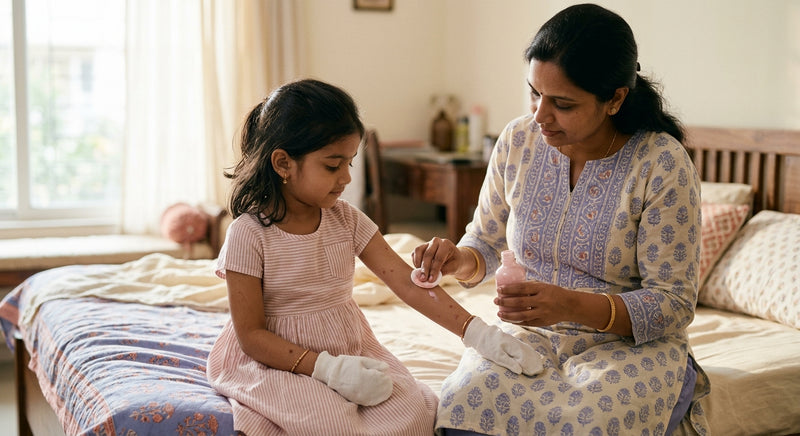
Short answer: some do, some don't — it depends entirely on the recipe, not the word "ayurvedic" on the label. A few traditional ingredients sit close to your baby's natural skin pH and behave gently. Others — including a couple parents assume are the safest of all — are mildly to strongly alkaline, and used daily they can nudge that delicate acid mantle off balance. Knowing which is which is the whole game.
A mother in Nagpur asked me this last month, holding a jar of homemade ubtan her mother-in-law swore by. "It's natural, na? So it must be balanced?" Natural and pH-balanced are two different things entirely. So here's what actually happens on a baby's skin when you wash and massage it — and a routine that respects both the tradition and the science.
At a glance
- Healthy skin sits slightly acidic — roughly pH 4.5 to 5.5. This "acid mantle" keeps moisture in and unfriendly microbes out.
- A newborn's skin starts closer to neutral and takes weeks to acidify, so it's more vulnerable early on.
- Traditional soaps and some besan/alkaline ubtans can read pH 9-11 — too high for daily baby use.
- Plain oils (sesame, coconut) are pH-neutral and gentle; the problem is usually the cleanser, not the massage.
- Look for "pH-balanced" or "syndet" cleansers and rinse-friendly ingredients — and patch test anything homemade.
If you want the bigger picture of how old recipes and modern testing fit together, I've laid it all out in our complete guide to bridging ayurvedic tradition and clinical skincare. This article zooms in on one thing only: pH.
What is baby skin pH, and why does it matter so much?
pH is just a scale of how acidic or alkaline something is, from 0 to 14. Seven is neutral. Healthy skin is deliberately, usefully acidic — around 4.5 to 5.5. That thin acidic film is the acid mantle, and it does real work: it keeps the enzymes that build your baby's barrier switched on, holds water in, and makes the surface inhospitable to the bacteria and fungi that cause trouble.
Newborns are the catch. A baby isn't born with that acidic surface. Right after birth the skin pH is closer to neutral — around 6.5 to 7 — and it takes the first few weeks of life to drift down into the protective acidic range. The barrier is still settling in through that whole window. And a baby's skin is 20-30% thinner than an adult's, so whatever you put on it has an outsized effect.
Wash with something alkaline — a classic high-pH soap bar, or certain DIY pastes — and you temporarily push the surface pH up. Adult skin recovers fairly quickly. Baby skin takes longer. Do it twice a day, every day, and the mantle never fully resets. That's when you see the dryness, the tightness, the extra sensitivity. So the honest answer to "does ayurvedic keep pH balanced?" is: only if that specific product is formulated and tested to.
Which ayurvedic ingredients are kind to pH — and which aren't?
This one surprises parents, so let me be specific. The word "herbal" tells you nothing about pH. What matters is the actual ingredient and how it's processed.
| Traditional ingredient | Roughly where it sits | Verdict for daily baby use |
|---|---|---|
| Sesame, coconut, almond oil (plain) | Neutral, non-water-based | Gentle — oils don't really carry a water pH; fine for malish |
| Oats / colloidal oatmeal | Mildly acidic to neutral | Soothing and pH-friendly |
| Besan (gram flour) paste | Mildly alkaline | Occasional, well-rinsed — not a daily cleanser |
| Multani mitti (fuller's earth) | Alkaline | Too drying for routine baby skin |
| Traditional soap / reetha-heavy washes | Strongly alkaline (pH 9-11) | Skip for daily newborn washing |
Notice what's at the top and what's at the bottom. The oils — the heart of Indian malish — are genuinely fine. Pure sesame or coconut oil isn't water-soluble, so it doesn't shift surface pH the way a watery alkaline paste does. The risk almost always comes from the cleansing step: the soap, the besan scrub, the reetha. That's where a well-meant tradition can quietly work against the acid mantle. I go deeper into how herbal oils and the barrier interact in our piece on the baby skin barrier, ceramides and herbal oils.
Can an ayurvedic product be both herbal and pH-balanced?
Yes — and this is where the formulation earns its keep. A modern ayurvedic-at-heart product can keep the soothing botanicals (oats, calendula-type herbs, gentle oils) and pair them with a syndet base — a synthetic-detergent cleansing system buffered to around skin pH instead of the high-alkaline chemistry of traditional soap. You get the herbal benefit without the pH spike.
That's the real gap between a homemade paste and a tested formulation. In a lab you can measure the finished pH, adjust the buffer, confirm it lands in the gentle zone, then check it on real skin. Wondering whether old recipes can stand up to that kind of scrutiny? I wrote a whole honest answer in can ayurvedic baby skincare be dermatologist tested? At Janma we make our formulations in our own GMP-certified facility, precisely so we can control and verify things like finished pH instead of trusting a label.
A pH-friendly daily routine you can follow tonight
Here's the routine I give parents who want to honour the malish tradition without bullying the acid mantle. Keep it boring and consistent. Boring is what baby skin loves.
- Massage first, with plain oil. Warm a little sesame or coconut oil between your palms and do a gentle 5-10 minute malish before the bath. Oil is pH-neutral and gives the barrier a head start.
- Use lukewarm water, not hot. Dip your inner wrist in — it should feel barely warm, the steel-tumbler test our mothers used. Hot water strips lipids and dries skin faster than any cleanser.
- Pick a pH-balanced, tear-free cleanser. For everyday washing, choose a syndet or a wash labelled "pH-balanced" over a traditional soap bar. A coin-sized blob is enough for a whole baby.
- Keep baths short. Five to ten minutes. Longer soaking, even in gentle water, softens and dehydrates the surface.
- Rinse besan or ubtan thoroughly — and only occasionally. If grandmother's ubtan is part of a ritual, treat it as a once-in-a-while thing, rinse every trace, and never scrub.
- Pat dry, don't rub. Leave the skin very slightly damp.
- Moisturise within 3 minutes. Seal in water while the skin is still damp with a fragrance-light balm or lotion. Of the whole routine, this is the step that protects the barrier most.
- Patch test anything homemade. A small dab on the inner forearm, wait 24 hours, watch for redness.
Honestly, that "moisturise within 3 minutes" step matters more than the cleanser you pick. For dry, sensitive or eczema-prone skin, a richer occlusive like the Hydra Healing Moisturizing Balm helps lock moisture in and supports the skin's natural barrier — in our lab work it increased Keratin-10 and Filaggrin expression, two proteins the barrier depends on.
What about ayurvedic eczema remedies and pH?
Eczema-prone skin already runs more alkaline than healthy skin, which is part of why it flares — the higher pH lets irritation-causing enzymes run loose. Put an alkaline home paste on top of that and you're pushing in exactly the wrong direction. Weighing a traditional remedy against a cream for a flare? I've compared the safety of both in ayurvedic remedy vs cream for baby eczema. The short version: for active eczema, lean on a pH-respecting, barrier-supporting routine and your paediatrician's guidance, not experiments.
When to see a doctor
Most pH-related dryness settles with a gentler routine. But see your paediatrician if you notice skin that's persistently red, cracked, weeping or crusting; a rash that spreads or comes with fever; intense itching that disturbs sleep; or any reaction that appears after a homemade product. These need proper assessment — a doctor can rule out infection or eczema and guide treatment safely.
In summary
- Healthy skin sits at pH 4.5-5.5; a newborn's starts near neutral and takes weeks to acidify.
- Judge each ayurvedic ingredient by its actual pH, not the word natural — oils are gentle, many soaps and pastes are alkaline.
- The pH risk almost always comes from the cleansing step, not the oil malish.
- Choose a pH-balanced, tear-free cleanser, keep baths short, and moisturise within three minutes.
- Stop all home pastes and see a doctor if skin is broken, weeping, spreading or feverish.
Frequently asked questions
What is the normal pH of baby skin?
Healthy skin sits slightly acidic, roughly pH 4.5 to 5.5, which forms the protective acid mantle. Newborns are different: their skin starts closer to neutral, around pH 6.5 to 7, and takes the first few weeks of life to acidify into that protective range. That's why a newborn's barrier is more vulnerable and needs especially gentle care early on.
Do ayurvedic products keep baby skin pH balanced?
Some do, some don't — it depends on the actual recipe, not the word ayurvedic. Plain oils like sesame and coconut are pH-neutral and gentle. But traditional soaps and some besan or multani-mitti pastes are alkaline (pH 9-11) and can disrupt the acid mantle with daily use. A modern ayurvedic-at-heart cleanser that is formulated and tested to be pH-balanced gives you the herbal benefit without the spike.
Is besan or ubtan bad for a baby's skin pH?
Besan (gram flour) is mildly alkaline and multani mitti is more so, so neither is ideal as a daily cleanser for thin baby skin. As an occasional, well-rinsed ritual on healthy skin it's usually fine, but never scrub, and always rinse off every trace. Skip it entirely on broken, irritated or eczema-prone skin, which already runs more alkaline.
Does massage oil affect baby skin pH?
Not really — and that's good news for malish. Pure oils like sesame, coconut and almond aren't water-based, so they don't carry a watery pH that shifts the skin's surface. They sit on top and support the barrier. The pH risk in a traditional routine almost always comes from the cleansing step, not the massage, so you can keep the oil malish with confidence.
What cleanser keeps baby skin pH balanced?
Look for a tear-free cleanser labelled pH-balanced or described as a syndet (synthetic-detergent) wash, rather than a classic alkaline soap bar. Use a small amount, lukewarm water, and keep baths to five to ten minutes. Then moisturise within three minutes of patting dry to seal water in. That sequence protects the acid mantle far better than any single product alone.