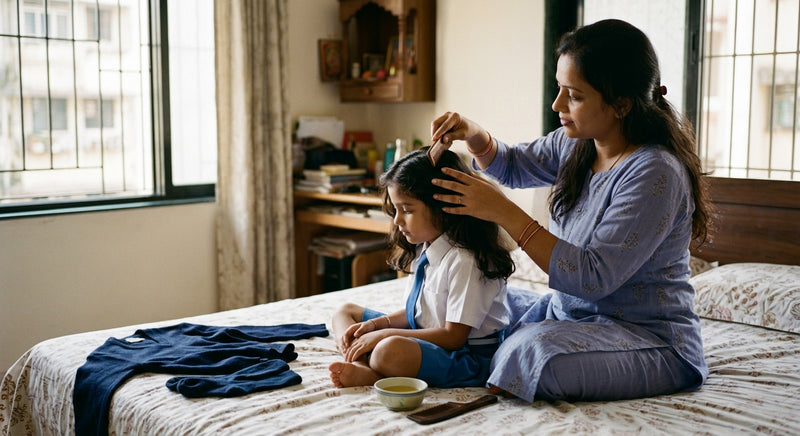
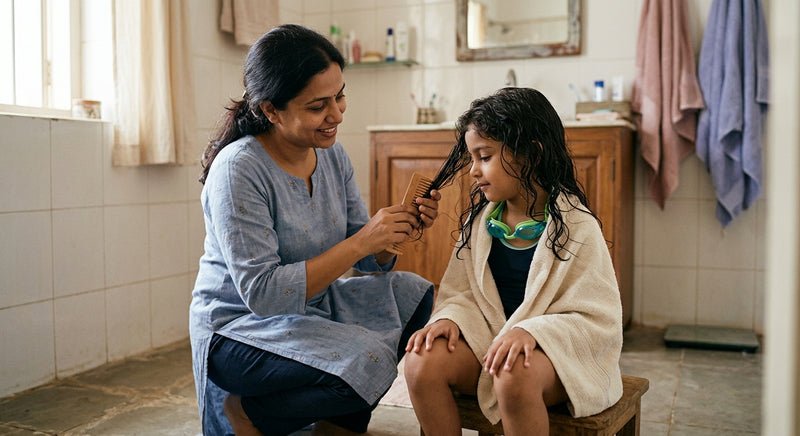
School pickup, 3:40 pm, Nagpur in May. My ten-year-old yanked the car door open, flung the school bag onto the back seat, and the whole car changed. Not the warm, biscuity sweat of a toddler. Sharper. Oniony. And the thought that arrived was probably the one you're having right now: do I buy a deodorant, or am I just not bathing this child properly?
At ten, that smell is normal. For most children, a bath routine done properly handles it. Underarms genuinely washed with cleanser, not splashed. A fresh cotton vest every single day. Yesterday's uniform shirt not going back on. Deodorant isn't dangerous and ten isn't too early — it's just rarely the first thing that needs fixing. Give the routine ten days. If the smell is back two or three hours after a good bath, or your child has started quietly sniffing their own sleeve in class, a simple roll-on is a completely fair next step.
At a glance
- New underarm smell somewhere between eight and eleven years is growing up, not poor hygiene.
- Sweat has no smell. Skin bacteria breaking it down is what you're smelling.
- A tighter bath and clothing routine sorts out most tween body odour inside a week or two.
- Start with the routine: underarms, feet, scalp, and daily fresh clothes next to skin.
- Odour back within hours of a proper bath? An unscented roll-on is reasonable at ten.
- Body spray is never a substitute for a bath. It layers fragrance over the bacteria, and by 2 pm that smells worse.
Is body odour at 10 too early?
No. It catches parents off guard, but it's one of the earliest visible signs that the body is shifting gear — commonly between eight and eleven, sometimes a little earlier in girls. The sweat glands in the underarms and groin change character. Instead of the watery sweat that cools you down, they start producing a richer sweat, one that carries protein and fat.
And that sweat, still, has no smell of its own. The odour comes from ordinary skin bacteria feeding on it. So the smell isn't evidence that your child is dirty. It's evidence that there's now something on their skin for bacteria to work on — and that it sat there for eight hours under a polyester uniform in 41°C.
Which is why the fix is mechanical, not chemical. Get the sweat off sooner. Cut the bacteria's food supply. Give it less time to sit. Deodorant works on the same principle, just from the other end.
Will a better bath routine actually fix it?
Usually, yes. Somewhere around eight, children take over their own baths, and a self-run bath tends to look like this: hot water on the head, one swipe of soap across the chest, a mug over the shoulder, done in ninety seconds. The underarms never get touched. Neither do the feet.
Three things go wrong in most Indian homes.
- The underarm is rinsed, not washed. Water alone won't lift the oily part of that new sweat.
- The uniform shirt gets a second day. Bacteria are already living in the fabric. A freshly bathed child in yesterday's shirt smells by lunch break.
- Feet and shoes are nobody's job. Closed school shoes plus one pair of socks all week is a separate smell altogether.
So here's the routine — written for a ten-year-old, not for you.
- Wet the whole body first, then take cleanser onto your hands or a soft cloth.
- Underarms: lather and count to ten on each side. Actually count. Then rinse fully — leftover cleanser under the arm can itch.
- Same for the feet (between the toes), the groin, behind the ears, the back of the neck.
- Rinse until the skin doesn't feel slippery. In hard-water cities that takes longer than you'd think.
- Dry the underarms and between the toes properly. Damp skin under a shirt is where the smell restarts.
- Fresh cotton vest, fresh socks, fresh shirt. Every day.
- Cricket practice or games period? Add a quick evening rinse. Five minutes, underarms and feet, no shampoo needed.
The cleanser matters less than people assume — though it isn't nothing. You want something mild enough for daily use on a growing child's skin without stripping it, and low on heavy fragrance, because perfume sitting on top of odour is not the same as removing the odour. Skip the harsh antibacterial bars marketed to adults. At ten, over-cleansing usually shows up around December as dry, itchy shins. A gentle daily wash made for this age group — ours is the Kids Gentle Body Cleanser — is the sort of thing to reach for, used properly, on the parts that need it.
So when does deodorant genuinely make sense — and which kind?
Ten days of the routine first. Then watch for three things:
- The smell comes back within two to three hours of a proper bath.
- Your child has gone self-conscious — arms held down, shirts changed, questions asked.
- Sweat patches on the uniform are the issue, not the odour.
Any one of those, and buying a deodorant is an ordinary decision. There's no rule that ten is too young. Format is what to get right.
| Option | What it actually does | Fit for a 10-year-old? |
|---|---|---|
| Better bath routine | Removes the sweat residue and bacteria that create the smell | Start here — fixes most cases on its own |
| Deodorant (roll-on or stick) | Reduces odour-causing bacteria and masks lightly; doesn't stop sweat | Good first choice if odour persists |
| Antiperspirant (aluminium salts) | Temporarily reduces how much sweat reaches the surface | Only if wetness — not smell — is the real problem |
| Aerosol body spray | Fragrance over skin; nothing removed | Weakest option — and never a bath substitute |
If you do buy one:
- Roll-on or stick, not aerosol. A child emptying a can inside a small closed Indian bathroom inhales a fair amount of it. A roll-on avoids that, and lasts longer.
- Unscented, or very lightly scented. Heavy fragrance plus sweat plus a warm classroom beats mild body odour for unpleasantness.
- Clean, completely dry skin, in the morning after the bath. On damp skin it does almost nothing and rolls straight off.
- Patch test first — a dab on the inner forearm, left overnight. Underarm skin is thin and reacts easily.
- Never on broken, shaved, freshly waxed or rash-affected skin. Wait till it's fully settled.
- One application a day is plenty. If it isn't lasting, the answer is the shirt or the second bath, not more deodorant.
What about the clothes, the shoes and that school bag?
This is the half that gets skipped, and in Indian conditions it often does more work than anything in the bathroom. School uniforms are largely polyester or poly-cotton blends. Those hold odour molecules far more stubbornly than pure cotton, and they don't let sweat evaporate freely.
- A cotton vest or banyan under the uniform shirt. It takes the sweat before the polyester does, and it gets washed daily.
- Uniform shirt: one day only. April to June especially, and right through the monsoon.
- Don't overload the washing machine. Clothes need room to rinse, or detergent and bacteria stay put in the fabric.
- Sun-dry whenever you can. In monsoon, if clothes dry indoors and come off the line smelling musty, they'll smell worse on a sweating child — rewash, don't iron over it.
- Rotate two pairs of school shoes so each gets a full day to air. Socks daily, never twice.
- Empty the school bag on Fridays. A leaking bottle or a forgotten tiffin lives in there.
We've written elsewhere in the Janma Journal about polyester uniforms and ghamori, and the principle carries straight over: whatever sits against the skin all day does most of the work.
When to see a doctor
Most of this is ordinary growing up. Book a paediatrician appointment if:
- Strong underarm body odour appears well before age eight, or alongside other early signs of puberty such as pubic hair or breast development in a young child.
- Sweating is heavy enough to soak through shirts daily, drip from the hands, or interfere with writing and school — there are treatments for this, and a doctor should assess it.
- The odour is sweet, fruity, ammonia-like or otherwise unusual rather than typical sweat.
- There's a persistent rash, raw skin, itching or a discoloured patch in the underarm that isn't settling.
- The smell doesn't improve at all after two to three weeks of a genuinely consistent routine.
None of it is common. Still, ten minutes with a doctor beats another month of guessing at home — and no article, this one included, can examine your child.
What I'd do tonight
Stand at the bathroom door and coach one bath. Not to supervise. Just to show the count-to-ten under each arm, and the bit between the toes, once. Put a cotton vest out for the morning. Buy a second pair of school socks. Then leave it ten days before you spend a rupee on deodorant. If you still need one after that, buy it without any guilt — at ten, it's a perfectly normal thing to own.
One more thing. If all that thorough washing leaves shins and forearms looking ashy and tight — and that happens fast in a dry Nagpur winter — a light daily moisturiser after the bath sorts it out, and helps support the skin barrier all that washing is working against. Our Hydrating & Soothing Moisturizing Lotion is the one we'd reach for on a school night.
In summary
- New underarm odour around eight to eleven is normal development, not a hygiene failure.
- Fix the bath routine first: a counted ten-second lather under each arm, feet, groin and neck, then dry properly.
- Change the cotton vest, socks and uniform shirt daily — polyester holds odour and re-wearing undoes a good bath.
- If smell returns within two to three hours of a proper bath, a mild unscented roll-on at ten is a fair choice.
- See a paediatrician if odour starts before eight, sweating soaks shirts daily, or nothing improves in three weeks.
Frequently asked questions
At what age can a child start using deodorant?
There's no fixed legal or medical age. Most children who need one start somewhere between nine and twelve, when underarm odour appears. The better test is need, not age: if the smell returns within a couple of hours of a proper bath, or your child is self-conscious about it, a mild unscented roll-on is reasonable. Fix the bath and clothing routine first, since that resolves most cases.
Is deodorant safe for a 10-year-old?
A simple roll-on or stick deodorant applied to clean, dry, unbroken underarm skin is generally well tolerated at this age. Patch test on the inner forearm overnight first, since underarm skin is thin and reacts easily. Prefer roll-ons over aerosol sprays, which children often use in small closed bathrooms and inhale. Avoid applying to shaved, waxed, broken or rash-affected skin.
Why does my child smell even right after a bath?
Usually one of three things. The underarms were rinsed rather than washed with cleanser. The clothes going back on are carrying bacteria from yesterday, especially a polyester uniform shirt. Or the skin was still damp when the shirt went on. Try a counted ten-second lather under each arm, a fresh cotton vest daily, and drying the underarms fully before dressing.
Deodorant or antiperspirant for a tween?
Start with deodorant. It targets the odour-causing bacteria and is the milder of the two. Antiperspirants use aluminium salts to temporarily reduce how much sweat reaches the skin surface, so they only make sense if visible wetness and sweat patches are the actual complaint, not smell. If sweating is heavy enough to soak shirts daily, see a paediatrician rather than escalating products.
How often should a 10-year-old bathe in Indian weather?
Once daily as a baseline, and twice on hot, humid or sports-practice days. The second bath can be a quick five-minute rinse of underarms, feet and groin, with no shampoo needed. Bathing more often is fine as long as you follow with a moisturiser, because over-washing in a dry winter tends to show up as itchy, ashy shins.
Can I use my own deodorant on my child?
Better not to as a default. Adult deodorants and antiperspirants are often heavily fragranced or alcohol-based, and both can sting or irritate thin underarm skin, especially just after a bath. If it's all you have on hand, patch test on the inner forearm overnight and use a very small amount. A mild unscented product bought for your child is the simpler answer.