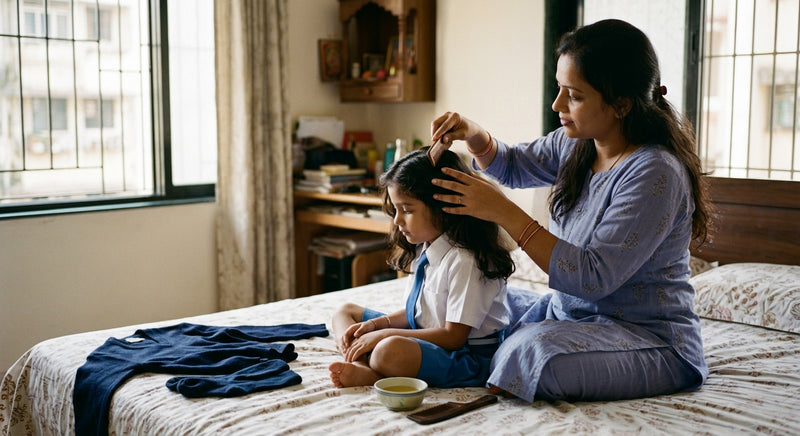
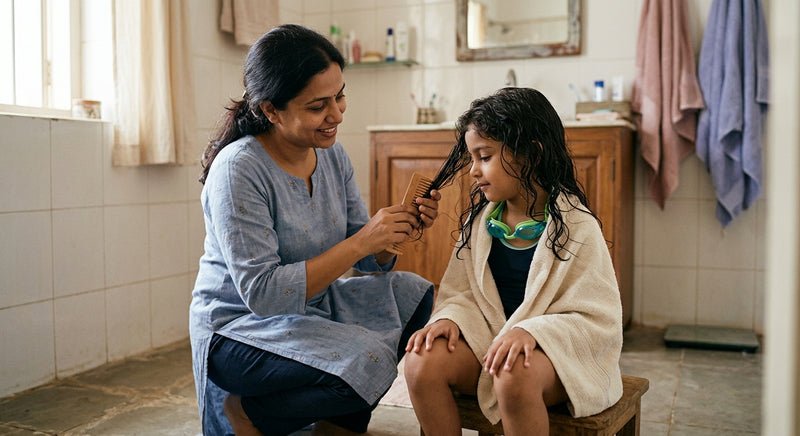
It's 7:20 in the morning. The bus comes at 7:35. You have wet hair, a comb, two ribbons and a school rule that says hair must be neatly tied. So you pull the plait tight enough to survive PT period, sweat and six hours of running about. She says aah. You say sorry. You tie it anyway.
So what does that do to her hair? A style pulled tight at the front puts steady mechanical tension on the smallest, finest follicles along the hairline and temples. Repeated daily over months, that pull can thin the hair there. Dermatologists call it traction alopecia. Caught early, it usually recovers once the tension comes off. No Indian school is going to agree to loose, flying hair, so I won't pretend that's the answer. What you can move is where the tension sits.
At a glance
- It's the repetition that does the damage: tension in the same place, every day. Tying hair up is not the problem.
- The hairline and temples show it first. Those hairs are finer, shorter, anchored in smaller follicles.
- Pain, a lunchtime headache, tiny bumps along the front after styling: all the same message. Too tight.
- Two low plaits with a moving parting beat one high ponytail, five days a week.
- Let slip do the work your hands are doing: detangle first, condition after washing, and never plait soaking-wet hair.
Can tight braids and ponytails really damage a child's hairline?
Yes. Now the scale, because I don't want anyone panicking over a school plait. Most children who wear a tied style every day are completely fine. The trouble sits in one specific pattern: high tension, applied daily, always to the same hairs. That's why the front hairline goes first, then the temples above the ears, then the nape. Those hairs are shorter and finer. They sit in smaller follicles. They take the whole load when the rest of the hair is dragged backwards.
The mechanics are not complicated. Hold a hair under constant pull and you are pulling on the anchoring structures at its root. A few hours of that and the scalp is sore. Every school day for two years, and some of those follicles stop producing properly. The early sign is easy to miss, because there's no bald patch yet: a fringe of very short, fine, broken hairs at the front, and a hairline sitting a millimetre or two further back than it did in last year's sports day photos.
How do I know it's too tight?
- She says it hurts, or it pulls at the outer eyebrows.
- A headache by lunch that lifts when the hair comes down.
- Tiny raised bumps or pinprick redness along the hairline after styling.
- Short broken hairs standing up along the parting or the temples.
- The scalp stays pink or tender where the band sat.
Braid, ponytail or bun: which is kindest to the hairline?
This is the real 7am decision in most Indian houses, so here it is, style by style.
| Style | Where the pull lands | Honest verdict |
|---|---|---|
| Two low plaits, centre parting | Spread across the whole scalp; the hairline is mostly spared | The best everyday school style. Neat enough for inspection, gentlest at the front. |
| One low plait | Whole head, but the single parting line takes it daily | Fine, as long as you shift the parting a centimetre every week or so. |
| Mid or high ponytail | Concentrated at the temples and nape; the weight swings all day | Two or three days a week, not five. Keep the band below the crown. |
| Top knot or dance bun | Highest tension of the lot: the twist drags the hairline back and pins add sharp point loads | Occasion only. Down the moment the performance ends. |
| Plait on soaking-wet hair | Same tension, on a fibre at its most stretchable | The first thing I'd change. Damp, not dripping. |
| Ribbon tied as the elastic | Ribbon knots slide, so they get retied tighter through the day | Soft elastic first. Ribbon over it, for the look. |
What I'd do: two low plaits Monday to Thursday, parting shifted each week. A low ponytail on games day so it stays out of her face. The bun saved for annual day. Swapping three high-ponytail days for low plaits takes almost all the load off the front hairline, and it breaks no school rule.
Why wet hair is the part parents get wrong
This part is chemistry, and it changes the whole morning. Water gets into the hair fibre and breaks the hydrogen bonds that hold keratin's shape. Wet hair swells, softens and stretches a long way before it snaps. That sounds protective. It isn't. Push it past its elastic limit and it doesn't come back: the fibre is permanently weakened and breaks somewhere down the line. A plait pulled tight on dripping hair, then dried into that shape all morning, is that stretch held for hours.
Towel-blot. Wait for damp. Detangle before you tie, in sections, working from the ends upward. Comb from the scalp down and you push every knot into one dense ball at the ends, and then you're pulling against the roots to get through it.
Does oil before the plait help or hurt?
Both, depending on when you use it. Coconut oil is one of the few oils with real lab evidence behind it: the lauric acid is small and straight enough to penetrate the cortex, and it reduces protein loss from the fibre. Worth having. It is still not a detangler. Spread a heavy layer over dry, already-tangled hair and the drag goes up. Strands stick to each other, the comb works harder, and your hand does the extra tugging.
What I'd do instead: a proper champi the night before wash day, scalp and lengths, left on for an hour or so, then washed out. On school mornings, keep oil off the hairline altogether. Two or three drops on the mid-lengths and ends, rubbed between your palms first.
Where slip actually comes from
Conditioner earns its place here as friction management, and it's the biggest lever you have on how hard you pull. A damaged cuticle carries a negative surface charge. Cationic conditioning agents (behentrimonium chloride, cetrimonium chloride and their cousins) are positively charged, so they adsorb onto exactly the roughed-up spots that need them, lie the cuticle scales flat, and drop the force needed to draw a comb through wet hair. Pair them with fatty alcohols like cetearyl alcohol and you get the soft lamellar structure behind that slippery feel. Less combing force, less pull at the root. That's the whole chain.
Hard water works against you, and most of urban India has it. Calcium and magnesium react with cleansing surfactants and leave a fine mineral-soap residue on the fibre. Hair feels squeaky and rough, grips itself, tangles faster and needs more force to comb. A mild, well-rinsing kids shampoo helps. Our Loving & Balancing Shampoo is built for that, and it's tear-free, so wash day isn't its own battle. (If wet versus dry detangling is your daily flashpoint, there's a longer piece on it in the Janma Journal.)
The school-morning routine that keeps it neat without the pull
- Detangle the night before, in sections, ends first. Mornings then start from zero knots.
- Blot to damp. Never plait dripping hair.
- Smooth with a soft brush, a tiny amount of leave-in, or a wet comb through conditioned hair. Neatness by slip.
- Part with the tail of a comb instead of dragging with your fingers, and move the parting line a centimetre every week.
- Start the plait a finger's width away from the scalp at the temples, not scalp-tight.
- Use a fabric-covered seamless elastic. Wrap it twice, not three times.
- Ribbon goes over the elastic, for the look. It does none of the holding.
- Run the one-finger slack test before she leaves.
- Hair fully down the moment she's home. No exceptions, sleepovers included.
If the tugging in your house starts at the comb, begin with a rinse-out that gives real slip. Our Rejuvenating & Detangling Conditioner is made to let the comb do the work your hands are doing now.
Sports day, dance and the high-tension weeks
Annual day rehearsals. Bharatanatyam class. A fortnight of drill practice before Republic Day. These are the stretches where a tight bun happens daily and nobody is keeping count. Build in tension holidays: a loose low plait on the days between rehearsals, no bun two days running, a proper scalp-oiling night on the weekend. Lice-check season needs the same thinking. The fine steel comb has to come out, so use it on conditioned, slippery hair, in small sections, or you'll do more damage than the lice.
When to see a doctor
Book a paediatrician or dermatologist if the hairline keeps receding despite looser styles. Book one too for smooth bald patches with no short broken hairs in them, because that pattern has other causes and needs a proper look. The same goes for sore or pustular spots on the scalp, sudden shedding all over the head rather than at the edges, or hair loss alongside anything else: weight change, fatigue, brittle nails. Hair loss in a child is worth a real examination rather than guesswork, and the earlier tension-related thinning is caught, the better it tends to recover.
In summary
- Tension in the same spot every day — not tying hair up as such — is what thins a child's hairline over time.
- Two low plaits with a parting you shift weekly beat a high ponytail five days running.
- Plait damp hair, never dripping: wet hair stretches past its limit and dries into that shape.
- Swap thin rubber bands for seamless fabric elastics, and let ribbon sit over the elastic rather than do the holding.
- See a paediatrician or dermatologist if the hairline keeps receding, or if you see pus-filled bumps or smooth bald patches.
Frequently asked questions
Can tight ponytails cause permanent hair loss in children?
Usually not, if you catch it early. Tension-related thinning at the hairline tends to recover once the daily pull stops, because the follicles are stressed rather than gone. What causes lasting loss is years of the same tight style in the same place. Loosen the style, move the parting, and give it a few months — and see a doctor if the hairline keeps receding anyway.
Is it okay to plait my daughter's hair when it's wet?
Damp is fine, dripping is not. Water softens the hair fibre and makes it far more stretchable, so a tight plait pulled onto soaking hair stretches strands past their limit and dries them into that shape for hours. Towel-blot first, detangle from the ends upward, then plait. If you're short on time, plait it loosely and let her tighten nothing.
Do rubber bands really break hair?
Yes, and the thin transparent ones are the worst. They grip a small bundle of strands over a tiny contact area, so the stress at that point is very high, and they tear hair out when you pull them off. Fabric-covered seamless elastics spread the load across a wider band. Wrap twice rather than three times, and cut a stuck band out rather than yanking it.
Does oiling before school protect hair from a tight plait?
Not the way most of us were taught. Coconut oil does have real evidence for reducing protein loss from the fibre, but that works best applied before a wash and left on for an hour or so. On dry, tangled hair a heavy morning layer increases drag and means more pulling. Keep oil off the hairline, and use two or three drops on the ends only.
How do I keep a low plait neat enough for school without pulling?
Neatness comes from slip, not tension. Detangle the night before, brush with a small amount of conditioner or leave-in through the lengths, part with a comb tail instead of dragging with fingers, and start the plait a finger's width off the scalp at the temples. Ribbon goes over the elastic. It looks just as tidy at inspection and holds all day.
My child has small bumps along her hairline after styling — what is that?
Most often it's irritation around follicles that are being pulled or rubbed, and it settles once the style is loosened for a week or two. Take the hair fully down at home, switch to low plaits, and keep oil and heavy product off the front. If the bumps have pus, crust over, spread, or hurt to touch, get a doctor to look at the scalp.