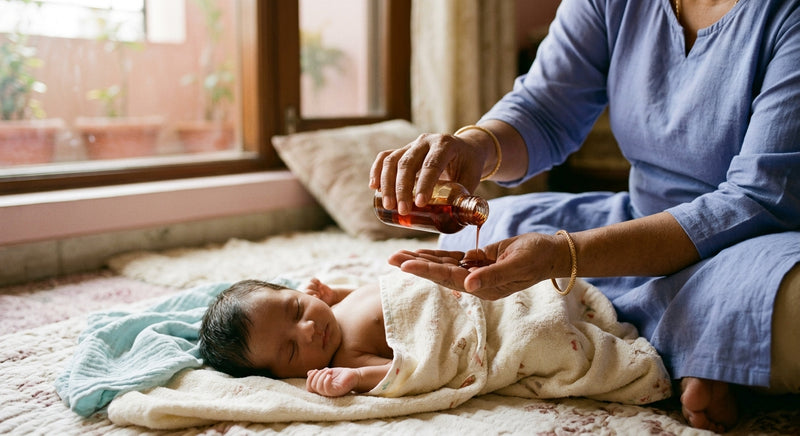
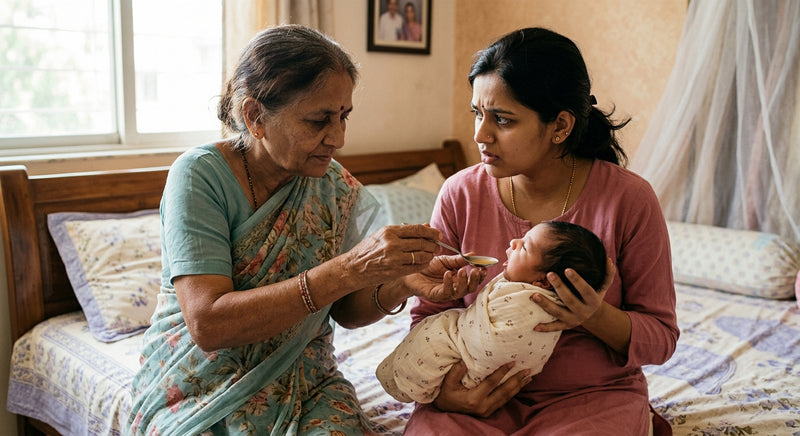
In most Indian homes, a patch test goes like this: dab the new cream on the back of the baby's hand, wait ten minutes while you fold the laundry, glance once — no redness — done. The tub joins the shelf. A safe patch test looks quite different: a small amount on the inner forearm or inner thigh, reapplied once a day for three days, watched through the 48–72 hour window in which delayed reactions actually appear. That gap — ten minutes versus three days — is where almost every patch-testing myth lives.
I've spent my working life in cosmetic science, so let me say this plainly: the ten-minute dab isn't useless. It catches the harshest irritants. But the reactions parents genuinely worry about — the slow, itchy, allergic kind — take one to three days to show. Skip that window and your "test" has told you almost nothing.
Let's sort the folklore from the evidence. If you're still comparing products before buying, our complete guide to choosing baby products covers the label side; this one covers what to do once the tub is in your hands.
At a glance
- Patch test on the inner forearm or inner thigh — not the back of the hand.
- Apply once a day for 3 days; check the spot at 24, 48 and 72 hours.
- "Natural", "herbal" and "hypoallergenic" products all still need testing.
- Test rinse-off washes the way they're used: lather, rinse, observe.
- Introduce one new product at a time, with a few days' gap before the next.
Myth 1: "A quick dab and a ten-minute wait is enough"
Skin can object to a product in two ways, and they run on different clocks. An irritant response — stinging, quick redness, a burning feel — can appear within minutes, and the dab test does catch that. An allergic contact response is slower: the immune system has to recognise an ingredient first, so redness, small bumps or a dry, itchy patch may only surface 24 to 72 hours later, sometimes on the second or third exposure rather than the first.
This matters more for babies than for us. A baby's skin is 20–30% thinner than an adult's, so ingredients reach living skin layers more easily. That isn't a reason to fear every product. It's just why a proper test runs three days instead of ten minutes.
Myth 2: "It's natural or Ayurvedic, so it can't react"
I love botanicals — I work with them daily — and precisely because I work with them, I test them. A plant extract is not one ingredient; it's dozens of naturally occurring compounds, and some of the best-documented contact allergens in all of cosmetics are natural fragrance components from essential oils. Traditional preparations deserve the same respect and the same caution: a home-pressed malish oil, a besan ubtan, grandma's ghee — each one is a new formula as far as your baby's skin is concerned, and each earns its own three-day test.
"Natural" tells you where an ingredient comes from — nothing about how gentle it is. We've unpacked the real difference between organic and natural labels before — the short version is that neither word is a safety certificate.
Myth 3: "It says hypoallergenic and dermatologically tested — I can skip the test"
Those labels do lower the odds of a reaction, and I'd always pick a tested product over an untested one. But panel testing tells you how a formula behaved on a group of test subjects — it cannot tell you how it will behave on your particular baby. Skin varies hugely from baby to baby, and up to ~48.6% of babies experience atopic-type skin issues; atopic-prone skin is simply more reactive than average.
Here's my honest position as someone on the formulating side: at Janma we in-vivo test our products on real infant skin under supervision, we make everything in our own GMP-certified facility — here's why that manufacturing control matters — and we still recommend a home patch test before first use. Any brand that tells you testing is unnecessary is overselling.
Myth 4: "Test it on the back of the hand or the wrist"
Think about what a baby's hands do all day: they get washed, wiped, rubbed on everything, and spend a good deal of time in the mouth. Product applied there is gone within the hour — and you don't want your baby swallowing a test smear. The inner forearm or inner thigh works far better: the skin behaves like the body areas where you'll actually use the product, it stays undisturbed, and it's easy to check in daylight. Behind the ear is the traditional spot for hair products, but babies sleep on it; for a shampoo or wash, the inner arm is easier to keep an eye on.
| What parents often believe | What's actually true |
|---|---|
| Ten minutes with no redness means it's safe | Allergic reactions can take 24–72 hours; watch the spot for three days |
| Natural and herbal products don't need testing | Botanicals and essential oils can react too — every new formula gets tested |
| "Hypoallergenic" means guaranteed safe | It means lower risk on a test panel, not zero risk on your baby |
| One test covers everything from a brand | Each formula is different — a wash and a balm need separate tests |
| A reaction means your baby has "sensitive skin" forever | Often it's one ingredient; a paediatrician can help you narrow it down |
How do you patch test a baby product safely? The 3-day method
- Night 1: after the evening bath, apply a thin smear about the size of a one-rupee coin to the inner forearm or inner thigh. For a rinse-off product like a wash or shampoo, lather a single drop on the same spot, leave it for 60–90 seconds, then rinse — that mirrors real use, because rinse-off formulas carry more cleansing surfactant but touch skin only briefly.
- 20 minutes later: glance at the spot. Brief pinkness from rubbing fades within minutes and is not a reaction. Stinging, spreading redness or fussing at the site means stop here and wash it off.
- Day 2: check the spot in daylight, then reapply the same way.
- Day 3: check and apply once more. You're now covering the full 48–72 hour window where delayed reactions surface.
- Day 4: if the skin is clear and calm — no redness, no bumps, no rough dry patch, no scratching — start using the product on the body. Introduce the face last, and go alternate days for the first week.
- Bring in only one new product at a time, with several days between introductions. If two products start the same week and a rash appears, you won't know which caused it.
What counts as a reaction — and what doesn't?
A real reaction: redness that persists beyond 20 minutes or grows over the following days, small raised bumps, a rough or flaking patch exactly where you applied the product, or a baby repeatedly rubbing that one spot. Not a reaction: a momentary flush right after application, pinkness that fades while you watch, or prickly heat appearing somewhere else entirely.
If you do see a reaction, wash the area with plain lukewarm water, stop the product, and photograph the ingredient list on the pack. This is the formulator in me talking: it's almost always one ingredient — frequently a fragrance component or a specific botanical — not the whole category. That photo lets your paediatrician or a dermatologist help you spot the likely culprit and choose around it, instead of writing off every cream on the market.
Do you need to re-test a product you already use?
Three situations, yes. First, if the formula changes — brands do reformulate, so if the ingredient list on a new pack reads differently, treat it as a new product. Second, after a long gap, especially if your baby's skin has been through an eczema-type flare in between; reactive skin can respond differently than it did months ago. Third, every item in a set: when you're building a newborn skincare kit, patch test each product separately over a couple of weeks rather than starting the whole basket on day one. For rinse-off items, a gentle formula matters most — something like our Head to Toe Baby Foam Wash is built tear-free for sensitive newborn skin, and it still gets the same lather-rinse-observe test as anything else.
When to see a doctor
A patch test is a screening habit, not a diagnosis. If reactions keep happening across several well-formulated products, that pattern itself is worth a paediatrician's or dermatologist's eyes — there may be an underlying tendency like atopic-prone skin that deserves a proper plan.
Three days of patience before a new product touches your baby's whole body — that's the entire method, and it costs nothing. When the test comes back clear and you want a leave-on that's been through formal in-vivo testing itself, our clinically tested Hydra Healing Moisturizing Balm is a gentle place to start.
In summary
- Patch test every new baby product on the inner forearm or inner thigh, never the back of the hand.
- Apply once daily for three days and check the spot at 24, 48 and 72 hours, because allergic reactions are slow to appear.
- Test rinse-off washes the way they're used — lather, rinse, observe — and leave-on creams as a thin coin-sized smear.
- Treat "natural", "herbal" and "hypoallergenic" labels as lower risk, not as permission to skip the test.
- Stop and wash off at the first persistent redness, and see a paediatrician if a reaction spreads, blisters or lingers beyond a day or two.
Frequently asked questions
Where should I patch test a new baby product?
Use the inner forearm or inner thigh. The skin there behaves like the body areas where you'll actually use the product, stays undisturbed through the day, and is easy to check in daylight. Avoid the back of the hand — babies mouth their hands constantly and the product rubs off within the hour, so the test tells you nothing reliable.
How long should I wait after a patch test before using a baby product?
Three days. Apply a small amount once daily to the same spot and check it at 24, 48 and 72 hours. Immediate irritant reactions show within minutes, but allergic contact reactions typically take one to three days to appear. If the skin is still clear and calm on day four, the product is ready for wider use — introduce the face last.
Do natural or Ayurvedic baby products need a patch test too?
Yes, every one of them. A plant extract contains dozens of naturally occurring compounds, and some well-documented contact allergens in cosmetics are natural fragrance components from essential oils. Traditional preparations like malish oil or ubtan count as new formulas for your baby's skin, so they earn the same three-day test as anything from a shop shelf.
How do I patch test a rinse-off product like a baby wash or shampoo?
Test it the way it's used. Lather a single drop on the inner forearm, leave it for 60 to 90 seconds, rinse with plain water, and observe the spot over the next 72 hours. Repeat once daily for three days. Rinse-off formulas contain more cleansing surfactant but stay on skin only briefly, so leaving them unrinsed overnight would give a false result.
What does a patch-test reaction look like on a baby?
Redness that persists beyond about 20 minutes or spreads over the following days, small raised bumps, a rough or flaky patch exactly where you applied the product, or the baby repeatedly rubbing that spot. Brief pinkness that fades while you watch is normal. If you see a true reaction, wash the area with plain water, stop the product, and photograph the ingredient list for your doctor.
Do I need to patch test again if we already use the product?
Re-test in three situations: when the ingredient list on a new pack reads differently, because brands reformulate; after a long gap in use, especially if your baby's skin has flared in between; and for each separate product in a gift set or kit. One clear test covers one formula only — a wash and a balm from the same brand still need separate tests.