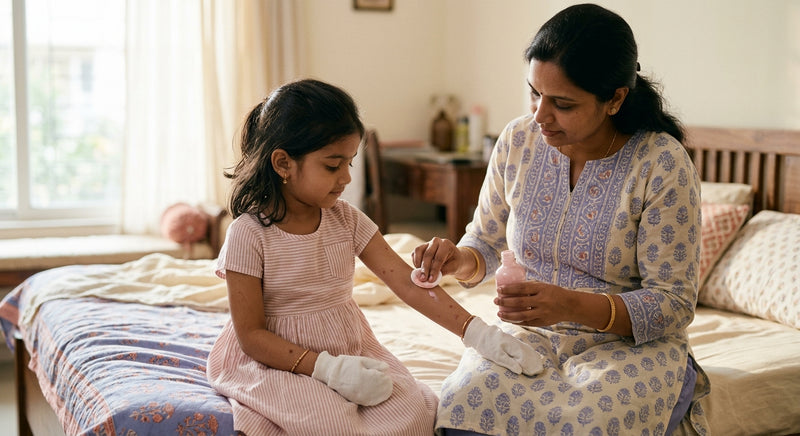
You're lying in bed, it's past midnight, and your belly will not stop itching. You've scratched, you've slathered on whatever cream was on the nightstand, and now you're typing this exact question into Google. So here is the short, honest answer: most itching in pregnancy comes from skin stretching faster than it can keep up, plus plain dryness — and it settles with a proper moisturising routine. But one specific pattern needs a doctor: intense itching on your palms and soles, worse at night, with no rash to show for it. That can be a sign of a liver condition called cholestasis of pregnancy, and it's picked up with a simple blood test. Call your obstetrician this week if that's your itch.
That's the whole article in three sentences. The rest is the detail — how to tell the harmless itch from the one that matters, and what will actually calm your skin tonight. For the bigger picture on what's safe to put on your skin right now, our complete guide to mother skincare covers the full nine months and beyond.
At a glance
- Most pregnancy itching = stretching skin + dryness. Moisturise generously, twice a day.
- Itchy palms and soles, worse at night, no rash → call your obstetrician this week. A blood test settles it.
- An itchy bumpy rash that starts inside your stretch marks late in pregnancy is usually PUPPP — miserable, but not dangerous for the baby.
- Tonight: lukewarm (not hot) bath, pat dry, thick fragrance-free balm within 3 minutes, loose cotton to sleep.
- Never wait on itching that comes with yellowing eyes or skin, dark urine, fever or blisters.
Why does skin itch so much during pregnancy?
Three things gang up on you at once. First, mechanical stretching. Your belly, breasts, hips and thighs are expanding on a deadline, and stretched skin itches — it's the same reason a healing wound itches as the skin pulls tight. This is also why the itch usually lands exactly where the growth is.
Second, hormones. Rising oestrogen changes how your skin makes oil and holds water, so skin that was never dry before suddenly feels tight and papery. Hormones re-tune your skin in several ways at once — it's the same shift behind the patchy facial pigmentation many mums notice around the second trimester.
Third, everything Indian bathrooms throw at skin: piping-hot bucket baths, hard water in most cities, and a ceiling fan or AC running all night. Each one pulls a little more moisture out. From formulating for dry skin every day, I'll tell you the itch–dryness link is the most underrated part of this story — a lot of "mystery" pregnancy itching is simply very dry, very stretched skin, and it responds beautifully to boring, consistent moisturising.
Which itch is normal — and which needs a doctor?
This is the question that keeps you up, so let's put it in one table.
| The itch | What it usually is | What to do |
|---|---|---|
| Itchy belly, breasts or thighs that eases after moisturising | Stretching + dryness — the common one | Moisturise twice daily; follow the night routine below |
| Itchy raised bumps starting inside your stretch marks, usually third trimester | Often PUPPP, a pregnancy rash | See your doctor for confirmation and relief; it's not harmful to the baby |
| Intense itching on palms and soles, worse at night, no rash | Possible cholestasis of pregnancy | Call your obstetrician this week — a blood test gives the answer |
| Itch with fever, blisters or a fast-spreading rash | Infection or a pregnancy-specific skin condition | See a doctor promptly, don't self-treat |
| Itch with yellow eyes or skin, dark urine, pale stools | Liver-related warning signs | Same-day medical attention |
What is cholestasis of pregnancy, and why do doctors take it seriously?
In cholestasis of pregnancy (doctors call it ICP), bile doesn't flow out of the liver the way it should, and bile acids build up in the blood. The classic sign is exactly the pattern above: relentless itching that often starts on the palms and soles, gets dramatically worse at night, and has no rash — though scratch marks may appear. It typically shows up in the third trimester, and it's reported somewhat more often in women of South Asian origin, which is one reason Indian obstetricians take night-time palm itching seriously.
Here's the reassuring part. It is uncommon, the check is a simple blood test (liver function and serum bile acids), and once found it is managed — medication, monitoring, and sometimes a plan to deliver a little earlier. What it needs is a phone call, not panic. What it does not need is a shopping trip.
What about itchy rashes — PUPPP, prurigo and heat rash?
If your itch comes with a visible rash, cholestasis is less likely, and one of these is more likely. PUPPP is the big one: itchy, raised bumps and plaques that classically begin inside the stretch marks on the belly (often sparing the belly button) in the last trimester of a first pregnancy. It can be maddening, but it doesn't harm the baby and clears after delivery — your doctor can prescribe safe relief so you can sleep.
Prurigo of pregnancy looks like scattered, insect-bite-like itchy bumps on the arms and legs. And in an Indian summer or a sticky monsoon, don't rule out plain heat rash — tiny prickly bumps where sweat gets trapped, under the belly, under the breasts, along the waistband. Loose cotton and keeping those folds dry does more for heat rash than any product.
When to see a doctor
- Itching on your palms and soles, especially if it's worse at night — even with no rash
- Itching so intense it stops you sleeping, anywhere on the body
- Yellowing of your eyes or skin, dark urine, or pale stools
- A rash with fever, blisters, or one that spreads quickly
- Any itch in the third trimester that feels different from your usual dry-skin itch
What can you do tonight to calm the itch?
Assuming your itch is the common kind — stretching plus dryness — this routine genuinely helps, and you can start it before bed tonight.
- Bathe in lukewarm water, under 10 minutes. Hot water feels good on an itch for exactly thirty seconds, then strips the oils that were holding moisture in.
- Pat dry with a soft towel — don't rub — and leave the skin slightly damp.
- Moisturise within 3 minutes of stepping out, while the skin is still damp. This one habit does more than switching products ever will.
- Use a thick balm or butter on the belly, breasts and anywhere that itches. A thin, runny lotion evaporates too fast to comfort stretched skin.
- Wear loose, breathable cotton to sleep. Tight waistbands and synthetic fabrics trap sweat and make every itch louder.
- Keep nails short, and when the urge hits, press a cool, damp cloth on the spot or rub with the flat of your palm instead of scratching. Scratching gives ten seconds of relief and a longer itch after.
- Repeat the moisturiser in the morning. Twice a day is the dose that works.
What should you look for in a pregnancy moisturiser?
This is where I can help most, because I read ingredient lists for a living. For itchy, stretched pregnancy skin, look for a formula that pairs humectants (glycerin, which pulls water into the skin) with rich emollients and occlusives — shea butter, kokum butter, cold-pressed oils — that seal that water in. Colloidal oatmeal is a lovely addition for itch-prone skin. Texture matters more than parents expect: for a belly at 32 weeks, a balm you have to scoop beats a lotion you can pour.
Just as useful is what to leave on the shelf. Skip heavily fragranced body creams — fragrance is the most common irritant on already-sensitised skin. Skip "cooling" balms loaded with menthol or camphor over large areas, and body lotions built around retinoids or high-strength acids; we've covered the full safe-versus-skip list in our guide to safe body care during pregnancy in India. This is also the thinking behind our own Hydra Healing Moisturizing Balm — a thick, scoopable butter-balm made in our own GMP-certified facility, and in a lab study it showed increased Keratin-10 and Filaggrin expression, markers that it helps support the skin barrier.
One last honest note: the dryness and itch often don't end in the delivery room. Between feeds, night wakings and hormone shifts, many mums find their skin stays thirsty for months — when you get there, our routine for postpartum dry skin in Indian weather picks up where this one leaves off.
And tonight? Lukewarm bath, pat dry, balm on the belly, cotton kurta, lights out. If your skin needs a rich, barrier-supporting companion for those months, our Hydra Healing Moisturizing Balm was made for exactly this kind of thirsty, hard-working skin.
In summary
- Most pregnancy itching comes from stretching skin plus dryness — moisturise with a thick balm twice a day and it usually settles.
- Itching on your palms and soles that's worse at night, with no rash, needs a call to your obstetrician this week; a simple blood test checks for cholestasis.
- An itchy bumpy rash starting inside your stretch marks late in pregnancy is usually PUPPP — uncomfortable but not dangerous, and your doctor can prescribe relief.
- Tonight: lukewarm bath under 10 minutes, pat dry, apply a thick fragrance-free balm within 3 minutes, and sleep in loose cotton.
- See a doctor the same day for itching with yellow eyes or skin, dark urine, fever, blisters or a fast-spreading rash.
Frequently asked questions
Is itchy skin normal during pregnancy?
Yes, mild itching is very common, especially over the belly, breasts and thighs where skin is stretching fastest. Hormonal changes and dryness add to it. If the itch eases after moisturising and doesn't disturb your sleep, it's almost always the harmless kind. Itching on the palms and soles, or itching intense enough to keep you awake, deserves a call to your obstetrician.
Why is pregnancy itching worse at night?
Two reasons. Warmth under blankets and fewer daytime distractions make any itch feel louder after dark. But night-time itching is also the classic pattern of cholestasis of pregnancy, a liver condition. If your itching ramps up sharply at night, especially on the palms and soles with no rash, mention it to your doctor promptly — a simple blood test can rule cholestasis out.
What does cholestasis itching feel like?
It's usually an intense, relentless itch without any rash — though scratch marks may appear. It often starts on the palms of the hands and soles of the feet, becomes much worse at night, and typically shows up in the third trimester. Some women also notice dark urine or yellowing eyes. Any of these signs means calling your obstetrician the same week.
Does an itchy belly mean the baby is growing hair?
That's a much-loved myth in Indian families, but there's no connection between your itch and the baby's hair. Belly itching comes from skin stretching quickly plus dryness, sometimes worsened by hot baths and hard water. It responds to lukewarm bathing and a thick moisturiser applied twice daily — no matter how much hair your little one arrives with.
Which cream is safe for itchy skin during pregnancy?
Look for a thick, fragrance-free or lightly fragranced balm or butter with glycerin plus rich emollients like shea or kokum butter; colloidal oatmeal helps itch-prone skin. Avoid heavily fragranced creams, strong menthol or camphor balms over large areas, and retinoid or high-strength acid body lotions. Patch test anything new on your inner forearm for 24 hours, and ask your doctor if a rash is present.