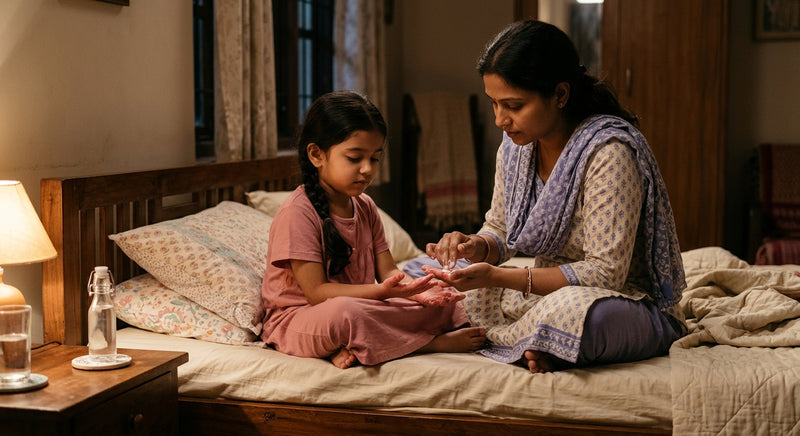
Your mother-in-law looks at the little dark patch near your baby's cheek, or the dry roughness on the legs, and says it with total certainty: “Manjishtha laga do, khoon saaf ho jayega.” Apply manjishtha, the blood will be cleansed, the skin will glow. In many Indian homes this is gospel, passed down like a family recipe — right alongside the haldi and the besan.
So let me answer the real question first, plainly. Manjishtha is a genuine Ayurvedic skin herb with a long, respected history, and lab studies show its root compounds have antioxidant and anti-inflammatory activity. But there is no good evidence it “purifies blood.” And raw manjishtha paste? Not something I'd put on a baby's skin. The herb is interesting. The way it's traditionally used on infants is where I'd ask you to pause.
At a glance
- Manjishtha (Rubia cordifolia) is a root used in Ayurveda for skin and “blood-cleansing” — the cleansing part isn't a scientific concept.
- Lab studies do show real antioxidant and anti-inflammatory compounds in the root, but almost none of that work was done on babies.
- It's a strong natural dye (the source of “madder red”), so raw paste can stain skin and clothes.
- A baby's skin is far thinner than yours, so raw herbal pastes carry a real risk of irritation and reaction.
- For most baby skin worries, gentle barrier care beats any single “miracle” herb.
What is manjishtha, actually?
Manjishtha is the root of Rubia cordifolia, sometimes called Indian madder. In classical Ayurveda it's the headline raktashodhak herb — a “blood purifier” — prescribed for skin complaints, pigmentation and what the texts loosely call heat or pitta in the blood. If you've been reading our complete guide to dosha-based baby skincare, you'll recognise that framing: skin troubles read through the lens of an internal imbalance.
Here's where I put on my formulator's hat. The madder root is genuinely rich in interesting molecules — anthraquinones like purpurin and munjistin, the same family of pigments that made manjishtha a prized fabric dye for centuries. Some of these have shown antioxidant, antimicrobial and anti-inflammatory effects in test-tube and animal studies. That part is real. It's why the herb keeps turning up in serious ingredient research.
But “shown activity in a lab dish” and “safe and useful on my four-month-old's cheek” are two very different claims. Almost none of that research touched infant skin. So when a label or a relative tells you manjishtha will fix your baby's skin, the honest answer is the uncomfortable one: we don't have the evidence to say that.
The big myth: does manjishtha “purify” a baby's blood?
This is the belief I want to take apart gently, because it runs so deep. The idea goes like this: skin problems — rashes, dark spots, dullness — come from “impure blood,” and a herb like manjishtha washes it clean from the inside.
Your baby's blood is already being cleaned. Around the clock, by a tiny liver and two tiny kidneys that are very good at their job. There's no scientific mechanism by which a herbal paste or drink “detoxifies” blood, and no clinical study showing manjishtha changes anything about a baby's blood. The classical concept of raktashodhana is a traditional framework, not a measured biological event. I say this with respect for the tradition, not against it — but a tired parent at 2am deserves the straight version.
And here's the thing: most baby skin issues aren't about blood at all. They're about a skin barrier that's still figuring itself out. Newborn skin loses water faster, reacts more, and recovers differently than ours. That's also why up to nearly half of babies go through some atopic, eczema-type phase. The fix is rarely a purifying herb. It's gentle cleansing and steady moisturising, done boringly, every day.
| What you may have heard | What the evidence actually supports |
|---|---|
| Manjishtha purifies the baby's blood and clears skin from inside | No evidence for “blood purification”; the liver and kidneys already do this |
| It's herbal, so it's automatically safe for newborns | Natural doesn't mean gentle — raw plant pastes can irritate or sensitise thin baby skin |
| Manjishtha lightens dark patches on baby skin | Lab antioxidant activity exists; no infant skin-lightening evidence, and most baby pigmentation fades on its own |
| A daily manjishtha lep is a good baby routine | The root is a strong dye and can stain; it's not a tested daily baby ingredient |
So why does manjishtha keep its reputation?
Two reasons, honestly. The tradition is old and sincere. And the root really does carry active compounds — this is no empty folk remedy. In a well-made adult formulation, a properly extracted, standardised, tested manjishtha active can earn its place. The trouble starts in the gap between that and a fistful of root powder mixed with water on the kitchen counter and smeared on an infant.
It's the same honest line we drew with A2 bilona ghee for baby skin and with the oils people choose for malish: tradition hands us wonderful starting points, but the form, the dose and the testing decide whether something is actually safe on a baby. A respected herb, used the wrong way, can still do harm.
Why raw manjishtha paste worries me on baby skin
A baby's skin is 20–30% thinner than an adult's. It absorbs more and reacts faster. Three risks come with raw herbal pastes, and they're not theoretical:
- Irritation and allergy. Plant compounds an adult shrugs off can redden and sting delicate baby skin — sometimes not that evening, but a day or two later.
- Contamination. Loose root powders aren't sterile. On broken or eczema-prone skin, that's an infection waiting to happen.
- Staining and masking. Manjishtha is, literally, a red dye. It can tint the skin and hide the very redness or rash a doctor needs to see clearly.
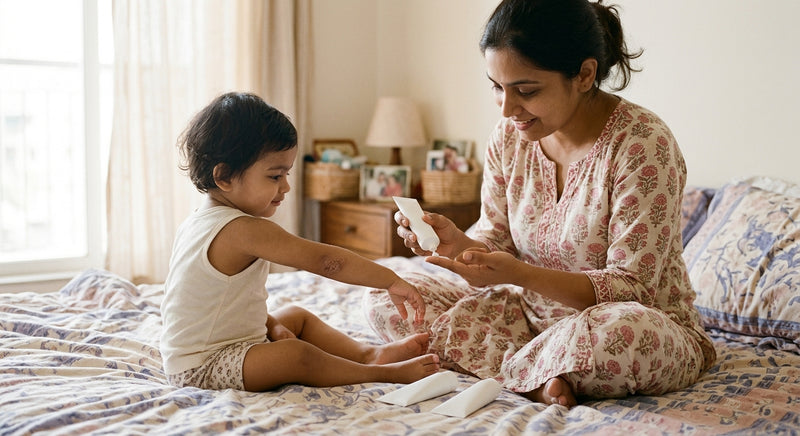
None of this means Ayurveda has nothing for your baby. It means the gentlest, best-tested version wins. For dryness, dark-looking dry patches, or eczema-prone skin, a simple fragrance-free barrier cream does more — and far more safely — than any purifying paste. Our Hydra Healing Moisturizing Balm was built for exactly that job: to comfort dry, sensitive skin and help support the barrier.
What to actually do tonight
Skip the experiment. Do the dull thing that works:
- Wash gently — lukewarm water, a tear-free baby wash, no scrubbing. Pat dry, don't rub.
- Moisturise within three minutes of the bath, while skin is still slightly damp, to lock the water in.
- For one dry or rough patch, a thin layer of a plain barrier balm, twice a day.
- Want an Ayurvedic ritual? Choose a tested oil for dosha-matched malish rather than a herbal lep on the skin.
- Patch-test anything new on the inner forearm and wait 24 hours before you trust it.
When to see a doctor
See your paediatrician if the skin is cracked, weeping, crusted or bleeding; if a rash spreads quickly, blisters, or comes with fever or poor feeding; if dryness or itch keeps your baby from sleeping; or if pigmentation looks unusual, is growing, or worries you. Dark patches that have been there since birth, or that are changing, should always be checked rather than treated at home with a herb.
The honest bottom line
Manjishtha is a real herb with real chemistry, and Ayurveda isn't wrong to respect it. But it doesn't cleanse the blood. “Herbal” doesn't make it safe for a newborn. And raw root paste belongs nowhere near a baby's thin, still-developing skin. Honour the tradition the way it deserves — by choosing the tested, gentle version of it — and let your baby's own skin barrier, not a purifying paste, do the real work.
In summary
- Manjishtha is a genuine Ayurvedic root with real antioxidant compounds, but “blood purification” isn't a scientific effect.
- Raw manjishtha paste isn't suitable for babies — thin skin means more absorption, irritation risk, and staining.
- Most baby skin worries come from a developing skin barrier, not impure blood, so gentle care beats any single herb.
- Wash gently, moisturise within three minutes of the bath, and patch-test anything new for 24 hours.
- See a paediatrician for cracked, weeping, spreading or unusual skin rather than treating it with a home herbal paste.
Frequently asked questions
Can I apply manjishtha paste on my baby's skin?
I wouldn't use raw manjishtha paste on a baby. Their skin is 20-30% thinner than an adult's, so it absorbs more and reacts faster, and loose root powder isn't sterile. It's also a strong dye that can stain skin and hide a rash a doctor needs to see. For dryness or irritation, a tested, fragrance-free barrier cream is safer and more effective.
Does manjishtha really purify a baby's blood?
No. There's no scientific mechanism by which a herb “purifies” blood, and no study shows manjishtha changes anything about a baby's blood. The liver and kidneys already clean the blood constantly. The Ayurvedic idea of raktashodhana is a traditional framework, not a measured biological event. Most baby skin issues come from a developing skin barrier, not impure blood.
Is manjishtha safe to give a baby by mouth?
Don't give manjishtha or any herbal “blood purifier” to a baby by mouth without a paediatrician's guidance. An infant's body processes substances very differently from an adult's, and internal herbs haven't been tested for safe infant doses. If you're worried about your baby's skin from the inside out, that's a conversation for your doctor, not a home remedy.
Does manjishtha lighten dark spots on baby skin?
There's no evidence it lightens pigmentation on infant skin. Lab studies show the root has antioxidant compounds, but that work wasn't done on babies. Most dark or rough patches on baby skin are either dryness or normal pigmentation that fades on its own. Any spot that's growing, changing, or present since birth should be checked by a paediatrician, not treated with a herb.
What's a safer Ayurvedic option for my baby's skin?
If you want an Ayurvedic ritual, a tested, dosha-matched massage oil for malish is far safer than a herbal paste on the skin. Pair it with gentle, tear-free washing and steady moisturising within three minutes of a bath. The aim is to support your baby's skin barrier, not to “detox” anything. Always patch-test something new and wait 24 hours.