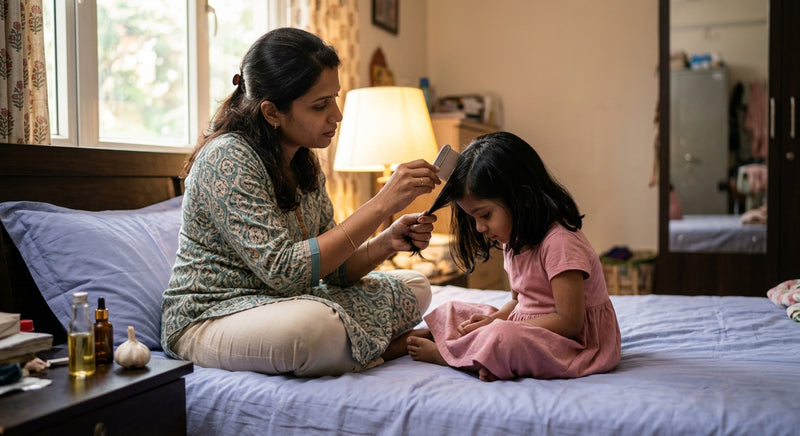
Sleeping baby on one arm, ten minutes before the next feed, and a face that's seen nothing but tap water for three days. So here's the honest answer to what you typed into your phone at 2am: yes, a five-minute routine is enough. Cleanse, moisturise, sunscreen in the morning. That's the whole thing. Everything else can wait, and you don't owe anyone guilt for skipping it.
I'm Ridhee, co-founder at Janma. I built this around how new-mum days actually run — interrupted, one-handed, short on sleep. Not the ten-step routine on your screen that quietly assumes you have a free evening. You don't. You have a baby.
At a glance
- Morning: gentle cleanse, moisturiser, sunscreen (about 3 minutes).
- Night: gentle cleanse, moisturiser (about 2 minutes).
- Pick fragrance-free, simple formulas — your skin (and baby) prefer them right now.
- Sunscreen is the one step that pulls real weight against postpartum pigmentation.
- If your skin is reacting badly or breaking out painfully, see a doctor — don't self-treat with strong actives while nursing.
Why your skin feels so different after birth
The hormones that ran your pregnancy crash in the first weeks after delivery. Oestrogen drops sharply. That one shift is behind most of what you're seeing in the mirror — the sudden dryness, the dullness, more sensitivity, sometimes new pigmentation across the cheeks, and yes, the hair in the shower drain. None of it means you're doing anything wrong. Your body is just resetting.
It's also why the products that suited you last year might sting now. Skin that ran oily can turn parched. Skin that never reacted suddenly flushes at a fragranced cream. The fix isn't more products — it's fewer, gentler ones. For the bigger picture across the whole postpartum stretch, our complete guide to skincare for mothers walks through each stage; this is the quick-start version, just for the newborn weeks.
The 5-minute routine, exactly
Here's all of it. Read it once and it's yours — it's kept this short on purpose.
Morning (about 3 minutes)
- Cleanse (45 seconds). Lukewarm water and a gentle, fragrance-free face wash. On the mornings you're truly out of time, plain water and a soft towel is fine. Really.
- Moisturise (45 seconds). A quick layer of a simple cream while skin is still a little damp. Damp skin holds moisture far better than dry.
- Sunscreen (60 seconds). Two finger-lengths over face and neck. This is the step I'd never skip — I'll get to why.
Night (about 2 minutes)
- Cleanse (45 seconds). Wash off the day. If you wore makeup, a gentle cleanser handles it; for everyday wear you don't need a separate remover.
- Moisturise (45 seconds). The same cream as the morning. A slightly heavier layer at night if your skin feels tight.
Morning vs night: what changes
Only sunscreen, and that's a morning job. Everything else stays put — which is the reason it survives a bad night.
| Step | Morning | Night |
|---|---|---|
| Cleanse | Yes (or water) | Yes |
| Moisturise | Yes | Yes (richer if tight) |
| Sunscreen | Yes — the key step | Skip |
| Time | ~3 min | ~2 min |
Why sunscreen is the one step worth protecting
If you do one thing for your skin this year, make it daily sunscreen. Postpartum hormones can leave skin more prone to pigmentation — those patches of melasma across the cheeks and upper lip that so many new mums notice. Sun is what deepens them. You can be faithful with every cream and still watch the pigmentation darken if you keep skipping SPF.
And you're catching more sun than you'd guess. The walk to the paediatrician. Standing by the window at noon, rocking a baby who won't settle. The school drop if there's an older one. Indian daylight is strong even through window glass, even on a grey monsoon morning. A mineral sunscreen sits on top of the skin and is a sensible, low-fuss pick for nursing mums; a gentle, broad-spectrum mineral sunscreen like our Daily Defender works for the whole household, so it's one bottle instead of three.
What to look for in your three products
You're nursing, you're tired, and you have no patience for decoding an ingredient list. So keep the rule short: gentle, fragrance-free, few ingredients. Your skin is more reactive right now, and anything that lingers on it can transfer during all that cheek-to-cheek time with the baby — so simpler is kinder to both of you.
- Fragrance-free or very lightly scented — added fragrance is a top trigger for reactive postpartum skin.
- A short, readable ingredient list, not a long one promising ten benefits.
- A moisturiser that actually comforts dry, tight skin and supports the skin's natural barrier — that barrier takes a hit when skin is dehydrated.
- Broad-spectrum sunscreen (UVA and UVB), SPF 30 or higher.
For the moisturise step, the skin barrier is the thing you're really tending — dryness and sensitivity both trace back to a barrier that's struggling. A rich, fragrance-free balm that comforts dry, sensitive skin and supports the barrier pulls a second shift: it goes on your hands, which take a beating from all the washing, and on any dry patches. Our Hydra Healing Moisturizing Balm is made for all ages, so it's safe on the baby's dry patches too — one jar, fewer things on the list.
What you can safely ignore right now
The internet will insist you need retinol, vitamin C, exfoliating acids, eye cream, and a separate serum for every worry. Honestly? Not in these weeks. Some strong actives aren't a good idea while breastfeeding anyway, and your skin is too reactive to introduce them well. If you're not sure what's off-limits while nursing, our guide to breastfeeding-safe skincare goes ingredient by ingredient.
Two things that aren't skincare problems and don't belong in a five-minute fix: the hair fall — it usually peaks around three to four months and then settles, and our piece on postpartum hair fall and skin changes lays out the timeline — and stretch marks, where a moisturiser keeps skin comfortable but won't erase them; we're straight about what actually works on stretch marks. Don't let either one rob you of sleep.
Do this tonight
No overhaul. Just set things up so tomorrow's routine more or less runs itself:
- Stand your cleanser, moisturiser and sunscreen together by the bathroom sink — visible, in reach.
- Tonight: lukewarm water, gentle cleanse, a layer of moisturiser. Two minutes. Done.
- Tomorrow morning: those same two steps, plus sunscreen, before anything else.
- Keep a pump of moisturiser by the feeding chair for your hands.
- That's the whole plan. Same on the good days and the wrecked ones.
When to see a doctor
Most postpartum skin changes settle on their own. But check in with your doctor or a dermatologist if you notice any of these: a sudden painful, spreading rash, or acne that's cystic and getting worse; skin that's red, hot and tender (a possible infection); pigmentation changing fast or looking unusual; or any persistent itching that disturbs your sleep — postpartum, that occasionally points to something worth checking. And if you're on any medication while breastfeeding and you're not sure a skincare ingredient is safe, ask your doctor rather than guessing.
Go easy on yourself in these weeks. Skincare now is maintenance, not a project — three gentle products and five minutes is enough. If you want one thing that genuinely deserves a spot on the shelf, a fragrance-free balm that comforts dry skin and supports the barrier is the one I'd reach for — gentle enough for you and the baby both.
In summary
- Keep it to three steps in the morning — cleanse, moisturise, sunscreen — and two at night.
- Choose fragrance-free, short-ingredient products that are gentle on reactive postpartum skin.
- Make daily sunscreen the non-negotiable step to help guard against postpartum pigmentation.
- Skip strong actives while nursing and don't waste sleep chasing hair fall or stretch marks.
- See a doctor for any painful, spreading, or rapidly changing skin issue rather than self-treating.
Frequently asked questions
Is a 5-minute skincare routine really enough for a new mom?
Yes. In the newborn weeks, three gentle steps in the morning (cleanse, moisturise, sunscreen) and two at night (cleanse, moisturise) genuinely cover what your skin needs. Postpartum skin is reactive and tired, just like you — it responds better to a few simple, fragrance-free products used consistently than to a long routine you can't keep up with.
What skincare is safe while breastfeeding?
Stick to gentle, fragrance-free cleansers, moisturisers and mineral sunscreen — these are widely considered safe while nursing. Be cautious with strong actives like retinoids and high-strength acids, and check with your doctor before using them. Since you're in constant close contact with the baby, simpler formulas with short ingredient lists are the sensible choice for both of you.
Why is my skin so dry and dull after having a baby?
Hormones, mainly. Oestrogen drops sharply after delivery, and that shift commonly brings dryness, dullness, sensitivity and sometimes new pigmentation. It's normal and usually settles over the following months. The fix is gentler, not more — a fragrance-free moisturiser on slightly damp skin twice a day, and daily sunscreen to stop pigmentation deepening.
Do I really need sunscreen if I'm mostly indoors with the baby?
Yes. Postpartum skin is more prone to pigmentation, and that builds from everyday, cumulative exposure — the window you stand by, the school run, the auto ride — not just proper outings. Indian daylight is strong even on cloudy days and through glass. A daily broad-spectrum sunscreen, SPF 30 or higher, is the single most protective step you can take.
Can I use one product for both me and my baby?
Some, yes. A fragrance-free moisturiser or balm made for all ages can go on your dry hands and patches and on the baby's dry skin too, which saves money and clutter. Mineral sunscreens formulated for all ages also work for the whole household. Just keep face washes and anything with active ingredients age-appropriate, and when in doubt, choose the gentler, simpler option.