Almost every Indian baby gets oiled. Your mother did it. Your mother-in-law does it, and somewhere between the third day and the thirtieth, someone will promise you that the oil is what gives a child thick hair for life. Then the scalp goes flaky one week, or a paediatrician glances at the bottle in your bag, and it's 11pm and you're typing is oiling baby hair safe into your phone with one hand.
It is safe. Fresh oil, single ingredient, very little of it, washed out the same day — that's the whole condition. What it will not do is grow new hair. Hair follicles are set before birth; no oil adds more. Oiling is a comfort ritual that happens to soften the scalp, and judged on that, it's lovely.
At a glance
- Oiling a baby's hair is safe when the oil is fresh, plain and washed out the same day.
- It doesn't increase hair count — follicle number is fixed before birth. It can soften flakes and make the scalp easier to comb.
- Use about half a teaspoon for a newborn head. More oil is not more benefit; it's more residue.
- Leave it on 20-30 minutes, not overnight — especially in humid Indian weather.
- Skip camphor, menthol and eucalyptus "cooling" hair oils on babies, and be cautious with mustard oil on newborn skin.
If you want the full picture of washing, detangling, cradle cap and hair fall, we've put it all together in our complete guide to baby hair care. This piece is just the oil.
Does oiling make a baby's hair grow thicker?
No. We get this question more than any other, and the answer never changes. The number of hair follicles on your baby's head was decided in the womb. Oil sits on the scalp and on the hair shaft — it doesn't reach down into a follicle and build a new one. A year of daily champi will not shift the density your child was born with.
The things oil does do are smaller, and worth having. It lubricates fine baby hair so it snaps less when a comb goes through. It softens the crusty scale of cradle cap so the scale lifts instead of getting scraped off. And a slow scalp massage settles a fussy four-month-old at 7pm, which any parent will tell you has its own value. Shaving gets the same scrutiny from us, by the way — does mundan actually make baby hair grow thicker.
Which oil should you actually use?
Most of my working week goes into oil specifications. Certificates of analysis. Peroxide values. Free fatty acid numbers. That's the unglamorous part of deciding a formulation, and none of it is something you can run at your kitchen counter. But you don't need to. Pick a sane oil, keep it fresh, and you're most of the way there.
| Oil | What it's good at | What to know |
|---|---|---|
| Virgin coconut | Light, absorbs well, the best-studied oil on infant skin; kind to the barrier | My default for Indian babies. Solidifies in winter — warm the bottle in a bowl of water, not on the flame. |
| Sesame (til) | The classic abhyanga oil; warming, traditional, good slip | Heavier. Use less than you think. Cold-pressed, not the dark toasted cooking kind. |
| Sweet almond | Light and easy to wash out; pleasant for scalp massage | A tree-nut oil — if there's a strong family history of nut allergy, ask your paediatrician first. |
| Mustard (sarson) | Deeply traditional in North and East India, especially in winter | The one I'd hesitate over. Research on newborn skin has raised concerns about mustard oil irritating and disrupting the barrier. If it's a family ritual you don't want to give up, keep it off broken or inflamed scalp and don't leave it on for hours. |
| "Baby hair oil" blends | Convenient, nice-smelling | Turn the bottle around. Many are mineral oil plus parfum plus a token herb. That's not wrong — it's just not what you think you're buying. |
What I look for on a hair-oil label
- One ingredient, or a short honest list. "Cocos nucifera oil" is a good label. A twelve-line list with parfum in the middle is a perfume with oil in it.
- No camphor, menthol or eucalyptus. These turn up in most Indian "cooling" hair oils and they do not belong on a baby. Camphor especially — it's absorbed through thin skin and it has a real toxicity record in small children.
- No fragrance. A baby's scalp doesn't need a scent, and fragrance is a leading cause of contact reactions.
- Cold-pressed, dark bottle, small size, visible batch and expiry. Buy the 100ml you'll actually finish, not the 500ml that will sit through a Nagpur summer.
- The smell test. Rancid oil smells faintly of old crayons, or of wall paint. If it does, bin it — oxidised oil is irritating, not nourishing. Heat and light are what turn it, so the kitchen shelf above the stove is the worst place you could keep it.
How to oil your baby's hair tonight
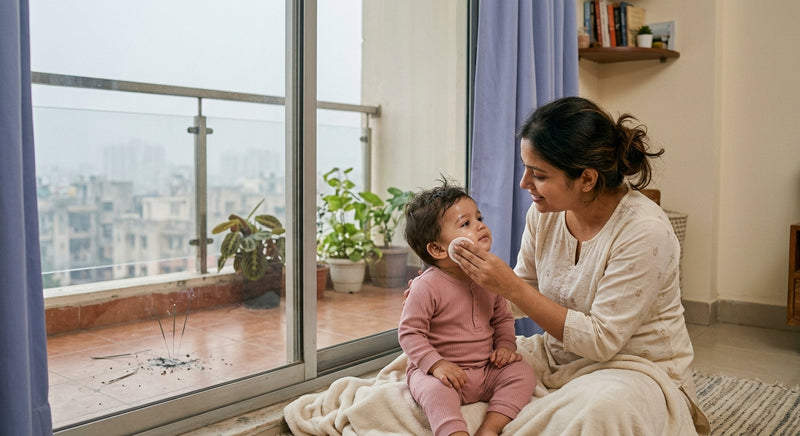
Do it before the bath, on a day you were going to wash the hair anyway. Not on a screaming, hungry baby. Right after a feed is the window — drowsy, fed, content.
- Warm a small amount. About half a teaspoon for a newborn head, a teaspoon for a toddler. Rub it between your palms first so it lands at skin temperature.
- Use fingertips, not nails. Small, slow circles. Light pressure — a baby's skin is 20-30% thinner than an adult's, and the scalp is no exception.
- Over the soft spot, just glide. The fontanelle sits under a tough membrane and gentle contact is fine. But do not press, do not dig, and don't let anyone "set" it with oil and pressure. That one we should quietly retire.
- Nothing in the ears or nose. No oil drops in the ear canal. No oil-soaked cotton in the nostrils. No matter who suggests it.
- Leave it 20-30 minutes. Long enough to soften scale, short enough that dust, sweat and lint don't settle into it.
- Wash it out. Same day, every time. Warm water alone will not shift oil — you need a mild, tear-free cleanser worked through with your fingers, then rinsed until the hair squeaks a little.
How long should the oil stay on? (Not overnight.)
Overnight oiling is where most of the trouble starts. Eight hours of oil on a scalp in Mumbai humidity is a warm, occlusive lid over a sweaty head. The heat stays in. Every particle of dust in the room finds it. And it feeds Malassezia, the yeast that lives on all our scalps and is closely linked to cradle cap. I've seen more flaky, angry infant scalps caused by well-meaning nightly oiling than by any product.
Twenty to thirty minutes, then wash. Once or twice a week is plenty. If you're unsure how often washing is safe, we've covered exactly that in how often you should shampoo baby hair. What matters in the shampoo is a mild surfactant system that lifts oil without stripping, a scalp-friendly pH, no fragrance, and a genuinely tear-free profile. That's what we built the Loving & Balancing Shampoo around, in our own facility.
When oiling backfires
Three situations where I'd pause the champi:
- Cradle cap that's already thick and greasy. Here oil only helps if you actually lift the scale and wash it out: soften for 15-20 minutes, brush very gently with a soft baby brush, then shampoo. Oil on, oil left, oil again tomorrow — that makes it worse. Not sure whether you're looking at cradle cap or plain dry flakes? This piece on telling dry scalp from cradle cap settles it in a minute.
- Broken, weeping or eczematous scalp. Don't massage oil into inflamed or open skin. That's a moment for a barrier-supporting moisturiser and a paediatrician, not a ritual.
- Prickly heat season. In peak summer, an oily scalp under a cap is a heat rash waiting to happen. Cut back to once a week, or leave it until the weather turns.
When to see a doctor
Book a paediatrician if the scalp is weeping, bleeding, crusted yellow or smells off; if redness spreads beyond the scalp onto the face or body; if your baby has a fever alongside a scalp rash; if flaking doesn't budge after two weeks of gentle care; or if you notice a distinct bald patch with broken hairs or scaly rings, which can point to a fungal infection needing prescription treatment. Any oil that produces a rash, bumps or swelling should be stopped immediately and the reaction shown to a doctor.
Keep the ritual. It's a good one — those ten quiet minutes are as much for you as for the baby. Just keep the oil fresh, keep the quantity small, wash it out the same day, and don't let it stay on all night. That's all safe practice really is.
And if you're rinsing oil out twice a week, the mildness of the shampoo ends up mattering more than which oil you picked — so read that label as carefully as you read the oil's: a gentle surfactant system, a scalp-friendly pH, no added fragrance.
In summary
- Oiling a baby's hair is safe — but it cannot add hair follicles or change how thick the hair grows.
- Choose a fresh, cold-pressed, single-ingredient oil; virgin coconut is the most reliable choice for Indian babies.
- Avoid camphor, menthol, eucalyptus and fragranced "baby hair oils", and be cautious with mustard oil on newborn skin.
- Use about half a teaspoon, leave it on 20-30 minutes, and always wash it out the same day with a mild tear-free cleanser.
- Skip oiling on broken, weeping or inflamed scalp, and see a paediatrician if flaking, redness or bald patches persist.
Frequently asked questions
Can I oil my newborn's hair from day one?
Most paediatricians are comfortable with gentle scalp oiling once the baby is settled at home and the skin is intact. Use a plain, fresh, cold-pressed oil, about half a teaspoon, and wash it out the same day. Avoid the umbilical stump area entirely, keep oil out of ears and nose, and stop if you see any redness or bumps.
Which oil is best for baby hair in India?
Virgin coconut oil is the most sensible default: it is light, absorbs well, is the best-studied oil on infant skin and washes out easily. Cold-pressed sesame is a good traditional alternative if you use less of it. Skip camphor or menthol "cooling" hair oils entirely, and be cautious with mustard oil on newborn skin.
Can I leave oil in my baby's hair overnight?
Better not to, especially in humid Indian weather. Oil left on for hours traps heat and dust and feeds the scalp yeast associated with cradle cap, so overnight oiling often makes flaking worse rather than better. Twenty to thirty minutes is enough to soften scale, and then it should be washed out with a mild, tear-free cleanser.
Does oiling stop baby hair fall?
No. The hair a baby loses in the first few months is a normal shedding phase driven by hormones, not by lack of oil, and it grows back on its own. Oiling can reduce breakage from combing and make the scalp feel softer, but it will not change how much hair sheds or how thick the hair eventually grows in.
How often should I oil my baby's hair?
Once or twice a week is plenty, ideally on the days you plan to shampoo anyway. Daily oiling adds no extra benefit and in Indian heat and humidity it can lead to a sweaty, flaky, dust-clogged scalp. In peak summer or during a prickly heat spell, cut back to once a week or pause until the weather turns.
Is it safe to press oil on the baby's soft spot?
Glide gently over it, never press. The fontanelle is covered by a strong membrane, so light contact during a massage is fine, but the practice of pressing or massaging oil firmly into the soft spot to "set" it has no benefit and carries needless risk. Keep the pressure light everywhere on a baby's scalp.