Parents write to us about this every summer. An eight-week-old, the skin on his shins and ankles flaking off like old paint, and a mother who is certain she has done something wrong. The hospital told her the peeling would stop after two weeks. It stopped. Now it's back.
She almost certainly hasn't done anything wrong. The short version: peeling at 2 months is almost never the newborn skin shed — that's finished by week three or four. Peeling at eight weeks is usually plain dryness, and in India it is usually caused by something in the room, the water or the bath. The AC that runs all night. Hard water that leaves a film. A bath a few minutes too long, a few degrees too warm. A soap that strips more than it should. Address the cause and gentle, consistent care usually helps the skin settle over the following week or two.
Working out which one it is takes a day of paying attention. Here's what to look at.
At a glance
- The true newborn shed — the vernix-and-dry-layer peel — is done by roughly week 3-4. Peeling that starts or returns at 2 months is a dryness signal, not the shed.
- Four Indian culprits, in the order we see them: air-conditioning, hard water, over-bathing, and a cleanser that's too strong.
- Shins, ankles, wrists and the outside of the arms flake first. Least oil, least protection.
- Moisturise twice a day on slightly damp skin. That single change helps with most of it.
- See a paediatrician if the skin is red, weeping, cracked, itchy enough to disturb sleep, or peeling in sheets from the palms and soles.
Isn't peeling just what newborns do?
For the first two or three weeks, yes. A baby spends nine months in fluid, coated in vernix. Once that comes off, the outermost layer of skin dries and sloughs — hands, feet, tummy, sometimes head to toe. It looks alarming. It means nothing. We covered that window in our guide to newborn skin care in the first week at home.
That process has an end date, though. By four weeks it is over. So a two-month-old who starts flaking is telling you something else: her skin is losing water faster than it can hold on to it. Baby skin is 20-30% thinner than an adult's, and the barrier is still being built. It dries out faster than yours, and it shows sooner.
Start with the room
Air-conditioning is the cause parents least suspect and the one we see most. An AC doesn't only cool a room. It wrings the water out of it. A baby sleeping eight hours under a vent, night after night, through a Delhi or Nagpur summer, is being freeze-dried in slow motion. The tell is timing and geography: worst in the morning, worst on whatever was left uncovered.
You don't have to switch it off. You have to blunt it. Set it to 26-27°C instead of 21°C — a baby doesn't need it colder, and the lower setting works the compressor harder and dries the air further. Move the cot out of the direct airflow. Leave a wide, open bowl of water in the room; it is a crude trick, the water evaporates, it helps. A humidifier, if you own one, does the job better. And if the drying is concentrated on whatever sits under the vent, our piece on how to moisturise a newborn safely goes deeper into the technique.
Now the water
Most of urban India runs on hard water — heavy in calcium and magnesium. You already know the signs: white crust around the taps, soap that refuses to lather, a chalky film on a steel tumbler once it dries. That same mineral residue stays behind on your baby's skin after a bath and pulls moisture out of it. Hard water, a foaming cleanser, no moisturiser. That is the standard recipe for a flaky two-month-old.
Softening your building's water is not happening tonight. Three things that are: shorten the bath, drop the temperature, and moisturise while the skin is still damp, so the water gets sealed in instead of evaporating off and taking the skin's own moisture with it.
Chennai in August, Ludhiana in January
The season changes the answer, and this is where generic advice falls apart in Indian homes. Same flakes, different cause, different fix.
| Season | Why skin peels | What to change |
|---|---|---|
| Summer (Mar-Jun) | AC dehydrating the room; sweat drying on skin and leaving salt behind | AC at 26-27°C, cot away from the vent, wipe sweat off with a damp cotton cloth, light lotion morning and a richer balm at night |
| Monsoon (Jul-Sep) | Damp air plus constant sweat means skin sits wet on the surface and dry underneath. Folds stay damp and get irritated | Dry the neck, groin and knee folds properly after every bath. Cotton only. Moisturise the limbs, keep the folds dry |
| Winter (Nov-Feb) | Cold, dry air; hot baths; heaters and blowers | Twice-daily moisturiser, bath water lukewarm not hot, cap the bath at 5-7 minutes, never point a blower at the cot |
| All year | Hard water | Short baths, mild pH-appropriate cleanser, moisturise on damp skin |
The routine to start tonight
Give it seven days before you judge it. Skin turns over slowly, and the flakes you can see are already dead. They have to come away before the smooth skin underneath shows.
- Bath: 5-7 minutes, lukewarm. Test it on the inside of your wrist. It should read neutral, not warm. If your hand says "nice", it is too hot for her.
- Cleanser every other day, not every day. A two-month-old is not dirty. Plain water on the days in between covers everything except the nappy area and the neck folds. When you do use a wash, make it a mild, tear-free one built for infant skin — a gentle head-to-toe foam wash, not an adult soap bar, which is far too alkaline for a baby's barrier.
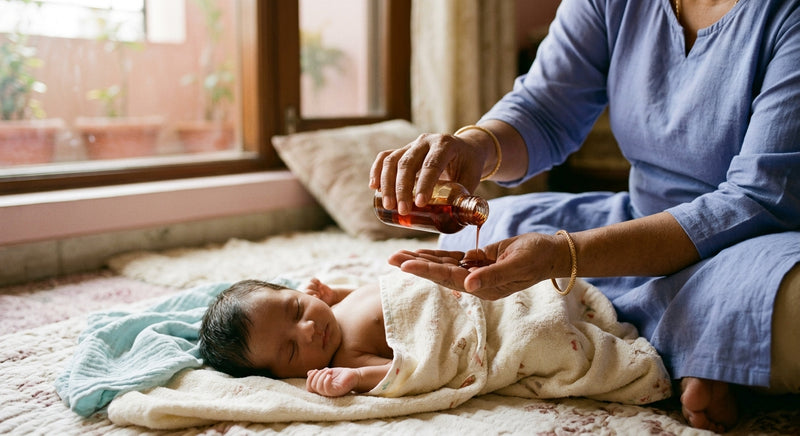
- Pat dry. Don't rub. A rough towel on flaking skin lifts the flakes and roughs up what is underneath them.
- Moisturise within 3 minutes, while the skin is still slightly damp. Head to toe, keeping clear of the eyes.
- Go again before the night feed if the shins, ankles or forearms are the problem areas. Those need two rounds.
- Cotton only, washed in a mild detergent and rinsed twice. Leftover detergent is an underrated irritant.
- Never pull a flake. Not once. Let it come off in its own time. Pulling tears the living skin below it, and that is how a dry patch turns into a raw one.
What to look for in a moisturiser
Advice before product, always. Peeling skin needs three things working together: a humectant to draw water in, an emollient to smooth the ragged edges of the flakes, and an occlusive to stop the water escaping again. That is the science, and it is not complicated. Fragrance-free, or very lightly fragranced. No alcohol high in the ingredient list. Texture tells you more than the marketing does — on genuinely flaky shins, a thicker balm beats a thin, watery lotion every time, because it stays where you put it.
Look for something that supports the skin's own barrier rather than just sitting on top of it. Our Hydra Healing Moisturizing Balm was formulated for exactly this skin — dry, flaky, comforting dry, sensitive skin and helping support the skin's natural barrier. In our lab study it increased Keratin-10 and Filaggrin expression, two of the proteins the skin uses to build its own barrier. It is in-vivo tested, and made in our own GMP-certified facility. A pea-sized amount per limb is plenty.
What if it isn't dryness?
Peeling is a symptom, not a diagnosis, and a few other things at this age can look like it. Cradle cap arrives as greasy yellowish scale on the scalp and eyebrows rather than fine dry flakes — we've written about cradle cap on a newborn's forehead and eyebrows separately. Eczema is peeling plus redness, plus itch, and it usually sits on the cheeks and the outsides of the limbs. Up to ~48.6% of babies experience atopic-type skin issues at some point, so it is far from rare. But eczema needs a paediatrician's eye, not a guess from a blog.
For the wider picture of what is normal on newborn skin and what isn't, start with our complete guide to newborn skin basics.
When to see a doctor
Book a paediatrician's appointment if:
- The peeling skin is red, raw, weeping, crusted or bleeding.
- The flaking is severe on the palms and soles specifically, or the skin comes off in large sheets.
- Your baby seems itchy — squirming, rubbing against the sheet, waking repeatedly.
- There's fever, poor feeding, or your baby just seems "off" alongside the skin changes.
- Nothing has improved after two weeks of a consistent, gentle routine.
- The rash spreads quickly or blisters.
You are not overreacting by asking. Two months is young, and a paediatrician would far rather see a baby with harmless dry skin than miss one who needed help.
In most homes the changes that matter are this ordinary: the cot moved a couple of feet away from the AC vent, the bath cut from fifteen minutes to six, and moisturiser going on while the skin is still damp, twice a day.
If your two-month-old's skin is flaking and dry, a rich, barrier-supporting balm applied on damp skin is the single change most worth making tonight — and if the skin is red, raw or itchy, speak to your paediatrician first.
In summary
- Peeling at 2 months is not the newborn shed — that ends by week 3-4 — so treat it as a dryness signal.
- Check the room first: an AC at 26-27°C, the cot away from the vent, and an open bowl of water fix a surprising number of cases.
- Shorten baths to 5-7 minutes in lukewarm water and use a mild infant cleanser only every other day.
- Moisturise within 3 minutes of a bath while the skin is still damp, twice a day on shins, ankles and forearms.
- Never pull or peel a flake, and see a paediatrician if the skin is red, weeping, itchy, or peeling in sheets.
Frequently asked questions
Is skin peeling normal in a 2-month-old baby?
The classic newborn skin shed is over by about three to four weeks, so peeling at two months usually means something else — most often plain dryness. In Indian homes the common causes are air-conditioning, hard water, long or hot baths, and a cleanser that is too strong. It's common and it's manageable, but it isn't the newborn peel.
Can I peel or rub off my baby's flaking skin?
No. Never pull, pick or scrub a flake, even if it's hanging loose. The skin underneath is still living and still fragile, and pulling tears it — which is how a harmless dry patch becomes a raw, sore one. Let flakes come away on their own during a bath. Moisturising on damp skin will speed the process up safely.
Does air-conditioning cause peeling skin in babies?
It's one of the most common causes we see in Indian homes. An AC removes moisture from the air, and a baby sleeping under a vent for eight hours loses water through the skin all night. You don't have to switch it off. Set it to 26-27°C, keep the cot out of the direct airflow, leave an open bowl of water in the room, and moisturise before bed.
How often should I bathe a 2-month-old with peeling skin?
Every other day is plenty at this age, and each bath should last only five to seven minutes in lukewarm — not warm — water. On the in-between days, plain water on a cloth for the neck folds and nappy area is enough. Use a mild, tear-free infant cleanser rather than soap, and always moisturise within three minutes of patting dry.
What moisturiser is best for a peeling 2-month-old?
Look for a fragrance-free or lightly fragranced formula that combines a humectant, an emollient and an occlusive, so it draws water in and stops it escaping. On genuinely flaky shins and forearms, a thicker balm holds better than a thin lotion. Apply it on slightly damp skin, twice a day, roughly a pea-sized amount per limb.
Does the monsoon make baby skin peel too?
It can, and it catches parents off guard. Damp monsoon air keeps the skin surface wet with sweat while the skin underneath still loses water, and folds at the neck, groin and knees stay damp and get irritated. Dry the folds carefully after every bath, stick to cotton clothing, and keep moisturising the limbs even though the air feels humid.