It's 1am. The baby's finally down. And you're holding a tube up to the nightlight, reading the word hypoallergenic in its soft little font, wondering whether it really means safe for your newborn's cheeks. Short version: it helps, but it isn't the promise you're hoping for. "Hypoallergenic" means a product was formulated to be less likely to trigger an allergic reaction — not that it can't. No single legal standard sits behind that word in India — or, honestly, almost anywhere — so what it tells you comes down to how the brand backs it up.
I'm a cosmetologist. Of all the words on a baby shelf, this is the one I see misread most. So here's what's actually happening behind it, and how to judge any product yourself in about two minutes.
At a glance
- "Hypoallergenic" is a formulation goal, not a certified guarantee — no universal legal definition stands behind it.
- What lowers reaction risk is real: fewer ingredients, no added fragrance or dyes, gentle preservatives, and a skin-friendly pH.
- A baby's skin is thinner and more reactive, so the bar for what touches it should be higher.
- The honest test of a "hypoallergenic" claim is whether the product is dermatologically tested and transparent about its full ingredient list.
- You can patch test at home tonight — it's the single most useful thing you can do.
If you want the bigger picture on how baby formulations are built and judged, this sits inside our complete guide to cosmetic ingredient science for baby skin. Here, I'm zooming in on the one word everyone gets wrong.
So what does "hypoallergenic" actually mean?
The prefix hypo- just means "less than." Hypoallergenic, literally, is "less allergenic" — less likely to cause a reaction than a conventional product. That's the whole claim. It's comparative, not absolute.
And here's what catches most parents off guard: in India, as in most markets, no government checklist exists that a product must clear before printing the word. A brand decides it has built a low-reaction formula and labels it accordingly. That's not dishonest by default — a carefully made product genuinely is less likely to react. But the word on its own guarantees nothing. Two tubes can both say "hypoallergenic" and hold completely different things inside.
So the useful question was never "does it say hypoallergenic?" It's "what has this brand actually done to make it that way — and can they show me?" That's the part where you get to be the gatekeeper.
Why a baby's skin reacts more easily in the first place
The stakes are simply higher on baby skin than on yours. It isn't only smaller — it's built differently. A newborn's barrier is still maturing. It loses water faster, soaks up whatever you put on it more readily, and hasn't yet built its defences against everyday irritants.
Skin that's 20-30% thinner means an ingredient you'd shrug off can linger and irritate far more on an infant. And with up to roughly 48.6% of babies running into atopic-type skin — eczema-prone, quick to react — at some point, a low-irritant formula stops being a nice-to-have. For a lot of Indian families, it's just the sensible starting point. That's the real reason "hypoallergenic" ever became a baby-aisle word.
What actually makes a product less likely to react?
When I formulate or assess something for sensitive baby skin, "hypoallergenic" is never one decision. It's a stack of small ones, and here's what's really doing the work.
1. A shorter, more deliberate ingredient list
Every extra ingredient is one more thing a baby's skin can react to. Tight, purpose-built formulas leave fewer openings for trouble. On a newborn, more isn't the flex — restraint is.
2. No added fragrance or dyes
Fragrance is among the most common contact allergens in skincare. It does nothing functional in a baby product; it's there for us, not the baby. Now, "fragrance" deserves more nuance than "always bad," and I've written about when fragrance is a real problem and when it isn't if you want the full picture. But for a product chasing low reactivity, leaving the perfume and colourant out is the safer default.
3. Gentle, well-chosen preservatives
This one gets demonised unfairly. A baby product with no preservation can grow mould and bacteria, which is far more dangerous than the preservative itself. The goal was never "preservative-free." It's the right preservative at the right level. I unpack this in why preservatives exist in baby skincare and whether they're safe.
4. A skin-friendly pH
A baby's skin sits at a slightly acidic pH, and that acidity is part of how the barrier protects itself. A wash or lotion that runs too alkaline can disrupt it and leave skin readier to react. A genuinely gentle formula respects that — here's why pH matters for a baby's skin barrier.
5. It's actually been tested on skin
This is the real differentiator. A brand that says dermatologically tested or in-vivo tested has run the finished product through human-skin assessment for irritation, rather than crossing its fingers. That testing is what moves a product from "we think it's gentle" to something closer to evidence.
| What the label says | What it actually tells you |
|---|---|
| Hypoallergenic | Formulated to be less likely to react — no fixed legal standard; check what backs it. |
| Fragrance-free | No fragrance added (a genuine plus for reactive skin). "Unscented" can still hide masking fragrance. |
| Dermatologically tested | The finished product was assessed on human skin for irritation — a meaningful step. |
| Natural / organic | Says where ingredients come from, not whether they irritate. Poison ivy is natural too. |
| pH-balanced | Formulated near skin's own slightly acidic pH — good, if it's true and measured. |
The ingredients I'd look for — and the ones I'd skip
For genuinely sensitive or eczema-prone baby skin, I lean toward formulas built on barrier-supporting ingredients: ceramides, humectants like glycerin, and calming botanicals such as colloidal oatmeal or licorice (yashtimadhu). These rebuild and soothe rather than just sitting on top.
What makes me cautious on a reactive baby: added fragrance and essential oils — yes, essential oils can absolutely irritate, because "natural" was never a synonym for "safe" — plus added dyes, harsh sulfate-based cleansers that strip the barrier, and alcohol high on the list. None of these are "toxic" in the scaremongering sense. They're just unnecessary risks on skin this delicate.
What to do tonight
You don't need to bin your shelf. Try this instead:
- Pick up your current baby product and read the full ingredient list, not just the front. If you can't find one, that's your answer.
- Look for the words dermatologically tested or in-vivo tested — that's the proof behind the promise.
- Check for added fragrance / parfum and dyes (CI numbers) near the end of the list. For reactive skin, fewer of these is better.
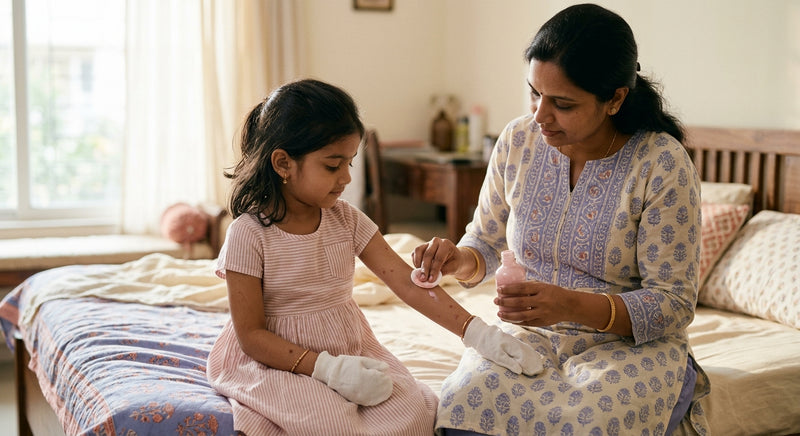
- Do a patch test: dab a small amount on the inner forearm, leave it 48 hours, and watch for redness, bumps or itching before using it on the face or body.
- Introduce one new product at a time, a few days apart — so if something does react, you know exactly which one.
That patch test is honestly the most powerful tool you've got. No label — mine included — can predict your baby's skin the way 48 hours on their own forearm can. Even a beautifully formulated, dermatologically tested product can run into a rare individual sensitivity. Testing first is how you find that out safely.
When to see a doctor
"Hypoallergenic" makes a good first filter. It just isn't the finish line. Read it as shorthand for "this brand tried to keep reactivity low," then check whether they'll show their working: a full ingredient list, no needless fragrance or dye, real skin testing. Do that, and a marketing word turns into an actual decision.
And if you want one product that lives up to the idea — gentle, barrier-supporting, dermatologically tested for delicate, reaction-prone skin — our Hydra Healing Moisturizing Balm is the one I'd reach for first.
In summary
- "Hypoallergenic" means formulated to be less likely to react — it's a goal, not a regulated guarantee.
- Judge the claim by what backs it: a full ingredient list, no added fragrance or dyes, gentle preservatives and skin-friendly pH.
- A baby's thinner, more reactive skin is why the bar for what touches it should be higher.
- Look for "dermatologically tested" or "in-vivo tested" — that's the real evidence behind the word.
- Patch test any new product on the inner forearm for 48 hours and introduce one product at a time.
Frequently asked questions
Is "hypoallergenic" a regulated or certified term?
No. In India and most countries there's no single legal standard a product must pass before printing "hypoallergenic." It signals the brand formulated the product to be less likely to cause a reaction — but the word alone isn't a guarantee. Judge it by what backs it up: a full ingredient list, no needless fragrance or dyes, and dermatological testing.
Does hypoallergenic mean a product can't cause a reaction?
No. "Hypo" means "less than," so it means less likely to react, not impossible. Even a well-made, dermatologically tested product can meet a rare individual sensitivity. That's exactly why a 48-hour patch test on your baby's inner forearm matters more than any word on the front of the pack — it tells you how your baby's skin responds specifically.
Is fragrance-free better than hypoallergenic for a baby?
They're not opposites — the best products are both. Fragrance is a common contact allergen and adds nothing functional to baby skincare, so fragrance-free is a genuine plus for reactive skin. Watch the wording, though: "unscented" can still contain a masking fragrance. For sensitive babies, look for "fragrance-free" plus a transparent ingredient list and skin testing.
What ingredients should I avoid in a baby product?
On reactive or eczema-prone baby skin, be cautious with added fragrance and essential oils, added dyes (CI numbers), harsh sulfate cleansers that strip the barrier, and alcohol listed high up. None are "toxic" in a scary sense — they're just unnecessary risks on skin that's 20-30% thinner than an adult's. Favour barrier-supporting ingredients like ceramides, glycerin and colloidal oatmeal instead.
How do I patch test a baby product at home?
Dab a small amount on the inside of your baby's forearm, leave it on, and watch for 48 hours. If you see redness, bumps, or itching, don't use it elsewhere. Introduce only one new product at a time, a few days apart, so if something reacts you know exactly which product caused it. This simple step beats trusting any label.