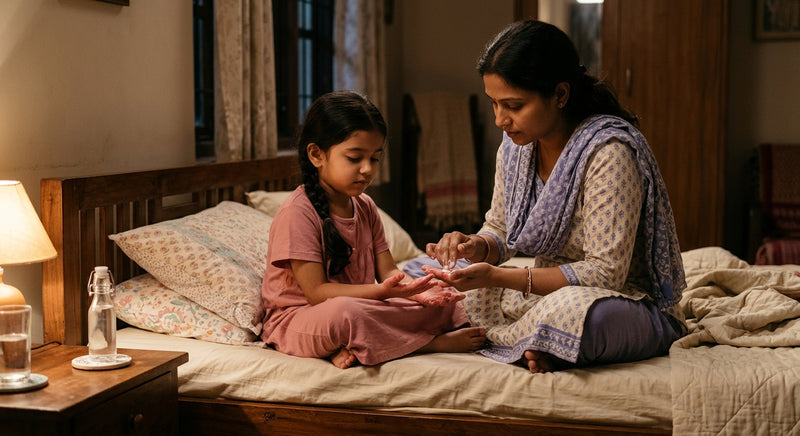
Last week a cousin sent me a photo of everything her mother-in-law had lined up for the baby's first malish: a bottle of til oil, a tin of ghee, a katori of besan, a pinch of haldi and a small block of chandan. Her message read, "Which of these is actually okay?" This glossary is my long answer. It walks through the ayurvedic ingredients Indian parents actually meet — what each one is, what tradition uses it for, and what I'd honestly do — with a five-step check to run before anything new touches your baby's skin.
One ground rule before the list. A baby's skin is 20-30% thinner than an adult's, so "natural, therefore safe" is not a rule you can lean on. Neem is natural. So is mustard oil. Both can sting a four-week-old. If you're new to reading your baby's skin the ayurvedic way, start with our complete guide to dosha-based skincare for babies and kids, then come back here for the ingredient-by-ingredient detail.
At a glance
- Gentlest of the lot: cold-pressed coconut, sesame (til) and almond oils, plus plain besan — introduced one at a time.
- Handle with care: haldi (stains, can irritate), chandan (only true Santalum album, in tiny amounts), neem (diluted only, never raw on a newborn).
- Skip for babies: mustard-oil malish, kumkumadi oil, and any home mix with lemon or raw milk.
- Before anything new: run the five-step check below and patch test for 24-48 hours.
The five-step check: do this before any new ingredient
Every entry in the glossary assumes you've done this first. It takes two days of patience and about three minutes of actual work, and it's the single habit that separates a happy malish story from a red, unhappy baby at 11pm.
- Name it precisely. "Sandalwood" can mean true Santalum album or a synthetic fragrance oil. "Almond oil" can mean sweet almond or bitter. Read the exact ingredient name on the label, or if it's loose from a kirana shop, know the source before it goes near your baby.
- Match it to your baby's age. Under four weeks: nothing new at all — vernix and plain, established basics are enough. One to six months: single, well-known oils only. Herbal actives like manjishtha or yashtimadhu: in properly tested formulations, not kitchen pastes.
- Patch test, then wait 24-48 hours. Dab a one-rupee-coin amount on the inner forearm or thigh, leave it uncovered, and watch for redness, bumps or dryness over the next two days.
- Start small. First real use goes on one limb, not the whole body. A little on the shins tells you everything a full-body malish would — with a fraction of the risk.
- Reassess after a week. Skin that's happy stays soft and even-toned. Any new roughness, redness or rubbing means stop and simplify, not add more.
The glossary: 14 ingredients in plain language
Here's the quick-reference version. The sections after it go deeper on the ones parents ask me about most.
| Ingredient | What tradition uses it for | What I'd actually do |
|---|---|---|
| Coconut oil (nariyal tel) | Everyday massage; considered cooling | A gentle default for most babies. Pick cold-pressed, food-grade. Lovely in summer. |
| Sesame oil (til tel) | The classic abhyanga oil; warming | Good winter malish oil. Choose cold-pressed (kachi ghani) and patch test — it's richer than coconut. |
| Almond oil (badam rogan) | Nourishing delicate skin | Sweet almond only, cold-pressed. Well tolerated by most babies. |
| Mustard oil (sarson) | Warming winter massage in North India | I'd skip it for babies. It's harsh on delicate skin, and gentler warming options exist (til). |
| Ghee | Dry patches, lips, ritual firsts | A thin smear on dry patches is fine for many babies. Never on broken skin; store it well — rancid ghee irritates. |
| Kokum butter | Very dry, rough skin | Lovely in a formulated balm; too stiff to use neat on a wriggling baby. |
| Besan (gram flour) | Ubtan base; gentle cleansing | Fine as a soft, wet paste. Never scrub with it. |
| Haldi (turmeric) | Traditional antiseptic in pastes | Handle with care: it stains everything and can irritate thin skin. A tiny pinch in ubtan at most; not on the face. |
| Chandan (sandalwood) | Cooling paste for heat and redness | Only true Santalum album, in tiny amounts — adulteration is rampant. Details below. |
| Neem | "Purifying"; kapha imbalances | Too harsh raw. Only diluted or in a tested product, and only for older babies. |
| Manjishtha | Pitta-calming skin herb | Sensible inside a tested cream or balm. Don't make kitchen pastes from the raw root. |
| Yashtimadhu (licorice) | Soothing, tone-evening | One of the better-studied herbs; well tolerated in properly made formulations. |
| Aloe vera | Cooling gel for heat-stressed skin | Pure inner-leaf gel suits many babies. Avoid whole-leaf preparations (the yellow latex irritates). |
| Kumkumadi oil | An adult facial oil with saffron and potent herbs | Not for babies. It's formulated for adult skin concerns, full stop. |
Which ingredients are genuinely gentle?
Honestly, the boring ones. Cold-pressed coconut, til and sweet almond oil have centuries of daily use behind them and behave predictably on most baby skin. My rule of thumb for Indian weather: coconut for sticky Nagpur-style summers, til for December mornings when the floor is cold, almond when you want something in between. Whichever you pick, the oil matters less than the hands — slow, warm, unhurried strokes. If you want the stroke-by-stroke method, our step-by-step shishu abhyanga guide walks through the full routine.
Besan earns its place too. As a soft paste it lifts oil after malish without stripping skin the way a harsh soap can. The mistake is treating it like a scrub — on a baby, it should glide off with water, never be rubbed in circles.
Which ones need real caution?
Four come up again and again in my inbox.
Haldi is the one grandmothers reach for first and the one I see cause the most avoidable redness. Turmeric's active compounds are strong, the powder in most kitchens is variable, and it stains skin, nails and every white onesie you own. If it appears at all, it's a pinch in a full katori of ubtan — never a paste on its own, never on the face.
Chandan genuinely is cooling, but most "chandan powder" sold loose isn't sandalwood at all — it's scented filler. If you can't verify it's true Santalum album, leave it out. I've written a full, honest look at whether sandalwood is safe for baby skin if this is your family's non-negotiable ritual.
Neem is powerful — which is exactly the problem. Raw neem paste or strong neem water on a young baby is a recipe for stinging. If neem is used at all, it belongs diluted or inside a tested product, and not in the newborn months.
Mustard oil I'd simply retire from the malish shelf. Tradition favours it for warmth, but it sits at the harsh end for delicate skin, and til oil gives you the same cosy winter massage without the gamble.
What about ubtan — the ingredient that's really a recipe?
Ubtan isn't one ingredient; it's a family recipe wearing an ayurvedic name, usually besan plus malai or curd, sometimes a whisper of haldi. Made soft and used gently once a week, it's a lovely ritual. Made thick and rubbed like a scrub, it's exfoliation a baby's skin didn't ask for. Our guide to using baby ubtan safely covers proportions and technique. On the days between ubtan, you don't need to improvise — a mild, tear-free cleanser like Janma's Head to Toe Baby Foam Wash does the everyday job without any guesswork about what's in the katori.
How do you spot a well-made ayurvedic product?
Here's my honest position as someone who makes these products: tradition tells you which ingredients are worth studying; testing tells you whether a specific formulation is gentle enough for a specific age. Both matter. When a label says "ayurvedic," look for the full ingredient list (every ingredient, not just the hero herbs), the words "dermatologically tested," a batch number, and a named manufacturer. At Janma we make everything in our own GMP-certified facility precisely so we can answer for what's in the jar — an herb like yashtimadhu or manjishtha behaves very differently in a stability-tested balm than it does as a coarse kitchen paste.
When to see a doctor
Home wisdom has limits, and knowing them is part of the tradition too. See a paediatrician if a rash spreads or worsens over 48 hours, if skin is broken, blistered, weeping or crusting, if a reaction comes with fever, facial swelling or any change in breathing, or if your baby seems unusually irritable and uncomfortable after a new product. Take the product or ingredient along — it makes the doctor's job much easier.
Most families need only three or four entries from this whole glossary: one massage oil, one gentle cleanse, one rich moisturiser for dry patches, and the patience to patch test. If dry, rough patches are what brought you here, Janma's Hydra Healing Moisturizing Balm — clinically tested and made in our own facility — is the one I'd point you to.
In summary
- Introduce one new ayurvedic ingredient at a time, and patch test on the inner forearm for 24-48 hours before real use.
- Cold-pressed coconut, sesame (til) and sweet almond oils are the gentlest traditional picks for baby massage.
- Treat haldi, chandan and neem as handle-with-care: tiny amounts, diluted, or inside tested formulations only.
- Skip mustard-oil malish, kumkumadi oil and any home mix with lemon or raw milk on baby skin.
- See a paediatrician for spreading rashes, broken or weeping skin, or any reaction with fever, swelling or breathing changes.
Frequently asked questions
Is coconut oil safe for newborn baby massage?
For most babies, yes — cold-pressed, food-grade coconut oil is one of the gentlest traditional massage oils and suits warm Indian weather well. Still patch test first: dab a little on the inner forearm and wait 24-48 hours. In the first month, keep everything minimal and introduce only one new thing at a time. If your baby's skin is eczema-prone, check with your paediatrician before starting oils.
Can I put haldi (turmeric) on my baby's skin?
Be careful with it. Turmeric is potent, kitchen powders vary widely in quality, and it can irritate a baby's thin skin — besides staining everything it touches. If your family ritual includes it, keep it to a small pinch mixed into a soft besan ubtan, avoid the face entirely, and patch test the mix first. Never apply a turmeric paste on its own or on broken skin.
What is the safest way to try a new ayurvedic ingredient on a baby?
Follow a five-step check: identify the exact ingredient and source, confirm it suits your baby's age, patch test a coin-sized dab on the inner forearm or thigh, wait 24-48 hours watching for redness or bumps, then start with one limb rather than a full-body application. Introduce only one new ingredient at a time so that if skin reacts, you know exactly what caused it.
Is kumkumadi oil safe for babies?
No — kumkumadi is an adult facial oil built around saffron and a concentrated blend of herbs formulated for adult skin concerns like uneven tone. A baby's skin is 20-30% thinner than an adult's and doesn't need any of it. For babies, stick to single gentle oils like coconut, til or sweet almond for massage, and a simple tested moisturiser for dryness.
Which oil is best for baby malish in winter versus summer?
A practical split: cold-pressed coconut oil for hot, humid months because it feels light and cooling, and cold-pressed sesame (til) oil for winter because it is richer and traditionally warming. Sweet almond oil sits comfortably in between and suits most seasons. Skip mustard oil for babies — it is harsh on delicate skin — and always patch test whichever oil you choose before the first full malish.