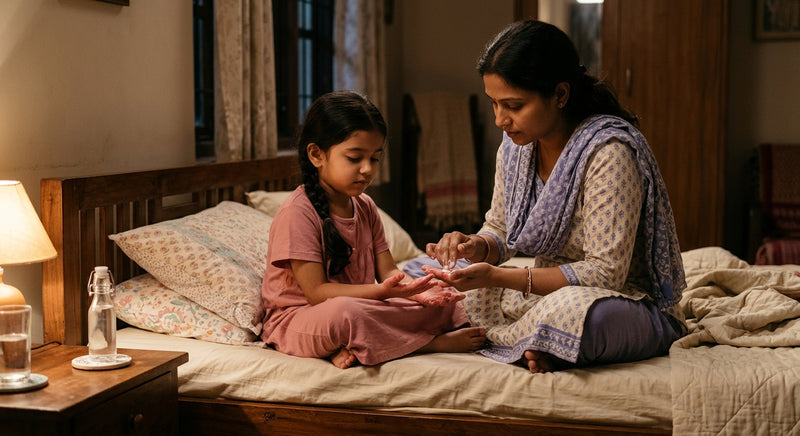
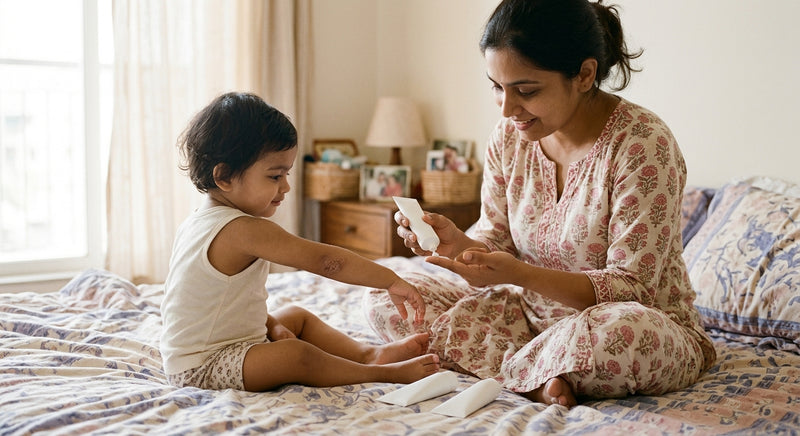
Almost every Indian family has a chandan story. A grandmother stirring a little sandalwood powder into milk or rosewater, dabbing it on a baby's cheeks before a function, certain it will keep the skin cool and “glowing.” It's gentle, it smells lovely, families have done it for generations — so it must be safe for a newborn, right?
Mostly, in its simplest form, yes — but with real caveats. Plain, food-grade sandalwood powder mixed into a paste is low-risk for most babies as an occasional, leave-on-briefly application. Concentrated sandalwood essential oil is a different story. So is anything sold loosely as “chandan” at a market stall. We just call all of them by one word, and that's where the trouble starts. So let me take them one at a time.
At a glance
- Plain sandalwood powder made into a paste is generally low-risk for occasional use on most babies over a few months old.
- Sandalwood essential oil is concentrated and a known skin sensitiser — not for routine baby use.
- A baby's skin is 20–30% thinner than an adult's, so it absorbs and reacts more.
- Always patch test, keep it away from eyes and mouth, and never leave a drying paste on for hours.
- For everyday dryness, a tested baby moisturiser does more, more safely, than a chandan paste.
Chandan is one small piece of a much bigger, often misunderstood picture. If you're weighing up traditional ingredients more broadly, read this next to our complete guide to Ayurvedic baby skincare and dosha-based care.
What does chandan actually do for skin?
Sandalwood (Santalum album, safed chandan) has a genuine place in Ayurveda. It's classed as sheetal — cooling — which is why families reach for it in hot, sweaty weather and for prickly-heat-type irritation. Modern skin science backs part of this up. Sandalwood does have mild soothing and antioxidant activity, and its main active, alpha-santalol, has been studied for calming effects on irritated skin.
So the tradition isn't baseless. What gets skipped is the distance between “this plant has some soothing properties” and “this is safe to put on my four-week-old's face every day.” Two very different claims. Most chandan advice jumps straight from the first to the second.
Powder vs oil: the difference that matters most
If you remember one thing from this article, make it this. When your grandmother says chandan, she means the powder — sandalwood ground fine, mixed with water, milk or rosewater into a thin paste. When a bottle on a shelf says “sandalwood oil,” that's usually a concentrated essential oil, sometimes hundreds of times stronger than the active dose in a paste.
| Form | What it really is | For baby skin? |
|---|---|---|
| Sandalwood powder paste | Ground wood + water/milk/rosewater, very dilute | Low-risk, occasional, patch-tested |
| Sandalwood essential oil | Concentrated steam-distilled oil, potent | Avoid for routine baby use — known sensitiser |
| “Chandan” cream/soap (unbranded) | Often fragrance + dye, little real sandalwood | Read the label; usually skip |
| Loose market “chandan” powder | Can be adulterated with dyes or fillers | Risky — purity unknown |
Essential oils are tempting because the word “pure” does a lot of quiet work on us. But pure and gentle aren't the same thing. A concentrated botanical can be far harsher on thin baby skin than a well-formulated synthetic. Sandalwood oil in particular turns up on fragrance-allergen watch lists, which is exactly why I'd keep it out of a baby's daily routine. The same logic runs through a lot of traditional ingredients — we wrote about it plainly in our piece on choosing a baby massage oil, where the “purest” option isn't always the kindest.
Myth vs fact: chandan for babies
Myth: “Chandan is herbal, so it can't irritate.”
Fact: herbal doesn't mean hypoallergenic. A botanical is a complex mix of dozens of compounds, and several of them can set off a reaction in sensitive skin. Because a baby's skin is 20–30% thinner than an adult's, it absorbs more and reacts faster. “Natural” tells you where something came from, not whether it's safe.
Myth: “Leave the paste on so it works longer.”
Fact: chandan paste dries and tightens as it sits. That pulls moisture out of skin that's already delicate, and you're left with flakiness. If you use it at all, treat it like a quick cooling dab — ten minutes on, then gently rinsed off. Never let it cake on overnight.
Myth: “It lightens or brightens baby's complexion.”
Fact: this is the one I'll push back on hardest. There's no good evidence chandan changes a baby's skin tone, and honestly, the idea of “brightening” a newborn isn't one any of us should be entertaining. A baby's colour is healthy exactly as it is. Use ingredients to comfort skin, never to change it.
Myth: “Market chandan and branded chandan are the same.”
Fact: real sandalwood is expensive, which makes loose powder one of the more commonly adulterated ingredients on the shelf — padded out with dyes, talc or other woods. None of that shows up to the naked eye. It's the same purity problem we flagged with A2 bilona ghee: a tradition is only as safe as the actual jar in your hand.
If you want to use chandan, do it this way
I'm not telling you to throw out a family ritual. Done sensibly, an occasional cooling dab is fine for most babies past the newborn weeks. The careful version goes like this.
- Use plain, known-source sandalwood powder — not essential oil, not unbranded market powder of unknown purity.
- Mix a tiny amount into a thin paste with cooled boiled water or plain rosewater. Skip milk on broken or rashy skin.
- Patch test first: a small dab on the inner forearm, then wait 24–48 hours and check for redness or bumps before using anywhere else.
- Keep it well away from eyes, mouth, nappy area and any cuts or open eczema.
- Leave on 10–15 minutes at most, then rinse with plain water and pat dry.
- Follow immediately with a gentle moisturiser — paste cools but also dries, so seal the skin afterwards.
What I'd actually reach for instead
Here's my honest formulator's view. If the goal is to soothe a hot, slightly irritated baby through a Nagpur summer afternoon, a quick chandan dab is a fine occasional comfort. But if the real problem is everyday dryness, flakiness, or skin that gets upset easily, a paste is the wrong tool. It doesn't moisturise, and that drying-down effect can make dry skin worse.
For that, a well-made moisturising balm built for sensitive baby skin does more, more reliably, with a known, tested ingredient list — no guessing about purity. And if it's calming sensitive skin you're after, the botanicals worth knowing are gentler, better-studied choices like yashtimadhu (licorice) and manjishtha, which we've written up honestly in the Janma Journal.
When to see a doctor
See your paediatrician if your baby develops a rash, hives, swelling or persistent redness after any chandan use; if irritated skin doesn't calm within a day or two; if there's any broken, weeping or blistered skin; or if your baby is unsettled, feverish or off feeds. For anything affecting the eyes or a large area of skin, don't wait — get it checked the same day. Traditional remedies are worth respecting, but a reacting baby always comes before a ritual.
In summary
- Plain sandalwood powder paste is generally low-risk for occasional, patch-tested use on babies past the newborn weeks.
- Avoid concentrated sandalwood essential oil and unbranded market powder of unknown purity on baby skin.
- Always patch test 24–48 hours first, keep chandan away from eyes, mouth and broken skin, and rinse after 10–15 minutes.
- Don't expect chandan to lighten skin — use ingredients to comfort, never to change a baby's natural colour.
- For everyday dryness, a tested baby moisturiser does more, more safely, than a drying paste.
Frequently asked questions
Is sandalwood (chandan) safe for newborn skin?
For newborns under a few months, I'd skip it. Their skin is at its thinnest and most reactive, and there's no real need to introduce a new botanical. Plain sandalwood powder paste is low-risk for older babies on an occasional, patch-tested basis, but concentrated sandalwood essential oil should be avoided for routine baby use because it's a known skin sensitiser.
What's the difference between sandalwood powder and sandalwood oil for babies?
Sandalwood powder is ground wood mixed into a very dilute paste — this is the traditional, low-risk form. Sandalwood essential oil is steam-distilled and highly concentrated, sometimes hundreds of times stronger, and appears on fragrance-allergen watch lists. The powder paste is the gentler choice; the essential oil is not suited to daily baby skincare.
Can chandan lighten or brighten my baby's complexion?
No. There's no good evidence that chandan changes a baby's skin tone, and “brightening” a newborn isn't a goal worth chasing. A baby's natural colour is healthy as it is. Use any ingredient to soothe and comfort the skin, never to alter how it looks.
How do I patch test chandan on my baby?
Mix a tiny amount of plain sandalwood powder into a thin paste with cooled boiled water or rosewater. Dab a small spot on the inner forearm, leave it briefly, then rinse and watch for 24–48 hours. If there's any redness, bumps or warmth, don't use it. If skin stays clear, it's lower-risk for occasional use elsewhere.
How long should chandan paste stay on a baby's skin?
No more than 10–15 minutes, then rinse with plain water and pat dry. Paste cools as it sits but also dries and tightens, which can pull moisture from already-delicate skin and cause flaking. Never leave it caked on for hours or overnight, and always follow with a gentle moisturiser to seal the skin.