It's 2am. You've just changed a nappy, and your baby's legs have gone a lacy blue-and-pink, like marble. Ten minutes later she's feeding and her whole face is a deep, angry red. So here you are on your phone at 2am, typing something you never imagined typing.
Short answer first. In a healthy newborn, skin colour that changes with temperature, crying and position — and comes back to normal when your baby is warm and settled — is almost always normal. A newborn's blood vessels are still learning to control themselves, and the skin above them is very thin, so whatever the blood underneath is doing shows straight through. The colour changes that matter are the ones that don't shift: blue lips or tongue, a grey or dusky look, a baby who is pale and floppy and feeding badly. Those need a doctor, not a search bar.
At a glance
- Mottling (a blue-pink lacy net on the arms, legs or trunk) usually means your baby is cold. It should fade within a few minutes of warming.
- Flushing — sudden deep red, often with crying, feeding, a warm bath or being over-bundled — settles as your baby calms and cools.
- Blue hands and feet in the first days, with a pink face and pink lips, is extremely common. Blue lips or tongue is not.
- None of this is a skin problem, so no cream fixes it. Your job is warmth, calm and a healthy barrier.
- A baby's skin is 20–30% thinner than an adult's — which is exactly why the colour underneath is so visible, and why what you put on it should be simple.
Why does a newborn's skin colour change so much?
Two reasons. Both are about plumbing rather than skin.
The tiny blood vessels near the surface open and close to control heat. In an adult, that system runs smooth and quick. A newborn's is still calibrating, so the vessels open and close unevenly, in patches. Where they're constricted, blood pools and the skin looks bluish. Where they're open, it looks pink. Put those patches side by side and you get a lacy, marbled net. The medical name is cutis marmorata. Most parents I speak to just say "the marble legs."
Then there's the skin sitting over all that. A baby's skin is roughly 20–30% thinner than an adult's, so there's less tissue to diffuse the colour underneath. It's the same thinness that lets newborn skin lose water and heat so quickly, and the same reason we're fussy about what goes on it in the first weeks (there's more on that in our complete guide to newborn skin basics).
So the colour show isn't a fault. It's a brand-new thermostat learning its job with the wiring on display.
The four colour changes Indian parents ask about most
| What you see | What it usually is | What it should do |
|---|---|---|
| Lacy blue-and-pink net on legs, arms, trunk — especially after a nappy change or bath | Mottling (cutis marmorata) — a cold response | Fades within minutes of covering up / warming the room |
| Sudden deep red face, chest or whole body while crying, feeding, or bundled up | Flushing — blood vessels wide open, heat and effort | Settles as the baby calms; skin returns to its usual tone |
| Blue-purple hands and feet, warm and pink everywhere else, first days of life | Acrocyanosis — circulation prioritising the core | Improves over the first days–weeks; hands pink up when warmed |
| Lying on one side, the lower half turns red and the upper half pale, with a clean line down the middle | Harlequin colour change — dramatic, harmless, brief | Disappears within a few minutes, or as soon as you move the baby |
Harlequin is the one that frightens people, and I understand why. It looks like somebody drew a line down your baby with a ruler. It's a quirk of position and gravity, and it leaves as fast as it arrived.
What's making it worse in an Indian home (and it's usually one of these)
Honestly? Most of the mottling parents describe to me traces back to something in the room.
- The ceiling fan on speed 3. Undress a newborn for a nappy change under it and she will mottle within a minute. Moving air strips heat far faster than still air at the same temperature. The AC does it quietly; the fan does it fast.
- Malish on a cold floor. Marble or mosaic in January pulls the heat out of a baby's back with startling efficiency, and a thin towel does very little about it. Fold a blanket under the towel.
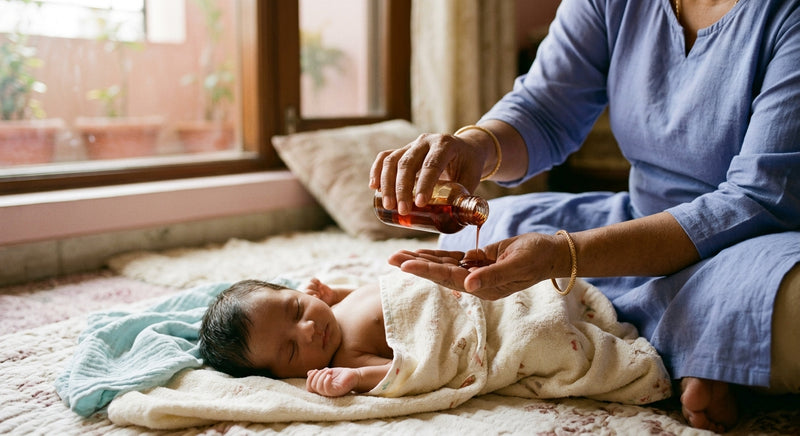
- The long, elaborate massage. Twenty unhurried minutes, an undressed baby, a cool room, oil everywhere. That's a lot of wet skin sitting in the air. Shorten it, or warm the room before you start.
- Over-bundling. The opposite mistake, just as common. A Nagpur June baby in a vest, an onesie, a swaddle and a topi will flush red and go sweaty. Feel the back of the neck. Damp means take a layer off.
- Bath water that's too hot. It gives you a lobster-red baby and a stripped barrier in one go. Warm, never hot. Test it with your elbow or inner wrist — your hands are the least reliable thermometer in the house.
Does this mean my baby's complexion is "changing"?
Let me answer this one straight, because in a lot of Indian families it's the question sitting underneath the question.
Yes, a baby's settled skin tone does develop over the first months as melanin production matures. Many Indian babies are born lighter than they will eventually be, and the tone deepens gradually. That is healthy pigment doing exactly what it is meant to do. It has nothing whatsoever to do with the minute-to-minute mottling and flushing this article is about.
And as someone who formulates for babies, I'll say the rest plainly: nothing you apply changes it, and you should not try. Besan-and-malai ubtan scrubbed on every day. Kesar in the milk. "Brightening" baby creams. At best they do nothing. At worst, the friction and the actives damage a barrier that is thin and still being built. Traditional first-week newborn care carries real wisdom — the fairness layer that got bolted on later carries none. Nobody gets to make you feel a certain way about a two-week-old.
What to look for in what you put on the skin
Colour changes aren't a skin condition, so no product treats them. But a well-supported barrier holds heat and water better, and that means less of the cold-blotchy cycle after every bath and change. Two things I'd check from the lab side.
Skip the "warming" ingredients. Camphor (kapoor), menthol, mint, strong eucalyptus — the backbone of half the balms and chest rubs on an Indian chemist's shelf. They produce a sensation of warmth while warming nothing at all, and they irritate thin newborn skin. On an infant they have no place in a daily routine. Read the ingredient list. The front of the box is advertising.
Then look for a barrier build. A useful baby moisturiser has three things working together: humectants to pull water in, emollients to smooth, occlusives to hold it there. Oil on its own is mostly just the third one. That's why a proper cream or balm after a bath holds so much better than oil rubbed into dry skin, and it's why we build ours around butters plus barrier-supporting actives. In our lab work, our formulation supported increased Keratin-10 and Filaggrin expression — the proteins the skin uses to build its own barrier.
Do this tonight: a warm, low-drama routine
- Warm the room before you undress your baby. Fan off, AC up, door shut. Two minutes of prep buys you ten minutes without blotchy legs.
- Keep the bath short and warm. Keep the cleanser mild, so you aren't stripping the barrier you're trying to protect. A gentle, tear-free head-to-toe baby foam wash is all a newborn needs. No soap bar. No scrubbing.
- Pat dry, never rub. Moisturise within about three minutes, while the skin is still slightly damp — that's when it traps water best.
- Dress in layers you can pull off. One thin layer more than you're comfortable in, then check the back of the neck: warm and dry is right, damp means remove one.
- Do the malish in a warm room, on a folded blanket, for as long as your baby is actually enjoying it. The schedule doesn't get a vote.
- When you're worried, look at the lips and tongue rather than the hands and feet. Pink lips are the reassurance you came for.
If there's flaking or peeling alongside the colour changes — very common in the first weeks — that's a separate process, and an equally normal one. We've written about why peeling happens in a two-month-old, and about the scaly patches that turn up on the forehead and eyebrows. Newborn skin does a lot of visible housekeeping in the first three months. Most of it asks for patience rather than intervention.
When to see a doctor
- Blue or dusky lips, tongue or the skin around the mouth (not just hands and feet), or a grey, ashen look.
- Mottling that does not fade when your baby is warmed, or mottling with fever, poor feeding, or a floppy, hard-to-rouse baby.
- Fast, laboured or grunting breathing; nostrils flaring; the chest sucking in between the ribs.
- Sudden pallor with sweating, or a baby who feels cold and won't warm up.
- Yellowing of the skin or the whites of the eyes that is spreading or deepening, especially with sleepiness or poor feeding.
- Any colour change alongside a rash that doesn't fade when you press a glass against it.
Everything else — the marble legs at the 3am change, the beetroot-red face mid-cry, the blue toes that pink up the moment you tuck them under you — wants a warm room, a calm hold, and a barrier that's been looked after. If your baby's skin is dry or flaky on top of all this, our Hydra Healing Moisturizing Balm is what we'd reach for after the evening bath.
In summary
- Mottling, flushing, blue hands and feet and harlequin colour change are all normal in a healthy newborn — the common thread is that they shift with temperature, crying and position, and settle again.
- Warm the room before you undress your baby, keep the fan and AC off during changes and massage, and use a folded blanket under the towel on a cold floor.
- Check lips and tongue, not hands and feet: pink lips with a warm, normally-coloured trunk is the reassurance you're looking for.
- No product changes your baby's skin colour, and daily scrubbing with ubtan or 'brightening' creams risks damaging a barrier that's still building — support the barrier instead with a mild wash and a proper moisturiser.
- See a paediatrician the same day for blue lips or a dusky look, mottling that won't fade with warming, laboured breathing, spreading jaundice, or a baby who simply doesn't look right.
Frequently asked questions
Is mottled, marbled skin on my newborn dangerous?
Usually not. Mottling — a lacy blue-and-pink net, most often on the arms and legs — is typically a cold response in a baby whose blood vessels are still learning to regulate temperature. It should fade within a few minutes once your baby is warmed and covered. Mottling that persists despite warming, or comes with fever, poor feeding or a floppy baby, needs a paediatrician the same day.
Why do my baby's hands and feet turn blue?
This is acrocyanosis, and it's very common in the first days and weeks. A newborn's circulation prioritises the core, so the hands and feet get less blood flow and look blue or purple while the face, chest and lips stay pink. Warming the hands usually pinks them up. Blue lips, tongue or skin around the mouth is different and needs urgent medical attention.
My baby turns bright red when crying or feeding. Is that normal?
Yes. Crying, feeding and effort all raise the heart rate and open up surface blood vessels, and because a newborn's skin is thin, that blood shows through as a deep flush. It settles as your baby calms. If your baby also flushes when quiet and is bundled up, check for over-heating: feel the back of the neck, and remove a layer if it's damp.
Will my baby's skin colour become darker or lighter as they grow?
A baby's settled skin tone does develop over the first months as melanin production matures, and many Indian babies deepen in tone from their newborn colour. That's normal, healthy pigment. It is unrelated to daily mottling and flushing. No cream, ubtan, oil or food changes a child's genetic skin tone, and scrubbing or applying brightening products can damage a thin, still-developing barrier.
Should I put balm or oil on mottled skin?
Nothing you apply will stop mottling — it's a circulation and temperature response, not a skin condition. Warmth is the fix. What a good moisturiser does do is help the skin hold heat and water better overall, so there's less drying and irritation from the bath-and-change cycle. Look for humectants, emollients and occlusives together, and avoid camphor, menthol or mint on newborn skin.
One half of my baby turned red and the other half pale. What was that?
That's harlequin colour change — a sharp, dramatic-looking division down the midline that can appear when a newborn lies on one side. It's caused by blood flow and gravity, it is harmless, and it disappears within minutes or as soon as you move your baby. It is one of the more alarming-looking normal things newborn skin does. If it does not resolve, get your baby checked.