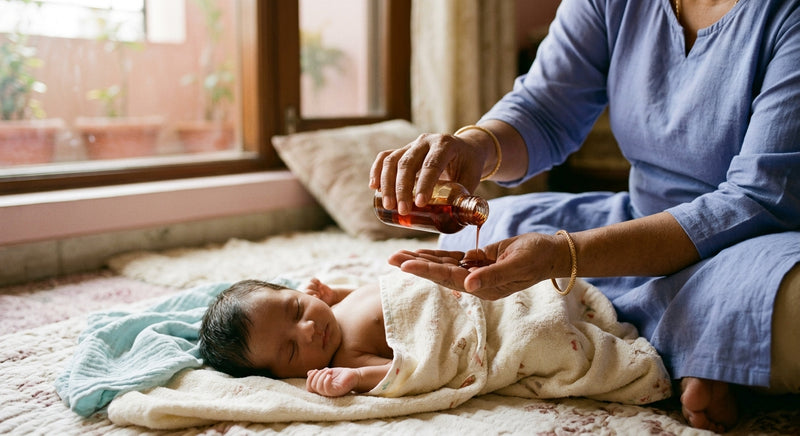
Day four at home. You lift her out of the towel and the skin around her ankles is coming away in thin, papery sheets — like a sunburn she never got. Your mother-in-law says oil. The neighbour is quite sure it's the water. Your brain, at 2am, says something is wrong.
Almost always, nothing is. Peeling in the first few weeks is shedding, not damage. She spent nine months floating in amniotic fluid. That outermost layer of skin is waterlogged; it meets dry air, lifts, and comes away. It starts around day two to five. It looks worst on the ankles, wrists, hands and shins. It settles within a couple of weeks. There is nothing here to treat — but there are three or four things worth stopping, and those are what make it drag on.
At a glance
- Peeling in the first 2–3 weeks is normal shedding of the outer skin layer — not a rash, not an allergy, not a sign of dehydration.
- Babies born a little past their due date peel more, and for longer. That's expected.
- Never pull, rub or scrub a flake off. Let it lift on its own.
- Short lukewarm baths (5 minutes, 2–3 times a week) plus a rich moisturiser within 3 minutes of the bath does most of the work.
- Peeling with redness, weeping, blisters, cracks that bleed, or a baby who is off feeds needs a paediatrician — see the list at the end.
Why is my newborn's skin peeling?
Before birth she's coated in vernix caseosa — the waxy white layer that looks like cold ghee. It is a moisturiser and a barrier in one. Vernix wears away through the last weeks of pregnancy and the first days after birth, and as it goes, the skin underneath dries, lifts and sheds. It's the same reason a 41-week baby peels dramatically while a 37-week baby, still thickly coated, may barely peel at all.
Nearly every parent reads this wrong in the first month. It's why we go through it properly in our complete guide to newborn skin basics. Flakes appear. Out comes the oil. Then more oil. Then somebody suggests a light scrub, just to "take the dead skin off". All three make it worse.
Here's what's actually happening underneath. A newborn's barrier is still under construction. A baby's skin is 20–30% thinner than an adult's, loses water faster, and hasn't yet built up its full acid mantle. The shedding is part of that skin growing up. Your job is to protect it while it does — not to hurry it along.
Where the peeling usually shows up
Roughly in this order: ankles and the tops of the feet. Then wrists, palms and soles, shins, forearms, the back. The scalp and behind the ears come last. Palms and soles peel in the biggest, most alarming-looking sheets — thick skin, thick flakes. If that's where yours is worst, peeling skin on a baby's hands and feet goes deeper into what's normal there.
What it should not look like: red, angry, wet, blistered, or itchy enough that she's squirming and scratching against the sheet. Shedding skin is dry, pale, and doesn't seem to bother her in the slightest. She'll sleep straight through you inspecting her ankle by phone torch at midnight.
The routine that settles peeling skin
It is deliberately boring. Boring is what a shedding barrier wants.
- Bathe her every second or third day, not daily. In the first month, 2–3 proper baths a week is enough. On the other days, a warm-cloth top-and-tail — face, neck folds, hands, nappy area — is all she needs.
- Test the water on the inside of your wrist. Fingers lie; they've been in and out of hot water all day. You want pleasantly warm, around body temperature — not hot. Hot water strips the very lipids you are trying to keep. Geyser water in winter runs far hotter than it feels in the mug, and in a Nagpur summer the tap alone can be warm enough. Check either way.
- Five minutes. In, out. Set a timer if the bucket makes you lose track. A long soak softens the outer layer and then dehydrates it, and the flaking gets worse.
- A tiny amount of a mild, tear-free, soap-free wash — or just plain water. Skip soap bars, antiseptic liquids, and anything foamy and fragranced. What you want is pH-appropriate, syndet-based and fragrance-light; our Head to Toe Baby Foam Wash is built for exactly this window.
- Pat dry. Never rub. A rough towel dragged over lifting flakes is how shedding turns into a red patch. Blot, and leave her very slightly damp.
- Then moisturise, within three minutes. Of everything on this list, this is the step that does the work. Damp skin plus an occlusive layer traps the water in. Dry skin plus cream just sits there.
- Again before the night feed. Twice a day, every day, bath or no bath. Ankles, wrists, shins, hands, feet.
- Keep her out of the AC's direct line. Point the vent away from the cot. If the room runs very dry, leave a bowl of water in the corner — it does help.
- Cotton, and one layer more than you're comfortable in. Sweating under synthetics takes you from peeling to prickly heat in a single afternoon.
What to look for in the moisturiser
Not a light lotion. This is the moment for something richer. You want three things working together: a humectant to draw water in, an emollient to fill the gaps between flaking cells so the skin feels smooth again, and an occlusive to seal it all in. In practice that means a thicker balm or butter-cream rather than a watery lotion, with a short, readable ingredient list, no added fragrance, and ideally something that has been dermatologically and in-vivo tested and is formulated to support the skin's natural barrier rather than just sitting on the surface.
The four things that make peeling worse
1. Pulling the flakes. I know. It is almost physically impossible not to. But a flake that isn't ready takes live skin with it, and leaves a raw pink patch that can get infected. Let it fall off in the cot.
2. Scrubbing with besan or ubtan. Ubtan has its place in a traditional routine — just not on a two-week-old who is actively shedding. Friction on peeling skin is friction on a barrier that is already open.
3. The daily hot bath. Very common, always well-meant, and one of the most common drivers of dryness in the first month. Hard water in most Indian cities makes it worse: the minerals leave a film, and the cleanser has to work harder.
4. Talc after the bath. It soaks up what little moisture is left and cakes into the neck and thigh folds. Skip it entirely.
Peeling, dryness or something else? A quick comparison
| What you see | Likely | What to do |
|---|---|---|
| Papery flakes on ankles, wrists, hands, feet in weeks 1–3. Skin underneath looks normal. Baby unbothered. | Normal newborn shedding | The routine above. Nothing more. |
| Fine flaking that keeps returning at 6–10 weeks, worse in winter or AC. | Dryness / barrier still settling | Twice-daily moisturiser, shorter baths — see our piece on skin peeling in a 2-month-old. |
| Blotchy, mottled or colour shifting from pink to pale to bluish-marbled, but not flaking. | Often circulation settling rather than peeling | Read why a baby's skin colour keeps changing — and if it persists, or she seems unwell, cold or off her feeds, check with your paediatrician. |
| Red, rough, itchy patches on cheeks or in elbow/knee creases. Baby scratches and sleeps badly. | Possible eczema — not shedding | See a paediatrician. Different problem, different plan. |
When to see a doctor
Call your paediatrician the same day if you see any of these:
- Cracks deep enough to bleed, or skin that weeps clear or yellow fluid
- Blisters, pus, or a spreading red patch that feels warm
- Peeling with fever, poor feeding, or a baby who has become unusually floppy or hard to rouse
- Peeling that is worsening rather than settling after three weeks
- Widespread redness with peeling over large areas of the body
- Any peeling on a baby who was born prematurely — get advice rather than self-managing
None of this is common. But an open barrier is a barrier that can be infected, and a newborn's immune system is new to the job. Ten minutes on a call beats a night of guessing.
What week three usually looks like
Flaking mostly gone. Skin still a little dry at the ankles. And you've stopped noticing — which is the point. No scrub, no long soak, no 2am panic. Just three quiet weeks of doing less than you were told to.
If you take one thing from all this, make it the after-bath step. Our Hydra Healing Moisturizing Balm — in-vivo tested, and in a lab study shown to help support the skin barrier through increased Keratin-10 and Filaggrin expression — is what I'd hand a new parent for exactly these three weeks.
In summary
- Peeling in the first three weeks is normal shedding of the outer skin layer, not dryness you caused.
- Never pull, scrub or ubtan-rub a flake — let it lift on its own.
- Bathe 2–3 times a week, lukewarm, five minutes maximum.
- Moisturise within three minutes of patting dry, and again before the night feed.
- Redness, weeping, blisters, bleeding cracks, fever or peeling that starts after the first month needs a paediatrician.
Frequently asked questions
Is peeling skin in a newborn a sign of dehydration?
No. Newborn peeling is the outer skin layer shedding after nine months in amniotic fluid, and it happens regardless of how well fed and hydrated your baby is. Dehydration in a newborn shows up differently — fewer wet nappies, a sunken soft spot, poor feeding, unusual sleepiness. If you see those signs, contact your paediatrician; peeling alone is not one of them.
How long does newborn skin peeling last?
Usually one to three weeks. It typically begins on day two to five and settles by the end of the first month. Babies born past their due date peel more heavily and for longer, because they've lost most of their protective vernix before birth. If peeling is still worsening after three weeks, or it starts fresh after the first month, that's worth a paediatrician's opinion.
Should I apply oil to peeling newborn skin?
Oil is fine as part of a gentle massage, but it isn't enough on its own. Most plant oils are emollient rather than occlusive, so they soften without sealing water in. The most useful sequence is oil before the bath if you do malish, a short lukewarm bath, then a richer moisturiser within three minutes of patting dry. Avoid undiluted mustard oil on a newborn.
Can I gently peel off the loose flakes?
No — let them fall away on their own. A flake that isn't ready to come off will take living skin with it and leave a raw patch that can sting or get infected. The same goes for scrubbing with besan, ubtan or a rough towel. Pat dry, moisturise twice a day, and the flakes will lift in their own time.
How often should I bathe a newborn who is peeling?
Two to three baths a week is plenty in the first month, each kept to about five minutes in lukewarm water. On the other days, a warm-cloth wipe of the face, neck folds, hands and nappy area is enough. Daily hot baths are the single most common cause of worsening dryness I see — especially in hard-water cities.
Is peeling on the hands and feet different from peeling elsewhere?
It looks more dramatic because the skin there is thicker, so it sheds in larger sheets rather than fine flakes. The cause is the same and so is the care: no picking, short lukewarm baths, and a rich moisturiser worked into the palms, soles, wrists and ankles twice a day. If the peeling there is red, cracked or painful, have it checked.