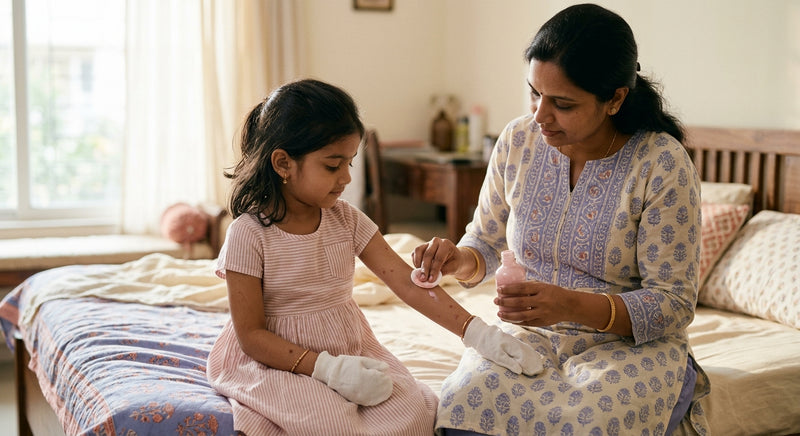
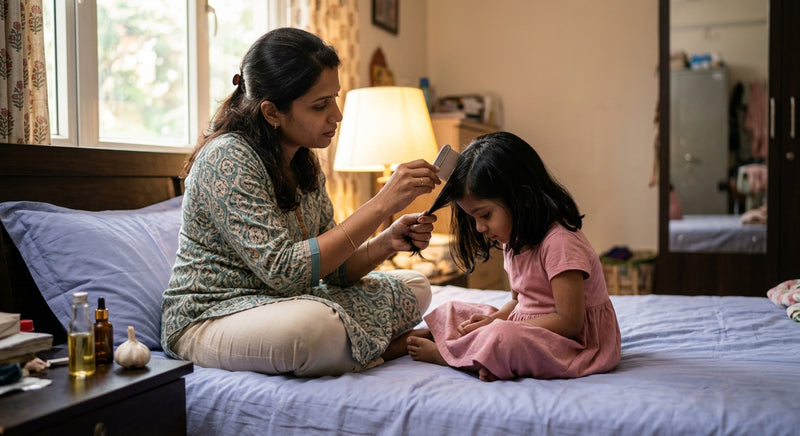
Sunday evening. Hair half-dry, comb stalled somewhere near the crown, and she is already twisting away from you. You apologise. She squirms. And the same thought arrives on schedule: am I buying the wrong shampoo?
Usually you aren't. The best shampoo and conditioner combo for Indian kids is a mild, tear-free shampoo that cleans without stripping, paired with a light rinse-out conditioner used only from the ears down. What decides the outcome is the pairing and the season. Hard water, monsoon damp and a dry Nagpur winter change what your child's hair needs far more than any front-of-pack promise does.
At a glance
- A good combo is a mild shampoo that doesn't strip, plus a light rinse-out conditioner on mid-lengths and ends. Never the scalp.
- Most school-age kids do well on 2–3 washes a week. Sweaty summer weeks and daily PE push that up, not down.
- Hard water is the biggest hidden variable in an Indian bathroom. It is why one shampoo behaves like two different products in Gurgaon and in Kochi.
- Once hair is past the shoulders, curly, or braided every school day, conditioner stops being optional.
- Same brand isn't compulsory. Matching the pair to your child's age and to the season is.
What makes a shampoo and conditioner work as a pair
They do opposite jobs. That is the point of buying them together.
A shampoo's cleansers carry a negative charge, so they lift away sebum, sweat, dust and Sunday's malish oil. The same process leaves the hair shaft slightly rough and negatively charged. Which is why freshly washed hair squeaks, catches on itself, and refuses the comb.
A conditioner carries a positive charge. It is drawn to the roughed-up cuticle, lies flat along it, and lets one strand slide past another instead of snagging. That slip is why detangling stops being a fight.
So the pair works when the shampoo is gentle enough that the conditioner isn't doing rescue work. If you need a heavy conditioner just to drag a comb through, the shampoo is too harsh for that child's hair. Not the other way round.
Does your child even need the conditioner?
Not every child does. A three-year-old with a soft, short, post-mundan crop rinses clean and combs out in ten seconds. Buy a conditioner for that hair and the bottle will expire before it empties.
The conditioner earns its place the moment one of these is true: hair past the shoulders, curly or wavy texture, daily plaits or a tight school ponytail, swimming class, hard water at home. Which covers most Indian kids from about four or five onwards, and almost every girl growing her hair out.
Which combo suits which Indian season?
The pair stays the same all year. Frequency changes, and so does how much conditioner you use. Most of us get both backwards, cutting washes in summer and skipping conditioner through the monsoon.
| Season | What you'll see at home | Shampoo | Conditioner |
|---|---|---|---|
| Peak summer (Mar–Jun) | Sweat at the hairline, oily roots by evening, an itchy scalp after games period | Wash more often. Alternate days is fine if the formula is mild | A thin layer on the ends. Skip it altogether on short hair |
| Monsoon (Jun–Sep) | Frizz, hair that never quite dries, a damp smell at the nape | Same mild shampoo. Rinse longer, and dry the scalp properly | Keep using it. Monsoon frizz is a moisture problem, not a dirt problem |
| Winter (Nov–Feb) | Static, flyaways, flaking, tangles that form overnight | Drop to about 2 washes a week. Lukewarm water, never hot | Every wash, a little more, left on a full minute |
| Hard-water homes (all year) | Dull, rough, coated feel, and you keep adding shampoo chasing lather | Mild shampoo. A second small lather only if the hair is truly oily | Non-negotiable. This is what makes the comb move again |
Why hard water decides more than the brand does
Across most of north and western India the tap water is hard. Delhi NCR. Large parts of Rajasthan and Gujarat. Borewell-fed homes in Chennai and Hyderabad. Calcium and magnesium react with cleansers and leave a fine film on the hair shaft. Wet, the hair feels rough. Dry, it looks dull. Extra shampoo doesn't fix it. Extra shampoo makes it worse.
Two things help. Extend the rinse, because most of us stop about thirty seconds too early, and leftover residue plus hard water is what builds that coated feel. Then keep a mug of stored or filtered water aside for the last pour. It costs nothing, and you'll feel the difference in the comb that same evening.
What I look for on a kids' shampoo label
The front of the bottle is marketing. Turn it around.
- A tear-free, mild cleansing system. A young scalp is skin, and it deserves the same gentleness as the rest of the body. A baby's skin is 20-30% thinner than an adult's, which is why we formulate the whole range on the mild side.
- A modest fragrance load. Kids' hair sits under their nose all day, and strong perfume is the most common reason a child refuses a wash.
- No strong actives. Salicylic acid, exfoliating acids and anti-dandruff agents belong on a doctor's advice, not in a routine bottle.
- Age guidance and dermatological testing printed on the pack, not buried on a website.
That is the standard we hold ourselves to with the Loving and Balancing Shampoo: mild, tear-free, dermatologically tested, and made in our own GMP-certified facility rather than bought off someone else's line.
The conditioner label is a shorter list
For children, pick a rinse-out conditioner over a leave-in as the everyday option. Leave-ins have their place on very curly hair. On fine Indian kids' hair they build up fast, especially in humidity, and you end up washing more often just to clear them.
Texture is the tell. Light, rinses away easily. If it takes three rinses to feel clean, it's too heavy for a child. Parents ask about silicones, so: rinse-out silicones aren't dangerous, they just need a proper wash to come off. On kids' hair I prefer lighter conditioning agents and plant oils, for one unglamorous reason. They forgive a hurried school-morning rinse.
Do they have to be from the same brand?
No. There's a real reason same-line pairs tend to work better, though. They're formulated to a matching pH and rinse profile, so the conditioner is built for the exact cuticle that shampoo leaves behind. Put a very stripping shampoo with a very heavy conditioner and you get the classic mismatch: hair that is somehow dry and greasy at the same time.
My rule, for what it's worth. Match the pair to the child's age band. Then the season. Brand last.
The wash-day routine that ends the comb fight
- Detangle dry first with a wide-tooth comb, small sections, working from the ends upward.
- Wet the hair properly with lukewarm water. A full two minutes, until it's soaked to the scalp.
- Take a rupee-coin-sized blob of shampoo, dilute it in your palm with a splash of water, and apply to the scalp only.
- Massage with the pads of your fingers for 30–45 seconds. No nails.
- Rinse until the water runs completely clear. Everyone shortens this step, and it's where hard water does its damage.
- Squeeze the dripping water out before conditioner. Soaking hair just dilutes it away.
- Conditioner from the ears down, never on the scalp. Leave it a full 60 seconds.
- Finish with a mug of cooler stored water.
- Blot with a soft cotton T-shirt instead of rubbing with a terry towel.
- Comb once the hair is mostly dry, or while the conditioner is still in, with a wide-tooth comb. Never plait damp hair.
We've written separately in the Janma Journal about wide-tooth combs versus detangling brushes, and about wet versus dry detangling, if you want to go deeper on that one step.
How much you'll get through
Worth costing this out honestly. A rupee-coin of shampoo covers most children's hair, and only genuinely oiled hair needs a second small lather. Conditioner runs about 2–3 ml per wash on shoulder-length hair, closer to 5 ml on long hair.
At 2–3 washes a week, a 100 ml conditioner lasts roughly two months on long hair and closer to four on shorter hair. If a bottle is vanishing in three weeks, it's going on the roots. Move your starting point down to the ears. It'll last twice as long, and the roots stay less greasy through humid weather.
When to see a doctor
Shampoo and conditioner are for ordinary hair care, not for scalp conditions. Book a paediatrician or dermatologist if you see round or patchy hair loss, persistent redness with thick flaking that doesn't settle, sores, oozing or crusting, a scalp that smells despite washing, or relentless itching. Especially if you spot nits, which need specific treatment, not a gentler shampoo.
Setting those signs aside, for everyday tangles on healthy hair the thing to look for is a light rinse-out conditioner that spreads easily on mid-lengths and ends and washes out in a single rinse. Our Rejuvenating and Detangling Conditioner is formulated on those lines, and it is for ordinary detangling and comfort — not for any of the scalp signs above.
In summary
- Pair a mild, tear-free kids' shampoo with a light rinse-out conditioner — and apply the conditioner from the ears down only.
- Wash 2-3 times a week as a baseline, more often through sweaty summer weeks, less through dry winter.
- In hard-water homes, rinse for longer than feels necessary and finish with a mug of stored or filtered water.
- Detangle dry before the bath, leave conditioner on for a full 60 seconds, and never plait damp hair.
- See a paediatrician or dermatologist for patchy hair loss, persistent flaking with redness, sores or nits — not a stronger shampoo.
Frequently asked questions
Do kids need conditioner every time they shampoo?
If hair is past the shoulders, curly, braided daily, or washed in hard water, yes — use it at every wash. For short hair on a young child, you can skip it entirely or use a small amount only in dry winter weather. The rule is simple: if the comb catches after washing, the conditioner belongs in that routine.
Can I use my own shampoo and conditioner on my child?
It's better not to make it the daily routine. Adult formulas are usually built for oilier scalps and stronger fragrance, and they aren't tear-free, which matters when a child tips their head back. A mild kids' shampoo paired with a light rinse-out conditioner suits a young scalp better and makes bath time far less of a negotiation.
Does the conditioner have to be the same brand as the shampoo?
No, though same-line pairs are formulated to a matching pH and rinse profile, so they tend to behave predictably together. What matters more is avoiding a mismatch — a stripping shampoo plus a heavy conditioner leaves hair dry at the ends and greasy at the roots. Match the pair to your child's age and your water first.
How often should kids wash their hair in Indian summer?
More often than in winter, not less. With daily sweat, games period and dust, alternate-day washing is reasonable if the shampoo is genuinely mild. Two to three washes a week suits most school-age children through the rest of the year. Winter is the season to reduce frequency, use lukewarm water, and be more generous with conditioner.
Does hard water ruin a good shampoo and conditioner combo?
It works against it. Calcium and magnesium leave a film that makes hair feel rough and look dull, and adding more shampoo makes it worse. Two fixes help most: rinse for noticeably longer than feels necessary, and keep a mug of stored or filtered water for the final rinse. Conditioner becomes essential rather than optional in hard-water homes.
Should conditioner ever go on a child's scalp?
No. Apply from the ears down — mid-lengths and ends only. The scalp produces its own oil, so conditioner there just weighs hair down, looks greasy within a day, and in humid weather means washing more often than you need to. Keeping it off the roots also makes a bottle last roughly twice as long.