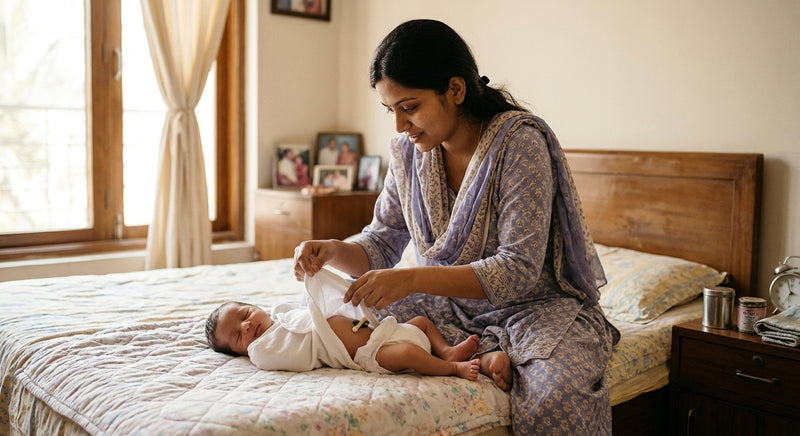
You had a C-section on Tuesday. It's Saturday night, your baby's ankles are flaking like old paint, your cousin's vaginally-born baby had skin "like butter" at this stage, and at 2am you typed the question into the search bar.
Short answer: how your baby was born makes very little difference to how their skin looks or behaves in the first few weeks. What shapes newborn skin is gestational age at birth, how much vernix stayed on, the air in your room, and what you put on them. Two things do differ by delivery route. One is the mix of microbes that first settle on the skin. The other is a small set of marks left by the birth itself. Neither needs a special product.
If you want the full picture of what's normal in month one, we keep it in one place: our complete guide to newborn skin basics.
At a glance
- Delivery route is a weak predictor of newborn skin. Gestational age and vernix are strong ones.
- Babies born vaginally are first colonised largely by their mother's birth-canal microbes. C-section babies are colonised by maternal skin, hospital and household microbes. The gap narrows over the following months.
- A planned C-section often happens a little earlier and without labour. So those babies frequently arrive with more vernix on, and peel a bit later. Not less.
- Birth marks like scalp swelling or forceps pressure lines come from the mechanics of delivery, not from skin quality. They fade on their own.
- Your routine should be identical either way: delayed first bath, short lukewarm baths 2–3 times a week, a mild wash, moisturiser once a day.
Does a C-section affect a newborn's skin?
Not in the way parents fear. There is no evidence that a baby born by caesarean has a weaker skin barrier, drier skin or more rashes in the first weeks purely because of the route they took. What does measurably change barrier function is gestational age. A baby born at 37 weeks has a less mature barrier than one born at 40. So does the humidity in the room, how often and how long they're bathed, and what's applied to them.
Researchers have looked at whether caesarean birth nudges up the later risk of eczema and allergy, probably through the microbiome. The findings are mixed, and any effect appears small. It isn't something to plan a newborn routine around, and it is certainly not something to buy a product for. A baby's skin is 20-30% thinner than an adult's regardless of how they were born. That is the fact your routine should respect.
What differs between the two births
| What parents ask about | Born vaginally | Born by C-section | Change your routine? |
|---|---|---|---|
| Vernix left on at birth | Often partly rubbed off during labour and descent | Frequently more intact, especially with a planned section before labour | No — leave it on either way |
| Peeling in weeks 1–3 | May start day 2–4 | May start a few days later | No |
| First skin microbes | Mother's birth-canal and gut flora dominate early | Maternal skin, theatre and home environment dominate early | No — skin-to-skin and breastfeeding help either way |
| Birth-related marks | Scalp swelling, pressure lines, forceps or vacuum marks | Fewer pressure marks; rarely a tiny nick from the incision | No — keep clean and dry, don't apply anything |
| Maternal antibiotics | Usually none | A single preventive dose is standard before the incision | No |
| First bath timing | Often delayed by the ward routine | Sometimes delayed longer while mother recovers | No — later is better anyway |
The microbiome difference is real, and it closes
This is the one difference with solid science behind it. A baby squeezing through the birth canal gets a thorough first inoculation of their mother's microbes. A baby lifted out through an incision meets maternal chest skin, then the operating theatre, then your home. For the first weeks, the communities on their skin and in their gut look different.
What tilts it back is ordinary and free. Skin-to-skin contact as early as you're able. Ask for it in theatre or in recovery; many Indian hospitals will allow it now if you ask, and the nurse often has to be prompted. Breastfeeding where possible. Letting family hold the baby. And not scrubbing or sanitising your baby's skin. Antibacterial soaps and alcohol wipes on a newborn's body work against the thing you're trying to build.
Why a C-section baby can look smoother at first, then flake more
Vernix is that creamy coating a baby wears at birth. It is clever stuff: mostly water held in a lipid and protein matrix, slightly acidic, carrying antimicrobial peptides. It is the original barrier cream. Nothing in a bottle copies it.
Labour and the trip down the birth canal wipe some of it off. A planned caesarean at 38–39 weeks skips that, so those babies often arrive waxy and well-coated, which reads to a parent as better skin. Ten days later the coating has absorbed, the flaking shows up, and it feels like a step backwards. It isn't. Peeling is the outer layer shedding as the skin adapts to air after nine months in fluid. It happens to almost every baby. Post-dates babies peel the most, because their vernix was used up weeks ago. We've written about peeling at one month and when it's just dryness in more detail.
So don't wash the vernix off. Don't rub it off with a towel. Pat, don't scrub, and let it absorb over a day or two.

Marks from the birth, not from the skin
Vaginal and instrumental births leave their own souvenirs. A soft swelling across the scalp that crosses the midline. A firmer lump on one side. Red pressure lines on the cheeks from forceps. Petechiae on the face from the squeeze. C-section babies usually skip all of that, though very occasionally there's a tiny superficial nick near the incision line, which a nurse will have already looked at.
All of these settle on their own. None of them wants cream, oil or powder on it. Colour is the same story. Newborn skin flushes, mottles and shifts tone in the first weeks whichever way the baby arrived, and we've unpacked why a newborn's colour changes after birth separately.
What to look for in a newborn wash and moisturiser
This is the part that matters, and it's where I spend my working days. A few things I'd hold out for on a label for a baby in their first weeks:
- A mild surfactant system, not soap. True soap sits around pH 9–10 and strips the acid mantle a newborn is still building. A syndet or gentle foam wash formulated nearer skin pH is kinder. There's a local reason too: if your water is hard, which it is across Delhi, Jaipur, Hyderabad and much of Maharashtra, soap leaves a scummy residue that a parent reads as dryness and then treats with more cream.
- A short, legible ingredient list. Not "chemical-free" — no such thing, and it's a misleading claim under Indian cosmetics rules. What I mean is no essential oils, no added colour, and either fragrance-free or a very low, declared fragrance load for the first months.
- Humectant plus occlusive, together. Glycerin pulls water into the skin and then lets it evaporate in dry Nagpur or Delhi winter air. It needs something on top to hold it there: a butter, a plant oil, a wax.
- Evidence that someone tested it on skin, not just on a mood board. Dermatologically tested. In-vivo tested. Numbers you can ask the brand for.
- Who actually made it. A brand that owns its formulation can tell you why every ingredient is in there. One that white-labels often can't. We make ours in our own GMP-certified facility in Nagpur for exactly that reason.
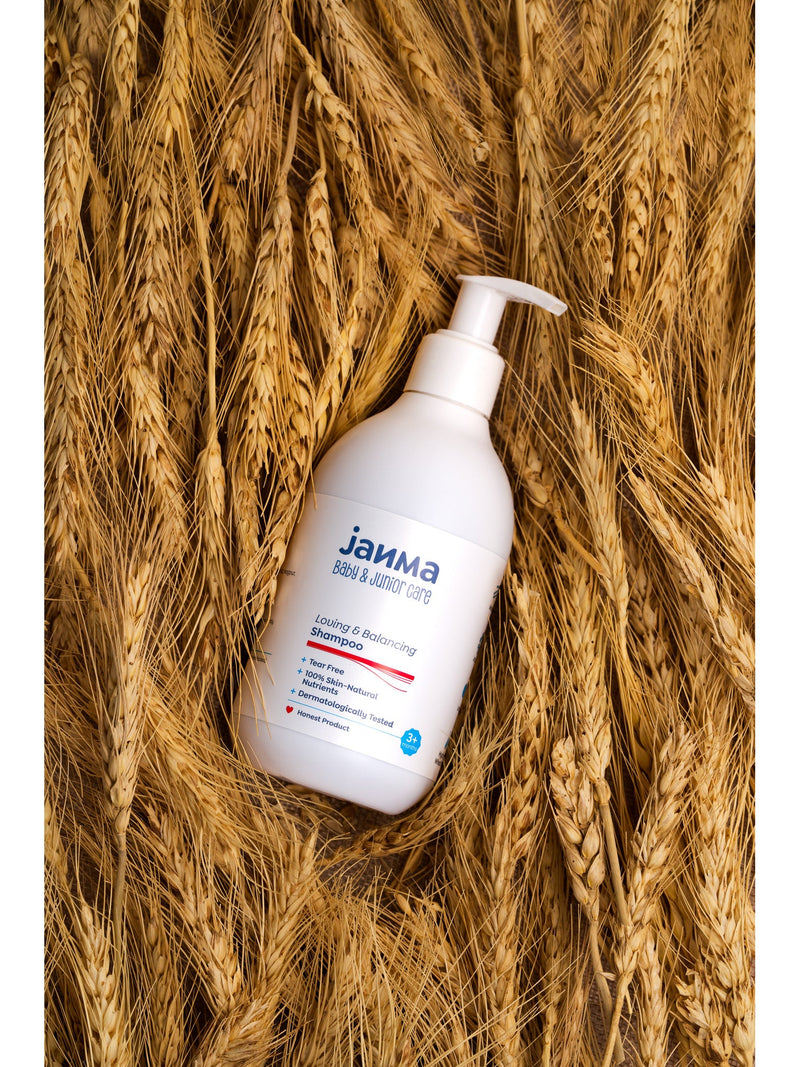
For the first bath or two, a tear-free wash designed for infants is plenty. Ours, the Head to Toe Baby Foam Wash, is formulated for exactly this age, and a pea-sized amount covers a newborn.

Do this tonight
- Skip the bath if your baby is under 24 hours old, or had one today. Top-and-tail with plain lukewarm water and cotton instead.
- Keep baths to 5 minutes, water at body temperature. Test with your elbow, not your fingertips.
- Use a mild infant wash 2–3 times a week. Water alone on the other days is fine for a newborn who isn't crawling anywhere.
- Pat dry with a soft cotton towel. Press, lift, move on. No rubbing, especially over flaking patches.
- Moisturise within three minutes of the towel, while the skin is still faintly damp.
- A rice-grain amount per limb for a lotion. A little less for a balm. More on ankles, shins and knees, where flaking concentrates.
- Leave the cord stump, any birth marks and the vernix strictly alone.
- Keep the room at 26–28°C with a fan on low, rather than cold AC blowing straight at the cot.
Where skin is dry, tight or flaking at the ankles and shins, a thicker balm earns its place over a light lotion. Ours is in-vivo tested and showed visibly calmer skin in as little as 1 day in 24- and 36-month subjects, and increased Keratin-10 and Filaggrin expression in a lab study, the markers that reflect support for the skin's own barrier. If that's the week you're having, the Hydra Healing Moisturizing Balm is the one I'd reach for on those ankles tonight.
When to see a doctor
Call your paediatrician, and don't wait for the next scheduled visit, if you see any of these:
- Fever, poor feeding, unusual sleepiness or floppiness in a baby under three months.
- Redness, warmth, swelling, pus or a bad smell at the cord stump or a C-section wound area.
- Blisters, pus-filled spots, or skin that looks peeled raw rather than flaky.
- Deepening yellow colour, yellowing of the palms and soles, or jaundice appearing in the first 24 hours.
- Cracking, bleeding or weeping skin, or a rash that spreads quickly.
- Any rash in a baby who also seems unwell. In the newborn weeks, how the baby is behaving matters more than how the rash looks.
And be kind to yourself here. A C-section is major abdominal surgery, and plenty of the worry that lands on your baby's skin at 2am is really exhaustion and a healing incision talking. Your baby's skin did not start behind.
In summary
- Delivery route barely affects newborn skin — gestational age, vernix and your routine matter far more.
- The one real difference is early microbial seeding, and skin-to-skin plus feeding help close it for free.
- C-section babies often arrive with more vernix on, so flaking can start later rather than less — leave the vernix alone.
- Birth marks like scalp swelling or forceps lines fade on their own and need nothing applied to them.
- Run the same routine either way: 5-minute lukewarm baths 2–3 times a week, a mild infant wash, moisturiser within three minutes of towelling.
Frequently asked questions
Is a C-section baby's skin more sensitive than a vaginally born baby's?
No. Skin barrier maturity tracks with gestational age, not delivery route. A baby born at 40 weeks by caesarean has a more mature barrier than one born vaginally at 37 weeks. What makes newborn skin behave sensitively is thinness, dry air, long or hot baths, and harsh products — all of which apply equally either way.
Why is my C-section baby peeling more than my friend's baby?
Most likely gestational age and vernix, not the surgery. Babies born later in pregnancy have less vernix left and peel more; babies born before labour often arrive well-coated and start flaking a week or so later. Peeling across the ankles, shins and wrists in the first three weeks is normal shedding, and it settles with gentle bathing and daily moisturising.
Does a C-section increase my baby's risk of eczema?
Studies have looked at this, probably through the microbiome route, and the results are mixed with any effect appearing small. It is not worth planning your routine around. Skin-to-skin contact, breastfeeding where possible, short lukewarm baths and consistent daily moisturising are what help a newborn barrier, whatever the birth looked like.
Should I ask for vaginal seeding after my C-section?
Paediatric bodies do not recommend it outside research studies. Swabbing a newborn with maternal vaginal fluid carries a real infection risk and hasn't been shown to give lasting benefit. Early skin-to-skin contact, breastfeeding, ordinary family handling and avoiding antibacterial washes on your baby achieve the same goal safely.
When can I give my C-section baby their first bath?
Waiting at least 24 hours after birth is the usual advice, and longer is fine. Delaying protects the vernix, stabilises temperature and blood sugar, and supports early feeding. Until then, top-and-tail with lukewarm water and cotton. If you are recovering from surgery, have someone else do the first bath while you supervise sitting down.
Do I need a different product because my baby was born by C-section?
No. The checklist is identical: a mild infant wash near skin pH rather than soap, no essential oils or added colour, a moisturiser that pairs a humectant with an occlusive, and a brand that can tell you why each ingredient is there. Route of delivery changes nothing about what a newborn's skin needs.