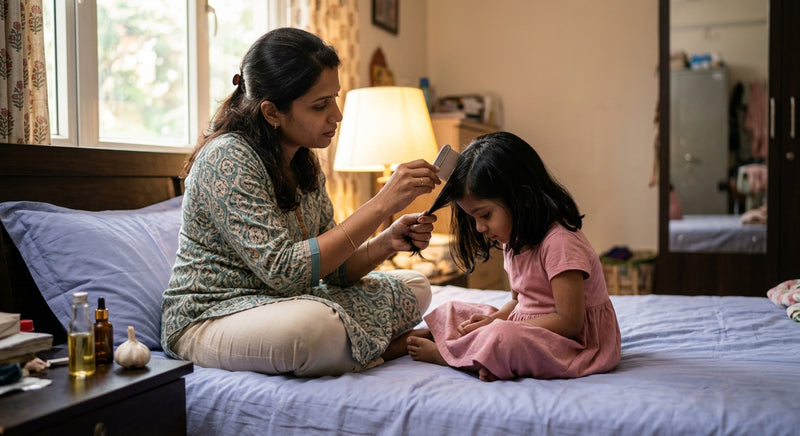
It's 11pm. The baby's bath is done, you've finally got under the shower, and your own bottle is empty. The baby's is sitting right there, still warm from the bucket.
Go ahead - for most adults it is perfectly fine. Baby shampoo is a mild cosmetic wash, and it is unlikely to trouble an adult scalp or adult hair (as with any product, stop if your skin reacts). But it's built for a completely different job, and on your hair that shows up fast: two or three lathers before you feel clean, roots greasy a day sooner, a comb that catches on the way down. Fine to use, yes. Suitable, usually not.
Mums ask me this constantly - almost always the ones already sharing half the bathroom shelf. So here is what's actually inside the two bottles, and where sharing genuinely makes sense.
At a glance
- Baby shampoo is generally fine for adults - it is a mild cosmetic wash, not a harsh one.
- It cleans less because it is designed to - milder surfactants, lower active load, no strong oil-cutting anionic in the lead.
- It sits closer to neutral pH to stay kind to eyes. Long adult hair does better on a slightly acidic wash.
- Little or no conditioning polymer, so anything past shoulder length tangles.
- The reverse swap - your shampoo on your baby - is the one that actually matters. Don't.
Why baby shampoo feels weaker on your hair
An adult scalp makes far more sebum than a baby's. Those glands wake up at puberty and never really go back to sleep. Now add a Saturday oil champi, dry shampoo on Monday, a serum, colour, and the sweat of an Indian summer. The daily load on your shampoo is nothing like the load on your baby's.
A baby shampoo is formulated for a head with fine, sparse hair, very little oil, and a high chance of lather running into the eyes. Every choice in the formula bends towards that. Low cleansing power isn't a flaw in it. It's the brief.
What is actually different inside the two bottles?
The surfactant system
This is the real difference. Everything else is packaging.
Most adult shampoos lead with an anionic surfactant - sodium laureth sulfate, or in the sulfate-free ones something like sodium cocoyl isethionate or a methyl cocoyl taurate. Anionics carry a strong negative charge. They grab oil fast and let go of it into the rinse water.
Baby washes lean on amphoterics and sugar-derived non-ionics instead: cocamidopropyl betaine, coco-glucoside, decyl glucoside, disodium laureth sulfosuccinate. They're picked because they're low-irritant on the eye's mucous membrane and on thin skin, and they're used at a lower total active level. In surfactant chemistry, gentler and less powerful are the same sentence.
And here is the bit that catches people out: tear-free is not a numbing agent. There is no anaesthetic in a baby shampoo. It's a low-irritation surfactant blend, kept at a low concentration, buffered close to the pH of tears. That's the whole trick. What "mild", "gentle" and "tear-free" are legally allowed to mean in India is a longer story, and we've written it up elsewhere in the Janma Journal.
The pH trade-off
Hair's isoelectric point sits low, around 3.7. So a slightly acidic wash - roughly pH 4.5 to 5.5 - keeps the cuticle scales lying flat and the fibre less negatively charged. Flat cuticle, less friction. Less frizz, fewer tangles.
Baby shampoos are usually formulated closer to neutral, because that's kinder if it runs into an eye. On 3cm of baby hair, that costs nothing at all. On 60cm of adult hair it costs you: more cuticle lift, more static, and that rough, squeaky feel at the ends that people mistake for "really clean".
What is missing: the conditioning polymer
Adult shampoos usually carry a cationic conditioning polymer - polyquaternium-10, or guar hydroxypropyltrimonium chloride. As the lather dilutes with rinse water, these drop out of solution and land on the fibre. That's why your hair feels smooth before conditioner has even touched it.
Baby shampoos generally skip them. A baby doesn't need slip. So you wash long hair with the baby's bottle, reach for the comb, and there is simply nothing on the fibre helping you.
Baby shampoo vs your usual shampoo: the honest comparison
| What you are comparing | Baby shampoo | Everyday adult shampoo |
|---|---|---|
| Built for | Fine, sparse hair and eyes that will get lather in them | Length, sebum, styling product, oiling |
| Main cleansers | Amphoterics and sugar-based non-ionics (betaines, glucosides, sulfosuccinates) | An anionic lead (laureth sulfate, or isethionate/taurate if sulfate-free) |
| Typical pH | Closer to neutral, to stay eye-friendly | Slightly acidic, usually 4.5-5.5 |
| Clears a coconut-oil malish? | Not in one wash - expect 2-3 lathers | Usually one, sometimes two |
| Slip and detangling | Little to none | Cationic polymer deposits as you rinse |
| In hard water | Lathers poorly, so you use more product | Foams better, but can leave scum |
| On long adult hair | Clean but squeaky, tangly, oily sooner | Designed for exactly this |
Read that table against your own hair, not an average. Fine hair, no oiling, a wash every second day - the baby bottle will genuinely do. Long, oiled, coloured, hard-water hair - it won't. And washing three times to compensate is rougher on the fibre than one wash with the right product.
When baby shampoo genuinely works for an adult
- Fine or short hair with no oiling. There isn't much sebum for it to fail at.
- A midweek freshen-up. Sweaty scalp, nothing to remove, you just want to feel human before bed.
- A fringe-only wash. Roots go oily days before the lengths do, so washing the front section on its own with something mild is smart, not lazy.
- A reactive phase. Some mums find their scalp turns touchy and tight in the months after delivery. Dropping to a milder wash for a few weeks is worth trying while you work out the cause.
- Everything that isn't hair. Makeup brushes. Hairbrushes. The baby's soft toys. Best possible use of a nearly-empty bottle.
One thing to be careful with: some eye doctors suggest a very dilute baby shampoo for cleaning lid margins. That's a doctor's instruction, not a bathroom-shelf decision. Ask first.
Where it will let you down
- After an oil malish. Coconut, sesame or a heavy branded malish oil needs an anionic surfactant to lift properly. Three baby-shampoo lathers get there eventually - but you've just triple-washed your scalp to do it.
- Hard water. Across much of central and north India the calcium and magnesium load kills lather, and mild surfactant systems suffer the most. If your shampoo "stopped working" after you moved cities, suspect the tap, not the bottle.
- Coloured or chemically treated hair. Treated fibre is more porous and more negatively charged. It wants an acidic, conditioning wash - the exact opposite of a near-neutral, polymer-free one.
- An oily scalp, or daily workouts. You'll be back at the roots by evening.
- A flaking, itchy or sore scalp. Mildness isn't the missing ingredient here. That needs a diagnosis.
Does baby shampoo cause hair fall - or stop it?
Neither, and I wish this myth would die. The shedding a lot of mums notice a few months after delivery is usually a hormonal shift working its way through the hair cycle - hair that stayed put during pregnancy letting go all at once. It started long before you touched that bottle.
What a mild shampoo can do during that phase is reduce the mechanical fight: less tangling, less tugging at the comb, fewer hairs snapping mid-shaft on the way out. That's worth having. It is not a treatment, and no shampoo on any shelf is. If the shedding carries on past a year, or your parting is visibly widening, that's a doctor's conversation, not a shopping one.
The swap that actually matters
So far this has all been you borrowing the baby's shampoo. The other direction deserves a firmer answer.
A baby's skin is 20-30% thinner than an adult's, and the scalp is no exception. Adult shampoos carry a higher surfactant load, a heavier fragrance dose, and sometimes actives - anti-dandruff agents, exfoliating acids, colour-protecting UV filters - that have no business near an infant's eyes. Once, by accident, is not an emergency. It just shouldn't become the routine.
What we would actually do
Two shampoos, one conditioner.
Keep the baby's wash for the baby, and for your own low-demand days. Keep an acidic, conditioning shampoo for yourself and use it on oil days, colour days, and after anything sweaty. The conditioner is the item genuinely worth sharing - a gentle detangler works the same way on a three-year-old's knots and on your mid-lengths, because the chemistry of slip does not care how old the head is.
- Oiled your hair? Use your own shampoo. One proper lather beats three mild ones.
- Dilute shampoo in a mug before it touches your scalp - especially in hard water.
- Shampoo on the scalp, conditioner on the mid-lengths and ends. Never swap the zones.
- Leave conditioner on for two full minutes, then rinse with the coolest water you can stand.
- Detangle with a wide-tooth comb while the conditioner is still in. Not after, on dry hair.
- Keep the baby's bottle in the baby's basket. Shared shelves are how the wrong one gets grabbed at 11pm.
What to look for in a conditioner you plan to share: a light cationic base for slip, enough fatty alcohol to smooth the cuticle without weighting fine hair, a low fragrance load, and a texture that actually rinses clean in hard water. That last one is where most conditioners quietly fail in Indian bathrooms. Our Rejuvenating & Detangling Conditioner was formulated to sit in that middle ground - made for children's tangles, and light in texture.
When to see a doctor
Book an appointment if a scalp stays itchy or flaky for more than two or three weeks despite a gentle wash. Same for painful or pus-filled bumps, a widening parting or visible bald patches, shedding that is still heavy a year after delivery, or any sudden reaction - redness, swelling, burning - after a product change. A dermatologist can look at the scalp itself. For a child's scalp, a paediatrician is the right call. A shampoo swap is not a substitute for either.
In summary
- Baby shampoo is safe on adult hair and scalp - it is just built for a much lighter cleansing job.
- The gentleness comes from mild amphoteric and sugar-based surfactants at a low active level, so it will not clear an oil malish in one wash.
- Baby washes sit closer to neutral pH to protect eyes, while slightly acidic adult shampoos keep the cuticle flatter on long hair.
- Keep separate shampoos but share the conditioner - slip chemistry works the same at any age.
- Never use your adult, anti-dandruff or clarifying shampoo on a child, and see a doctor for a scalp that stays itchy, sore or flaky.
Frequently asked questions
Can I use my baby's shampoo on my hair every day?
You can, and it is safe. Whether you should depends on your hair. Fine hair with no oiling will do fine on it daily. Long, oiled, coloured or very oily hair will feel under-washed, and you will end up lathering two or three times per wash, which is harsher than one wash with a shampoo built for adult hair.
Does baby shampoo cause hair fall in adults?
No. Baby shampoo does not cause hair fall, and it does not stop it either. Shedding a few months after delivery is a hormonal shift moving through the hair cycle. A mild shampoo can reduce tangling and breakage while you go through it, which helps hair look fuller, but it is not a treatment. See a doctor if heavy shedding continues past a year.
Will baby shampoo remove coconut oil from my hair?
Not in one wash. Baby shampoos use mild amphoteric and sugar-based surfactants at a low active level, which are deliberately poor at lifting heavy oils. Expect two or three lathers to clear a proper malish. If you oil weekly, keep a normal adult shampoo for oil-wash day and save the baby bottle for lighter days.
Can my toddler use my shampoo instead?
Better not to make it a routine. A child's skin is thinner than an adult's, and adult shampoos carry a higher surfactant load, more fragrance, and sometimes actives that sting eyes. Anti-dandruff, clarifying and exfoliating shampoos should never be used on a child, even diluted. One accidental wash is not an emergency, but keep the bottles separate.
Is baby shampoo good for coloured or keratin-treated hair?
It is safe, but it is not the right tool. Treated hair is more porous and more negatively charged, so it does best with a slightly acidic wash containing a conditioning polymer that deposits on the fibre. Baby shampoos usually sit closer to neutral and skip the polymer, so coloured hair often feels rough and tangles more after using one.
Why does baby shampoo hardly lather in my bathroom?
Usually the water, not the shampoo. Hard water across much of India carries calcium and magnesium that interfere with foam, and mild surfactant systems are hit hardest. Squeeze water out of your hair first, dilute the shampoo in half a mug of water, and apply it to the scalp. You will get a usable lather from far less product.