Day four. You unwrap her after a feed and there are little curls of skin on her ankles, like the papery bit of an onion. It looks alarming. It almost never is.
Short answer: yes, essentially every full-term baby sheds some skin in the first two weeks. Some peel so lightly you only catch it on the shins and wrists. Others shed in visible sheets across the tummy and back, and you find flakes in the vest at every change. Both are normal. This is not dryness in the way adults mean dryness, and it is not a verdict on anything you did or didn't do. It is a baby's outer skin finishing a job it started before birth. For the wider picture of what's normal in these first weeks, our complete guide to newborn skin basics goes through it condition by condition.
At a glance
- Nearly all newborns peel a little. How much you actually see varies hugely from baby to baby.
- It usually starts around day 2-5 and settles within the first two to four weeks.
- Babies born past their due date often peel more, because the vernix (that white coating) had already worn away in the womb.
- Indian weather changes the look of it: dry winters and AC make flakes look worse, monsoon humidity often hides them.
- You don't treat peeling. You protect the skin underneath: short bath, gentle wash, moisturise while damp.
So do all babies shed their skin?
Near enough all of them. What varies is the timing, and how much drama comes with it.
Think about where she has spent the last nine months. Floating in amniotic fluid, coated in vernix caseosa, that thick white-cheese layer that waterproofs the skin and stops it macerating in fluid. Then the fluid stops and the air begins. Room air in Nagpur in May is nothing like amniotic fluid. Room air in Delhi in January is even less like it.
The outermost layer of skin, the stratum corneum, has to change jobs almost overnight: from surviving submerged to holding water in and keeping the world out. The cells that formed underwater are not the ones she needs in a Nagpur bedroom. So they lift, they dry, they go. A fresher, better-adapted layer is already waiting underneath. Nothing more mysterious than that.
Which is why the amount of peeling tracks vernix so closely. A baby born at 41 or 42 weeks has usually rubbed most of hers off in utero, so her skin has been quietly drying out before anyone even met her. Those babies peel the most, sometimes with visible cracks at the ankles and wrists. A baby who arrives a little early, still buttered in vernix, may barely peel at all. And a baby who was wiped down briskly in the first hour will shed more than one whose vernix was left to sink in.
Peeling vs dry skin: are they the same thing?
No. And the difference decides what you do next.
Physiological peeling is the shedding described above. A one-time handover from the old skin to the new. The skin under the flakes looks healthy and normal-coloured, and your baby could not care less about any of it. It sorts itself out even if you do nothing.
Dry skin is what can follow after that, if the new barrier keeps losing water faster than it can hold it. Rough patches. Skin that looks tight. Sometimes redness. Sometimes a baby who squirms when you touch her tummy. That one does answer to care. We compared the two properly in our honest guide to newborn shedding versus true dryness, and when to worry, and there's a week-by-week timeline of how long peeling actually lasts if you want to know when it should stop.
Flaking in week one is usually plain physiological peeling. Skin that is still rough, tight or irritated in week five usually is not, and that is the point at which it is worth a closer look.
Why Indian weather changes what you see
The biology is the same everywhere. What lands in your lap in a Delhi January, or a coastal July, is not.
| Season | What it does to newborn peeling | What to change |
|---|---|---|
| Dry winter (North India, Dec-Feb) | Low humidity pulls water out of the new barrier. Flakes look bigger, edges lift, ankles can crack. | Moisturise twice daily, not once. Cap baths at 2-3 minutes, lukewarm. |
| Summer + AC | The AC is a dehumidifier. Ten hours in it dries skin as reliably as a Delhi January. | Bowl of water in the room, AC at 25-26 degrees, moisturise before the long night stretch. |
| Monsoon humidity | Damp air keeps flakes soft, so peeling often looks milder. But sweat sits in neck and thigh folds. | Dry the folds properly. Lighter layer of moisturiser, cotton only. |
| Hard water (most Indian cities) | Calcium and magnesium leave a residue that irritates skin already mid-handover. | Rinse well, keep bath short, moisturise on damp skin to seal. |
Hard water is the one that catches people out. In Chennai, in Hyderabad, across large parts of Delhi-NCR, a baby's peeling week can look far worse than it should, and the bath water is doing half the damage. Nothing about the baby has changed. Only the tap.
Where does the peeling show up first?
Almost always the extremities: ankles, tops of the feet, wrists, hands. Least fat underneath, most exposure. Tummy and the small of the back come next. The face peels least, though the nose and forehead can flake lightly.
In the same fortnight you may notice her colour shifting as well, blotchy one hour and even-toned the next. Different process, equally normal, and we've explained it in our piece on why newborn skin tone darkens, lightens or turns blotchy.
What to do tonight
You are not treating the peeling. You are protecting what sits underneath it, so it doesn't tip over into real dryness. Five things, and they fit inside the bath and the ten minutes after it.
- Shorten the bath. Two to three minutes. Water that feels neutral on the inside of your wrist, not water that feels nice. Hot water strips a barrier that is busy rebuilding itself.
- Use a wash that doesn't fight the skin. Soap-free, tear-free, pH-appropriate, short ingredient list. Plain soap is alkaline and will make a peeling week worse. A gentle formulation like our Head to Toe Baby Foam Wash is built for exactly this stage. And on plenty of nights, warm water on its own is enough.
- Pat, don't rub. A towel dragged over lifting flakes tears skin that wasn't ready to go. Blot.
- Moisturise within three minutes, on damp skin. If you do one thing off this list, do this one. Damp skin plus an occlusive layer seals the water in. Dry skin plus the same cream mostly just sits there.
- Cotton, loose, and check the folds. Neck, groin, behind the knees. A damp fold in a Mumbai August turns into sweat rash fast.
What to skip during the peeling weeks
Traditional care has real wisdom in it. The shedding fortnight is just not the window for most of it.
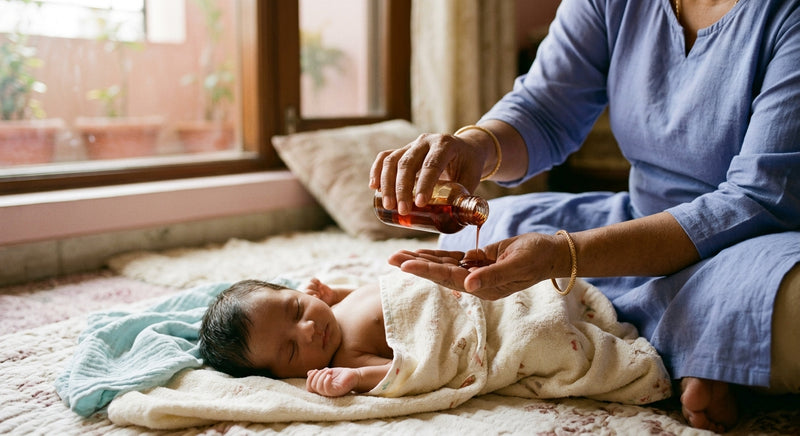
Ubtan is a mild abrasive. Besan and haldi rubbed over lifting flakes is micro-injury, not cleansing. Save it for later, if at all. Vigorous malish can wait as well: gentle stroking with a light oil is fine, but the deep, firm strokes an aunt will happily demonstrate on the bed will tug at flakes. And mustard oil, which so many families reach for the moment it turns cold, is sharply irritant on any skin with cracks or fissures in it. Wait until the surface is whole again.
Nothing exfoliating either. No scrub mitts, no antiseptic soaps, and please, no talc over flaking skin. It cakes.
When to see a doctor
- Peeling that is still spreading or worsening after 4-6 weeks, rather than settling.
- Cracks that bleed, weep, ooze, or crust yellow, or skin that looks angry and hot around them.
- Skin peeling in large sheets with underlying redness, or blisters anywhere.
- Fever, poor feeding, unusual sleepiness, or a baby who cries when the area is touched.
- Very deep cracks at the ankles or wrists in a post-term baby that don't improve with a week of consistent moisturising.
- Peeling on the palms and soles alone, which is worth a look rather than a guess.
None of this is a 2am emergency. It is a morning appointment. A paediatrician will see in thirty seconds what a search engine will keep you guessing about all night.
The reassuring bit
Newborn peeling is one of the few things in early parenthood that resolves whether or not you get involved. Your job is small and specific: don't strip the barrier, don't scrub, and put water back in with something occlusive while the skin is still damp. That is the whole brief.
What you want in a moisturiser through these weeks is boring, in the best sense. Rich enough to hold water through a dry January or an over-air-conditioned May. No fragrance. Nothing clever on skin that is already busy. Our Hydra Healing Moisturizing Balm was formulated for exactly that: it comforts dry, sensitive skin and helps support the skin's natural barrier, is in-vivo tested, and is made in our own GMP-certified facility.
In summary
- Nearly every full-term newborn sheds some skin in the first two weeks as the outer layer adapts from amniotic fluid to open air.
- Peeling usually starts on days two to five and settles within two to four weeks; post-term babies with less vernix tend to peel most.
- Dry winters, air conditioning and hard water make flakes look worse; monsoon humidity often hides them but traps sweat in the folds.
- Keep baths to two or three minutes with a soap-free wash, pat dry, and moisturise on damp skin within three minutes.
- Never pull or scrub flaking skin, and see a paediatrician if it bleeds, weeps, blisters, or is still worsening after four to six weeks.
Frequently asked questions
Do all newborn babies peel their skin?
Nearly all full-term babies shed some skin in the first two weeks, though the amount varies a lot. Peeling is the outer layer that formed in amniotic fluid lifting away so a new, air-adapted layer can take over. Babies born past their due date usually peel more; babies born slightly early, still coated in vernix, may barely peel at all.
How long does newborn peeling last?
It typically begins around day two to five and settles within two to four weeks. Ankles, wrists and feet peel first, then the tummy and back. If peeling is still spreading or getting worse after four to six weeks, or the skin is cracking and weeping, that's worth a paediatrician's opinion rather than more cream.
Should I moisturise a peeling newborn?
Yes, gently. You are not treating the peeling itself, which resolves on its own, but protecting the new skin underneath so it doesn't become genuinely dry. Apply a fragrance-free moisturiser within about three minutes of patting your baby dry, while the skin is still damp. In a dry winter or an air-conditioned room, twice daily is better than once.
Can I peel or rub off the flaking skin?
No. Pulling at a flake that is still attached tears skin that isn't ready to separate, leaving a raw patch that can sting and get infected. Skip scrubs, exfoliating mitts and ubtan during these weeks. Let flakes fall on their own into the towel or vest, and blot rather than rub after a bath.
Does Indian weather make newborn peeling worse?
It changes how much you see. Dry North Indian winters and long hours in air conditioning pull water out of the new barrier, so flakes look larger and ankles can crack. Monsoon humidity often keeps flakes soft and less visible, but sweat collects in neck and thigh folds. Hard water in most Indian cities leaves a residue that irritates skin further.
Is peeling skin a sign my baby is dehydrated?
No. Newborn peeling reflects the skin's surface adapting from fluid to air, not your baby's hydration status. A well-fed newborn passing regular wet nappies is hydrated even while shedding visibly. If you're worried about feeding, nappy output or your baby's alertness, speak to your paediatrician; those are the signals that matter, not the flakes.